

Shone Muune@ShoneKahuria
2
Events attended
2
Submissions made
Kenya
2+ years of experience
About me
I am a Full-Stack Developer and Informatics Student at Strathmore University with a knack for building modern web and mobile apps. My toolkit includes the MERN Stack, python and PostgreSQL, but I also bring a data science lens to every project I touch. I am dedicated to continuous learning and love turning complex problems into clean, efficient and data-aware code
🤝 Top Collaborators
.png&w=640&q=75)
.png&w=640&q=75)
.png&w=640&q=75)

🤓 Latest Submissions
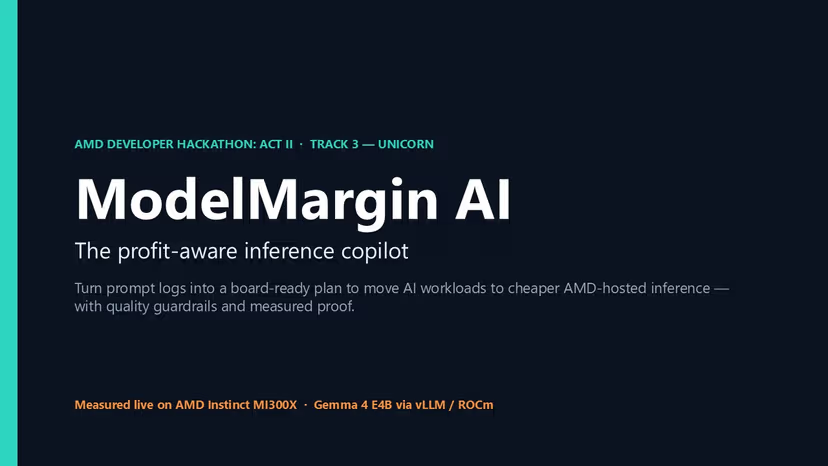
ModelMargin AI — Profit-Aware Inference
Every company shipping an LLM feature has the same silent problem: inference is the largest variable cost of the product, and it grows with usage — the more users you win, the worse your gross margin gets. Teams suspect some traffic could run on cheaper models, but can't prove which, or by how much, without risking quality. ModelMargin AI is a profit-aware inference copilot that turns raw prompt logs into a board-ready decision. It profiles traffic by task, complexity, and risk; simulates five routing strategies; uses Gemma 4 to judge whether cheaper routes retain quality; benchmarks the AMD ROCm/vLLM route; and generates a Margin Dossier with before/after cost, latency, quality retention, gross-margin lift, risks, and a one-command deployment. Crucially, the AMD numbers are not simulated. We served Google Gemma 4 E4B — the featured model — on a real AMD Instinct MI300X via vLLM 0.23.0 / ROCm 7.2.4 on AMD Developer Cloud, and measured 449.7 ms average latency, 213.4 tokens/sec, and 100% success at full GPU utilization. Simulated values elsewhere are always clearly labeled. The market is horizontal: every AI startup and platform team owns an inference cost-of-goods problem, and the buyer is the founder or platform lead who answers for margin. Routing is crowded — our edge is the honest, measured Margin Dossier and the guardrails that keep high-risk prompts on premium fallback. ModelMargin AI turns "should we move to AMD?" from a gut call into a measured business decision.
12 Jul 2026

AgriSync
AgriSync is an agricultural intelligence platform for smallholder farmers across Africa's 54 nations. Two problems destroy farm income every season: 1. Crop disease goes undiagnosed — the nearest agronomist is hours away or unaffordable. A farmer watches their maize develop grey leaf spot and doesn't know whether to spray, wait, or replant. 2. Farmers sell at the wrong market — without real-time price data, a farmer in Nakuru may sell tomatoes locally for KES 20/kg when Nairobi is paying KES 31/kg that same morning. On 500 kg that's KES 5,500 lost to information asymmetry. AgriSync solves both in one flow. A farmer takes a photo of their crop leaf with any smartphone. Our two-stage vision pipeline — Llama-3.2-11B-Vision-Instruct as primary, with LLaVA-v1.5-7B (fine-tuned on plant diseases) as specialist fallback, both running on AMD MI300X — identifies the disease, severity level, and the specific PCPB-approved chemical available at the nearest agro-vet, with the price in KES. At the same time, our ArbitrageEngine agent queries crop prices across African market hubs, calculates net profit after transport costs, and recommends the single best market to sell at today. The OrchestratorAgent (Mistral-7B-Instruct) combines both outputs into a bilingual English and Swahili advisory. For farmers without a smartphone, the same advisory is delivered as a 160-character SMS via Africa's Talking API. The platform covers diseases across major African food crops: Tomato Late Blight, Maize Gray Leaf Spot, Cassava Mosaic Disease, Fall Armyworm, Groundnut Rosette, Rice Yellow Mottle Virus, Bean Angular Leaf Spot, Potato Late Blight, and more.
10 May 2026

