
Rosario Barbagallo@RosarioBarbagallo
1
Events attended
1
Submissions made
Italy
9+ years of experience
About me
Software engineer with 8+ years of experience designing and delivering enterprise systems and distributed platforms. I’ve worked across the full development lifecycle, from early-stage design to production deployment, in environments where multiple systems and data sources must integrate reliably. My role has progressively evolved toward architecture and technical leadership. While working as a software engineer, I actively contribute to system design and architectural decisions, guiding development choices and collaborating closely with business stakeholders to deliver scalable and maintainable solutions. I have experience coordinating small teams and working on cloud-native and data-intensive systems. More recently, I’ve been focusing on applying AI within enterprise contexts using Azure AI services to improve automation and decision-making processes
🤓 Latest Submissions
OtoChronicle AI
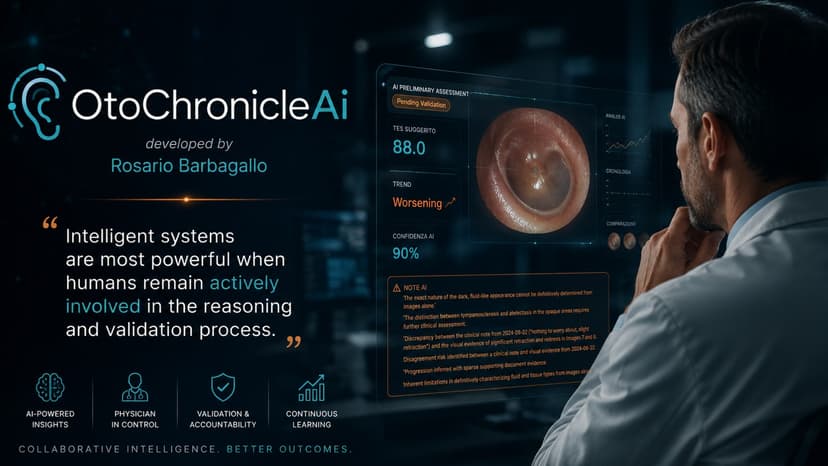
OtoChronicle AI is a longitudinal clinical intelligence platform built for ENT specialists. Instead of asking the classic question "what disease is in this image?", it answers the question physicians actually ask every day: "How is this tympanic membrane evolving over time,is it improving, worsening, fluctuating, or stable?" The platform ingests otoscopic images, audiometry reports, clinical notes, and prior physician validations, and reconstructs a continuous temporal narrative for every patient. Each new visit is compared against the entire longitudinal history, producing an explainable Tympanic Evolution Score (TES) on a 0–100 scale, a trend label (Stable, Improving, Worsening, Fluctuating, Uncertain), a clinical sentiment, a progression velocity, and a set of natural-language observations such as increased opacity, progressive retraction, vascular congestion, or membrane thickening so the doctor always understands why a score changed. Under the hood, OtoChronicle AI is a cloud-native, enterprise-grade system. A Flutter Web frontend gives physicians an interactive patient timeline, TES chart, and validation workspace. An ASP.NET Core 9 backend on Google Cloud Run acts as the source of truth, handling patients, exams, persistence on PostgreSQL/Cloud SQL, JWT authentication, and image storage on Google Cloud Storage through signed URLs. A Python agentic runtime built on Google ADK, FastAPI, Vertex AI, and multimodal Gemini orchestrates three specialized agents — Acquisition Intelligence, Temporal Clinical Reasoning, and Clinical Validation & Trust — in a sequential, async pipeline. OtoChronicle AI is human-in-the-loop by design. Every AI output is preliminary: physicians can validate, adjust, reject, or annotate it, and the system preserves the full audit trail original AI output, physician correction, and disagreement history building over time a trustworthy, human-validated longitudinal dataset.
19 May 2026
