.png&w=256&q=75)
🤓 Latest Submissions
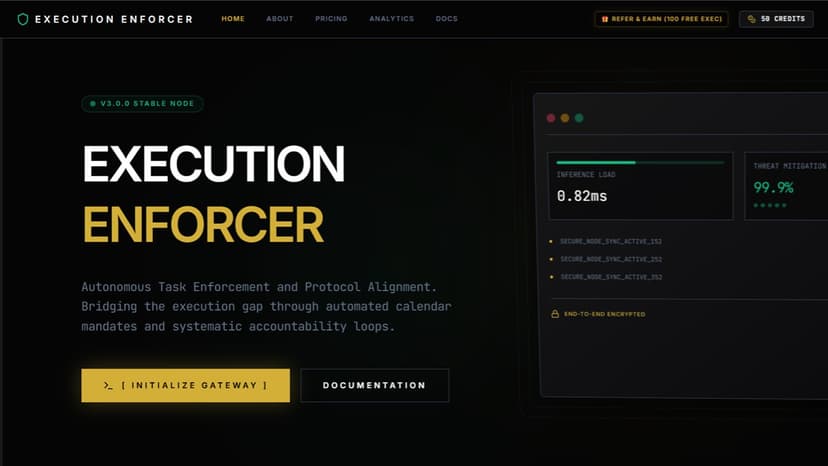
Execution Enforcer: The Autonomous Protocol Agent
Sentinel is an autonomous compliance agent designed to bridge the gap between static intention and active execution in modern DevOps environments. Traditional logging tools are completely passive; they record system data but fail to remediate configuration errors or enforce security baselines in real-time. Sentinel changes this dynamic by scanning active infrastructure and automatically evaluating it against rigorous enterprise standards like SOC2, ISO 27001, and NIST SP 800-53.The application is engineered as a highly scalable, serverless cloud gateway. The backend reasoning engine taps directly into the Gemini 3 Flash Preview framework via a project-bound cloud connection, which allows it to process up to one million tokens of system metadata with deep evaluation logic and a rapid round-trip latency of just 1.1 seconds. The user interface features a custom obsidian-and-gold theme that uses a native browser DOM-parsing engine to instantly map the incoming structured JSON cloud payloads into clear, readable risk-assessment cards and status badges. The entire stack is containerized and deployed live on Google Cloud Run.During an evaluation cycle, Sentinel runs a multi-dimensional audit across critical infrastructure layers. It tracks identity management to prevent over-provisioned admin accounts, audits terminal-level CLI and SSH connections for multi-factor authentication loops, validates AES-256 encryption at rest, and checks node-to-node mTLS transit paths. It also flags vulnerabilities like static cryptographic salts on sensitive data and monitors centralized SIEM log tracking alongside backup disaster recovery drill timelines.Moving forward, our roadmap includes implementing native Model Context Protocol (MCP) tool bindings for autonomous hotfixes, as well as downstream webhooks to auto-generate urgent tracking tickets inside Jira or GitHub Issues the moment a non-compliant flag is triggered.
19 May 2026
Execution Enforcer: The Autonomous Protocol Agent
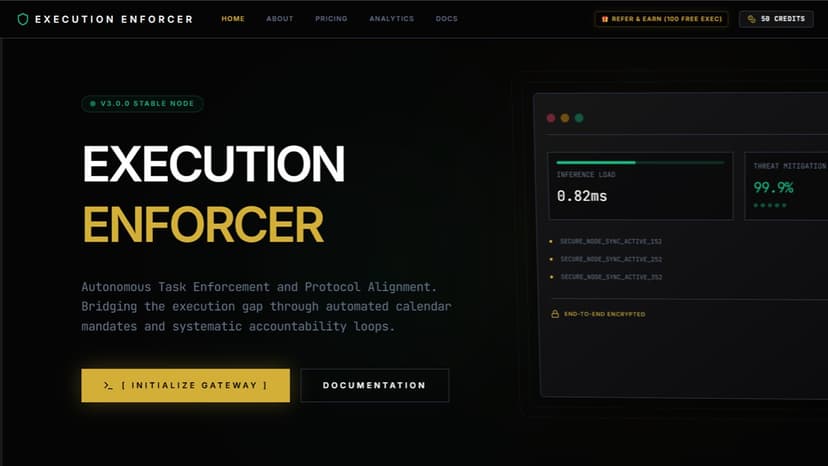
Project Overview: Traditional DevOps monitoring and project tracking systems operate purely as passive logs. They register infrastructure configurations or task states but lack the innate intelligence to actively analyze, flag, and enforce security compliance in real time. This disconnect creates a dangerous "Execution Gap" where critical system vulnerabilities and compliance drift go unnoticed until a system failure or security breach occurs. Sentinel solves this architectural bottleneck by introducing an intelligent, active compliance engine built directly on top of serverless cloud technology. Instead of forcing teams to manually audit massive configuration environments against rigid industry standards, Sentinel leverages an automated AI agent pipeline to turn raw ecosystem metadata into real-time, actionable risk diagnostics. Technical Architecture: Sentinel features a high-performance, ultra-low latency frontend interface designed with a luxury minimalist obsidian-and-gold aesthetic that prioritizes scannability for mission-critical operations. The application completely bypasses legacy, fragile network proxy layers by utilizing a secure, direct-to-cloud serverless connection straight to the next-generation Gemini 3 Flash Preview framework via Google AI Studio. When a diagnosis is initialized, the system bundles raw system context—including user privileges, encryption methods, database logs, and network routing configurations—and transmits it directly to the Gemini 3 cloud backbone. Operating under advanced system instructions, the model runs a deterministic, deep-dive evaluation of the data against elite cybersecurity frameworks including ISO 27001, SOC2, and NIST SP 800-53. The client-side DOM parsing engine then strips any structural artifacts, formats the incoming payload, and dynamically injects contextual status badges ([COMPLIANT], [RISK WARNING], [NON-COMPLIANT]) directly into the user interface.
19 May 2026


