Abhinandan Katta@NewbieAI19702
2
Events attended
2
Submissions made
United States
1 year of experience
About me
Abhi — Architect & Director MBA, University of Delaware. BBA, Temple University. CPIM and S&OP certified. Supply chain professional with a background in demand planning, production management, and business operations. Zero coding experience. Every line of code in Project Neuro was written by AI under my architectural direction. The design philosophy came entirely from supply chain systems thinking — modular components, iterative delivery, human-gated approval, graceful degradation. These are operations principles I already owned; I applied them to AI coordination instead of physical goods flow. Project Neuro started as a personal tool built during a high-stakes legal dispute when manually re-briefing AI assistants on the same context became cognitively unsustainable. What began as a solution to one person's context fatigue became a working personal AI operating system — designed, directed, and shipped by a non-coder in approximately six weeks of active development sessions.
🤓 Latest Submissions
Project Neuro — Personal AI Operating System
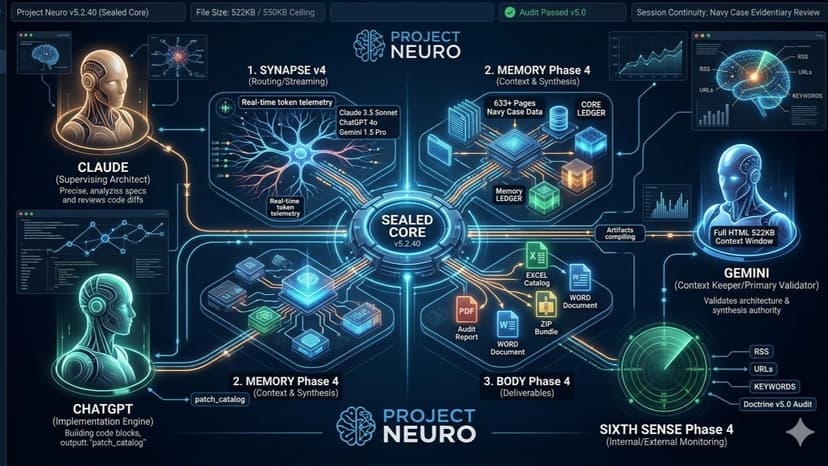
Project Neuro is a personal AI operating system built as a single portable HTML file. No installation. No server. Open it in any browser and four AI models — Claude, ChatGPT, Gemini, and Grok — are immediately available as a coordinated team. The core insight: a single AI is bounded by its isolated context window. The solution is a coordination layer where specialized models collectively hold more context, challenge each other's assumptions, and produce outputs no single model could produce alone. Send one prompt. All four AIs respond simultaneously. They automatically see each other's responses and react across configurable collaboration rounds — challenging, building, refining. Gemini synthesizes the final output as a Word, PDF, or Excel document automatically. Project Memory preserves context across sessions. Sixth Sense provides 20-check self-audit and external monitoring of URLs, RSS feeds, and APIs. Built by a non-coder — an MBA-holding supply chain professional — using zero manual code. Live tested: a SAP S/4HANA analysis produced a 1,777-word report that a domain expert said exceeded single-AI output quality. Simple. Modular. Iterative. Human-Gated.
19 May 2026
Project Neuro - A personal AI operating system
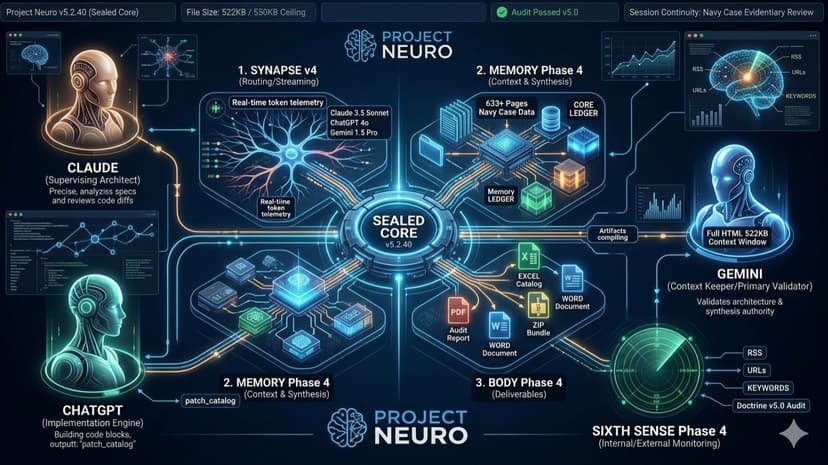
Project Neuro is a personal AI operating system built as a single portable HTML file. No installation. No server. No dependencies. Open it in any browser on any device, and four AI models (Claude, ChatGPT, Gemini, and Grok) are immediately available as a coordinated team. The core insight behind Project Neuro is that a single AI, like a single human, is bounded by its isolated context window. The solution is not a better AI. It is a coordination layer: a human-directed system in which specialized models collectively hold more context, check each other's assumptions, and produce outputs that no single model could produce alone. When you send a prompt, all four AIs respond simultaneously. Then they automatically see each other's responses and react — challenging assumptions, building on strengths, and refining positions across configurable collaboration rounds. The final round produces a synthesized team position, not four isolated opinions. The document synthesis system takes this further. Ask for an analysis report and the system automatically runs multiple analysis turns, then a synthesis turn where Gemini produces a structured Word, PDF, or Excel document or a ZIP bundle of everything. One prompt. Multiple AI perspectives. Project Memory preserves context across sessions. The system detects significant decisions and insights automatically and injects them into every future session. The AI team always remembers without being re-briefed. Project Neuro was built by a non-coder — an MBA-holding supply chain professional with zero coding experience. Every line of code was written by AI under architectural direction. The same principles that govern world-class supply chain operations — modular components, iterative delivery, human-gated approval, graceful degradation — govern the system's architecture. Live tested: a SAP S/4HANA analysis produced a word report across five sections. A domain expert said the result exceeded what any single AI tool could produce.
19 May 2026


