
Mahesh Loya@Mahesh-Loya
2
Events attended
2
Submissions made
India
1 year of experience
About me
Engineering student at PICT Pune with interests in AI, data engineering, and problem-solving. I enjoy building practical tech projects, participating in hackathons, and collaborating with teams to create impactful solutions. Experienced in event coordination, sponsorship outreach, and leading student initiatives through Pictofest and Pictoreal. Passionate about learning new technologies and turning ideas into real-world applications.
🤝 Top Collaborators
🤓 Latest Submissions
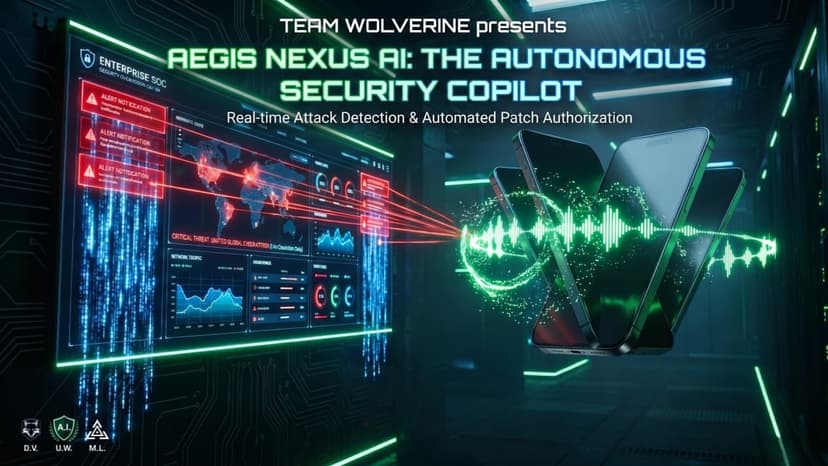
AI Calling Agent - Autonomous Security Copilot
Aegis Nexus AI is an autonomous, real-time incident response voice agent for enterprise SOCs, deployed on Vultr cloud infrastructure. THE PROBLEM: Enterprise server downtime costs roughly $5,600 per minute. When zero-day breaches occur off-hours, SOCs rely on passive alerts (email/Slack). By the time an engineer reads the alert, investigates, and deploys a patch, massive financial damage has occurred. THE TECHNICAL SOLUTION: Aegis bridges AI threat detection and human execution. Instead of emailing, our Node.js backend triggers a Twilio voice call to the on-call engineer. To achieve human-like latency, we bypassed Twilio's standard TwiML. We architected a continuous WebSocket bridge that pipes raw 8kHz mulaw audio directly into the Speechmatics Real-Time API. As the engineer speaks, transcriptions route to Google Gemini 2.5 Flash. Using native function calling, Gemini can: - search_threat_intel: Query the SQLite knowledge base - get_active_incidents: Check real-time server status - send_incident_report_whatsapp: Dispatch crash logs to WhatsApp - escalate_to_level3: Transfer to a human manager Responses are synthesized via ElevenLabs' Multilingual V2 model, automatically adapting to English, Hindi, or Marathi. VULTR DEPLOYMENT: The entire architecture—Express.js server, WebSocket streamers, and React dashboard—is fully deployed on a Vultr Compute instance using SQLite WAL. Aegis Nexus AI reduces critical incident response time from 30+ minutes to under 60 seconds.
19 May 2026
AI Calling Agent Enterprise Security Voice Copilot
The Problem: Alert Fatigue & Response Latency In modern enterprise security, the most critical vulnerability is response time. When edge systems detect a zero-day breach or a catastrophic server outage at 3:00 AM, Security Operations Centers (SOCs) are typically flooded with dashboard alerts and emails. However, human engineers still have to wake up, read logs, VPN into the network, and manually authorize patches. Every single minute of downtime costs enterprises thousands of dollars and compromises data integrity. Our Solution: Aegis Nexus AI Aegis Nexus AI completely reimagines incident response. By integrating Google Gemini 2.5 Flash's powerful reasoning engine with Veea’s Lobster Trap Deep Packet Inspection (DPI) technology, we built "Aria"—a fully autonomous, multilingual enterprise security copilot. Instead of generating passive alerts, Aria takes active command of the situation. When a network anomaly is detected, the system autonomously dials the on-call engineer's actual mobile phone using our Twilio telecom integration.
19 May 2026

