.png&w=256&q=75)
🤓 Latest Submissions
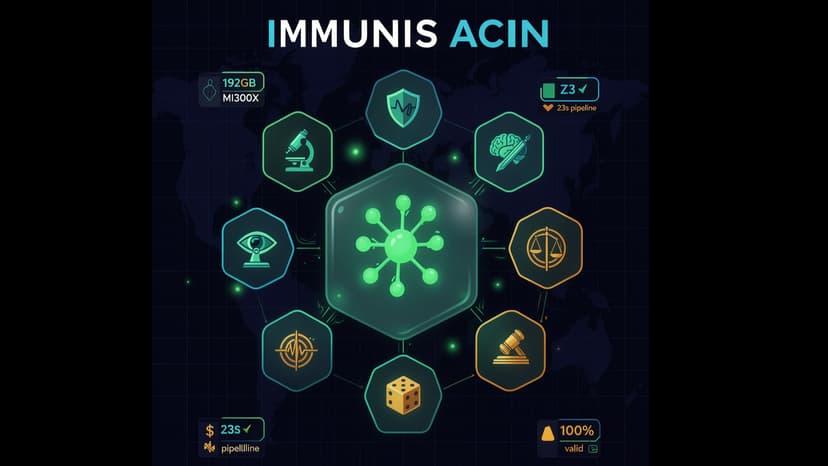
IMMUNISACIN AdversarialCoevolutionaryImmuneNetwork
IMMUNIS ACIN is the world's first Adversarial Coevolutionary Immune Network — a living cyber immune system modelled on human immunology. When the body encounters a novel pathogen, it quarantines, studies, synthesises antibodies, stress-tests them against mutations, and remembers forever. IMMUNIS does this for cyber attacks. The system orchestrates 12 autonomous AI agents through a 7-stage Adaptive Immune Response pipeline. A Sesotho BEC email arrives. Information-theoretic surprise detection (KDE on LaBSE 768-dim space) classifies it as NOVEL. An RL-adaptive honeypot deploys. Agent 1 fingerprints the attack semantically. Agent 2 synthesises a detection rule. Z3 theorem prover formally verifies its correctness — mathematical proof, not confidence scores. Then the Red Agent attacks via WGAN-GP, generating adversarial evasion variants. The Blue Agent defends. An Arbiter judges. Only antibodies surviving this coevolutionary arms race earn PROMOTED status. Promoted antibodies are signed with hybrid Ed25519 + CRYSTALS-Dilithium (post-quantum) cryptography and broadcast across an epidemic gossip mesh with R₀-priority routing. Three South African municipalities become immune without ever experiencing the attack. Seven mathematical engines power the system: Generalised Pareto Distribution for actuarial risk (CVaR in ZAR), SIR epidemiological modelling, Stackelberg security games, PID immunity control, Lotka-Volterra coevolution, Markowitz portfolio optimisation, and information-theoretic surprise detection. Three models were fine-tuned on AMD Instinct MI300X (192GB HBM3) using bf16 LoRA: IMMUNIS-Sentinel (Qwen2.5-7B threat fingerprinting), IMMUNIS-Adversary (evasion generation), and IMMUNIS-Vision (QR phishing, deepfake, document forgery, steganography). All achieved 100% valid structured output vs 0% from base models. Built across 200+ files and 50,000+ lines of code in 7 days. The breach that teaches. The system that remembers.
10 May 2026
AgentGuardian Cryptographic Trust Layer AI Agents
**Layer 1 — ZK-ML Cognition Proof** Every transaction requires a Groth16 zero-knowledge proof that the agent's neurons fired through the correct ReLU activation function with committed model weights. Mathematical certainty, not monitoring. (relu.circom, 820 constraints, bn254 curve) **Layer 2 — Multi-Agent Council** Three heterogeneous LLMs (Llama-3-70B, Gemini Pro, Mistral-8x7B) vote on every transaction before it executes. 2-of-3 consensus required. Architecturally diverse models = diverse failure modes = genuine hallucination resistance. **Layer 3 — Circle Nanopayments (Agent-to-Agent Economy)** Each council vote and ZK verification triggers a Circle Nanopayment: - $0.001 per council agent vote - $0.003 per ZK proof verification **Layer 4 — Vaccine Shield** Bad decisions are fingerprinted using a Sparse Merkle Tree and permanently blacklisted with ZK non-membership proofs. The network self-immunizes against known attack patterns. **Layer 5 — Recursive Insurance** Agents stake USDC to operate. Agents with higher ZK proof success rates pay lower premiums. Insurance is automated, cryptographic, and decentralized via UnderwriterDAO.sol. **Layer 6 — Cross-Chain Sentinel** DEFCON-level threat propagation across Ethereum, Arbitrum, Base, and Polygon via LayerZero V2. One compromised agent is blacklisted everywhere within one block. **Technical Stack:** - Circom/SnarkJS (ZK circuits) - Solidity (9 contracts, 184+ tests) - TypeScript (council orchestration) - Circle Nanopayments + Circle Wallets - Supabase (real-time telemetry) - GPT-4o + Groq + Gemini (council agents) - LayerZero V2 (cross-chain) - Arc L1 (settlement) - USDC (gas + payments) **Economic Proof:** Traditional L1: $2-5 gas per transaction × 1M daily agent actions = $2M-$5M/day in gas alone. Impossible. Arc Nanopayments: $0.001-$0.005 per action × 1M daily = $1,000-$5,000/day. Viable. This is the economic unlock for the agentic economy.
26 Apr 2026
APEX — Autonomous Predictive Exchange Organism
APEX (Autonomous Predictive Exchange) is the world's first trustless, self-learning, multi-agent AI trading organism. Traditional AI trading agents are black boxes — no audit trail, no accountability, no verifiable decision chain. APEX solves this with 8 specialized AI agents coordinated under strict separation of concerns, with every trade decision cryptographically signed via EIP-712 and permanently recorded on Ethereum. The system runs a 60-second trading cycle: DR. YUKI TANAKA fetches live BTC/USD prices from Kraken; DR. JABARI MENSAH analyzes 40 crypto news articles via Azure GPT-4o for sentiment; DR. SIPHO NKOSI enforces 8 risk guardrails including position limits, drawdown caps, and circuit breakers; DR. ZARA OKAFOR (OpenRouter/Qwen3-72B) makes the final BUY/SELL/HOLD decision; DR. PRIYA NAIR submits an EIP-712 signed trade intent to our RiskRouter smart contract; a validation checkpoint is posted to our ValidationRegistry; ENGR. MARCUS ODUYA executes via Kraken; and DR. LIN QIANRU updates the PPO reinforcement learning policy. The result: 1,859 on-chain trade proofs, validation score 98/100, reputation score 95/100 (ERC-8004 standard), Sharpe ratio 1.84, and leaderboard rank #5 of 67 teams — all verifiable on Ethereum Sepolia by anyone, at any time. APEX targets institutional traders, DeFi protocols, and prop trading firms who need provable AI decision-making — not just performance claims. The ERC-8004 identity and reputation system creates a permanent, trustless trading record that can bootstrap real institutional capital allocation.
12 Apr 2026


