
🤝 Top Collaborators
.png&w=640&q=75)
.png&w=640&q=75)
.png&w=640&q=75)
🤓 Latest Submissions
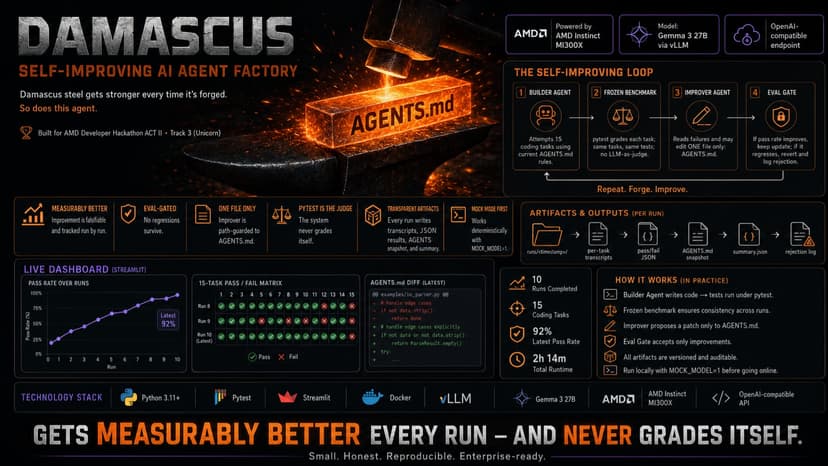
Damascus — Self-Improving Agent Kernel on AMD
Self-improvement claims in AI are usually vibes. Damascus makes them falsifiable. A builder agent (Gemma 3 27B, self-hosted with vLLM on an AMD Instinct MI300X via ROCm) attempts a frozen benchmark of 15 small coding tasks, each graded by its own pytest suite. An improver agent reads the failures and may edit exactly one file — AGENTS.md, the project rules injected into the builder's prompt. It can never touch the tasks, the tests, or the code, and this is enforced in code with a path check, not just in the prompt. The loop then re-runs the full benchmark against the exact same tests. The key mechanism is eval-gating: if a rules update drops the pass rate, the kernel rejects it and reverts automatically — like a package manager refusing a broken dependency. In our runs, the pass rate climbed from 60% to 91% across 8 runs (14/15 tasks passing), with 6 of 8 proposed rule revisions accepted and 2 rejected and reverted with no manual intervention. Every number is reproducible from the runs/ artifacts: per-task transcripts, pass/fail JSON, and every AGENTS.md snapshot. The agent never grades itself — pytest is the only judge. No LLM-as-judge anywhere in the pipeline. The diff history between AGENTS.md versions is a human-readable record of what the agent actually learned, making Damascus the missing regression test for prompt engineering. A dashboard renders it all like an OS: process monitor, kernel version, and a ledger of accepted and rejected updates. Damascus steel gets stronger every time it's forged. So does this agent.
13 Jul 2026

OBSERVA
OBSERVA is a privacy-first AI mobility assistant designed for blind and low-vision users who need safe, reliable navigation support in everyday environments. Unlike many tools that depend on cloud processing, OBSERVA is built to run core safety features fully on-device, including in airplane mode, so users can rely on it in low-connectivity settings and for sensitive private contexts. Our current Android prototype uses a continuous CameraX loop with low-latency audio and haptic alerts, a hazard engine with cooldown and scene memory to avoid repetitive alert spam, and an accessibility-focused interface optimized for non-visual interaction. The product direction includes robust object recognition, hazard detection, contextual navigation assistance, and multilingual interaction/translation pathways while maintaining strict local processing guarantees. We position OBSERVA in a gap between pure OCR/vision apps and infrastructure-dependent systems (e.g., code-tag ecosystems), focusing on independent mobility, comfort, and trust. Our core value proposition is simple: private, offline, safety-oriented assistive intelligence that is usable in the real world, not just in ideal network conditions.
28 Jun 2026

Erebus
Erebus is an AI-powered pentesting assessment agent that turns authorized targets—domains, URLs, repos, files, APIs, and LLM apps—into prioritized, report-ready security findings grounded in real tool evidence. Paste this into Long Description: Erebus is an AI-powered pentesting assessment platform built for the age where software ships faster than security teams can manually validate it. The agent takes an authorized target such as a domain, URL, repository, uploaded file, API endpoint, or LLM-powered web app, then gathers evidence through safe security tools and intelligence sources. Instead of simply chatting about cybersecurity, Erebus acts like an assessment layer. It connects scanner output, HTTP metadata, public web intelligence, dependency analysis, exposed service data, repository review, file inspection, and LLM application testing into a single normalized report. The system is designed to avoid hallucinated vulnerabilities: findings are only created when there is evidence from tools, user-provided artifacts, or controlled test results. Each finding is converted into a pentest-style format with severity, confidence, affected asset, evidence, business impact, remediation guidance, validation steps, and security mappings such as CWE or OWASP categories. This makes Erebus useful not only for auditing our own apps before production, but also for helping teams investigate suspicious repositories, files, phishing surfaces, exposed services, and AI application behavior. The project combines a fine-tuned cybersecurity model, retrieval over modular security datasets, and an extensible tool architecture. Today it can support web security assessment, OSINT enrichment, malware and file triage, dependency risk review, and LLM security checks. In the future, Erebus can grow into a full autonomous security assessment copilot that helps developers, startups, and security teams validate products faster without lowering the quality of the analysis.
31 May 2026


