.png&w=256&q=75)
🤝 Top Collaborators
.png&w=640&q=75)
.png&w=640&q=75)
.png&w=640&q=75)
🤓 Latest Submissions
LogiSecure AI
LogiSecure AI is an enterprise-grade, autonomous agent platform designed to revolutionize global supply chain management by resolving the critical trade-off between real-time logistical visibility and corporate data sovereignty. Currently, international logistics companies face a massive operational challenge: they must choose between exposing highly confidential cargo and operational data to public clouds, or isolating themselves within secure local systems that remain entirely disconnected from dynamic global contexts like weather, traffic, and geopolitics. This friction leads to costly delays and limits proactive decision-making. Our solution acts as an intelligent, on-premise control hub. It continuously monitors open-source and global APIs—such as GNSS, aviation, and maritime transponders—to detect worldwide anomalies like port strikes or extreme weather. Once a disruption is detected, the LogiSecure AI agent securely queries the company's local database to identify exactly which confidential shipments and corporate assets are affected. Powered entirely by the AMD ROCm™ software stack and local AMD Radeon™ or Instinct™ GPUs, our internal LLM analyzes these disruptions locally. It simulates the financial impact and calculates multi-modal alternative routes (air, sea, or land) without ever leaking data to third-party cloud vendors. Finally, the system executes a proactive response plan by automatically pushing updated GPS coordinates to transit operators via API and pre-drafting client communication alerts for final executive approval. LogiSecure AI eliminates costly delays, drastically reduces recurring cloud AI costs, and demonstrates the immense power of deploying complex, agentic workflows locally on AMD hardware.
13 Jul 2026
.png&w=828&q=75)
VanTage - Due diligence, on a timeline
Private equity associates spend roughly 40 hours per target on preliminary due diligence—a full week lost to browser tabs, public filings, news archives, and litigation records, manually stitched into something an investment committee will trust. Most of that week isn't analysis; it's gathering. Vantage does it in 40 seconds. Point it at a company and it pulls from 12 distinct web sources at once, assembling them into a live knowledge graph: a connected map of the target's people, financials, legal exposure, customers, suppliers, and reputational signals. Relationships that normally take days to cross-reference appear instantly—the board member sitting on a competitor's audit committee, the lawsuit filed quietly three states away, the executive churn that began before the numbers softened. Red flags don't wait to be found. Vantage automatically surfaces litigation spikes, leadership departures, restatements, and regulatory actions, ranked and explained. A 90-day time slider lets you drag through recent history and watch the target's profile change—because knowing when something shifted is often more revealing than knowing that it did. Every claim is cited back to its source, so partners can audit it and committees can rely on it. Every memo lands IC-ready. This defensibility is powered by Bright Data, whose reliable, large-scale, structured web access makes a trustworthy knowledge graph possible where brittle scrapers and stale databases fail. We target middle-market PE associates—the highest willingness-to-pay segment in B2B software, where seats command $500–$2,000 per month. Their time is billed against nine-figure decisions, and a single avoided bad deal or faster close justifies the spend many times over. Vantage turns the most tedious week in the deal process into a 40-second starting point.
31 May 2026
StoryTrace - Git for News
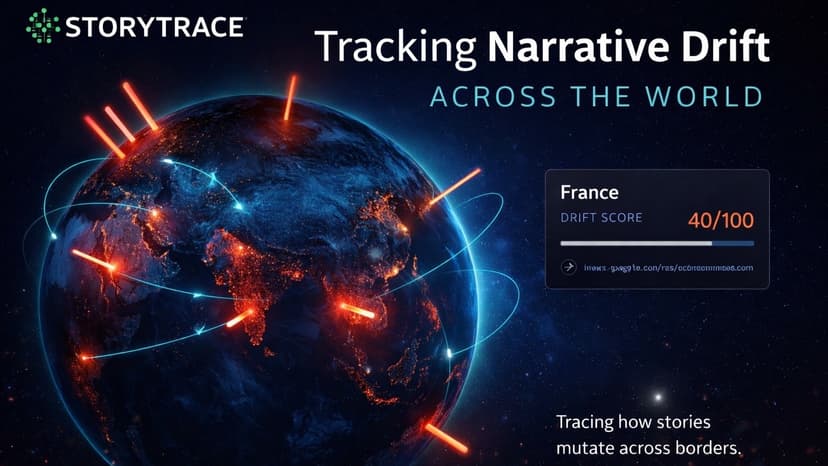
StoryTrace is a "Git for News" — a tool that tracks how a story mutates as it travels across global media outlets. You paste any article URL or type a topic (e.g. "Iran nuclear deal"). StoryTrace's 7-agent LangGraph pipeline springs into action: the Seed Agent finds the original wire story via GDELT, the Crawler Agent scrapes 15 RSS feeds across 8 countries, a Translator Agent localizes non-English coverage to English, the DNA Extractor (Featherless/Qwen2.5) pulls structured facts from each article, the Drift Scorer measures how many key facts each outlet dropped or distorted, the Geo Builder organizes coverage by country into a D3-ready tree, and an Alert Agent fires webhooks when drift exceeds a threshold. The results render as an interactive D3.js tree — nodes colored green (faithful), amber (moderate drift), red (high drift) — alongside a 3D globe showing which countries covered the story and how differently. Clicking any node reveals a DiffPanel showing exactly which facts were kept, dropped, or altered. The backend is FastAPI + LangGraph + PostgreSQL + Redis. The frontend is Next.js 16 with D3 v7 and react-globe.gl. AI layers: Featherless API (Qwen2.5-7B) for structured JSON fact extraction, Google Gemini for translation and optional world-impact forecasting, spaCy for local NER (zero tokens). The entire pipeline runs on ~4,000–6,000 tokens per story — lean by design. StoryTrace addresses a real problem: media consumers have no tool to see how coverage diverges from the original facts. We make that drift visible, quantified, and interactive.
19 May 2026
App Architect Studio
App Architect Studio bridges the gap between rapid visual ideation and enterprise engineering. Developed for the IBM Bob Hackathon 2026, our platform allows developers to upload any UI mockup or screenshot and instantly watch it synthesize into scalable, structured, and multi-file production React code. Unlike generic image-to-code generators, App Architect Studio features deep repository context awareness powered by the IBM Bob integration. It automatically analyzes your existing codebase's file structures, state management rules, and component libraries to generate code that fits flawlessly into your ecosystem. Key Technical Pillars: Vision-to-Code Pipeline: Converts visual designs directly into organized React and TypeScript files. Style Lock Enforcement: Guarantees that all generated UI matches your exact corporate design systems, tailwind configs, or styling rules. Voice Mode Engine: Enables hands-free component modifications using real-time voice-to-code prompting workflows. Multi-Language i18n: Autogenerates localization files alongside components for instant global readiness. By transforming static screenshots into production-ready repositories, App Architect Studio cuts enterprise frontend development lifecycles from days to seconds while maintaining zero architectural debt.
17 May 2026
RunwAI - Predictive AI for Air Traffic Safety
RunwAI transforms air traffic control from reactive problem-solving to predictive, real-time prevention. The FAA manages over 45,000 flights daily across increasingly congested airspace, while delays and cancellations have grown at nearly double the rate of flight volume - costing the aviation industry over $30B annually. RunwAI addresses this by combining multimodal AI with AMD GPU acceleration. The system fuses three live data sources: OpenSky Network for real-time flight positions and transponder data, METAR weather feeds for atmospheric conditions, and live video streams for visual runway and airspace monitoring. These inputs are processed through an AI pipeline running on AMD Instinct MI300X GPUs, leveraging ROCm 5.x with HIP-optimized kernels for efficient tensor operations across inference workloads. Core capabilities include: (1) Predictive congestion detection - identifies emerging conflicts before they escalate; (2) Weather-aware intelligence - continuously analyzes weather severity and its impact on routes; (3) Intelligent rerouting - generates optimized flight paths balancing safety, fuel efficiency, and airspace capacity; (4) Explainable decision support - delivers evidence-based recommendations with confidence metrics. Performance benchmarks: sub-4ms detection latency, under 2-second response latency, 35% improvement in conflict detection, and over 99% rules check accuracy - processing 10,000+ flight updates per second. The live dashboard provides an airspace map view, conflict alerts panel, and AI-powered rerouting suggestions for controllers in real time.
10 May 2026


