
🤓 Latest Submissions
Quantix: Autonomous Structural Takeoff Agent
The construction industry loses countless hours to manual quantity surveying. For structural engineers, completing a steel takeoff means tracing 50+ members across complex PDF framing plans, squinting at mark labels (e.g., "SB-1"), measuring lines by hand, and tallying results in a spreadsheet. It takes 3 to 5 hours per drawing and is highly prone to human error. Quantix solves this by reducing a multi-hour task into a 2-minute autonomous workflow. Quantix is not just a standard OCR wrapper; it is a true reasoning agent built on a ReAct (Reason, Act, Observe) loop powered by Google Gemini 3 Flash. The core challenge with engineering drawings is that they encode meaning across two entirely separate representations: symbolic text (the labels) and vector geometry (the physical lines). OCR only sees text; standard CAD parsers only see lines. Quantix bridges this gap via "Spatial Binding." Our agent extracts the exact scale from the drawing, reads the raw vector data, and uses Gemini's advanced reasoning and context window to orchestrate a suite of 15+ domain-specific tools (such as get_lines and match_marks). The agent autonomously binds text labels to the correct geometry based on proximity and orientation, converting PDF points to real-world meters with 0.001m precision. To ensure enterprise-grade trust and safety, Quantix features a built-in Human-in-the-Loop correction system. If the agent happens to select the wrong line, the user simply clicks to reject it. The agent instantly clears that specific page, excludes the rejected coordinates, and re-runs its reasoning loop to find the next best match without requiring manual tracing. Once complete, Quantix instantly exports a clean, highly accurate Bill of Materials (BOM). By leveraging Gemini's multi-step tool calling, Quantix transforms unstructured geometric data into actionable enterprise intelligence.
19 May 2026
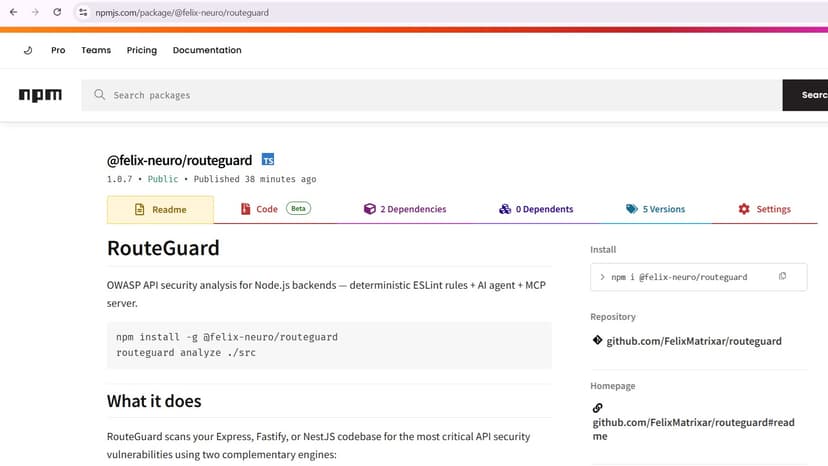
RouteGuard: Offline AI-Powered API Security
RouteGuard is a developer-first security tool designed to protect Node.js APIs from critical OWASP Top 10 vulnerabilities right in the IDE or CI/CD pipeline. Traditional security tools often rely on complex cloud setups, dynamic testing that requires running applications, or sending proprietary source code to external LLMs. RouteGuard solves this by combining the speed of deterministic static analysis with the deep contextual understanding of a local AI agent. It features two complementary engines: a lightning-fast deterministic scanner powered by a custom ESLint plugin that performs intra-file taint-analysis to catch BOLA (IDOR), mass-assignment, SSRF, SQL injection, and path traversal in milliseconds. For more complex business logic flaws, it employs a local IBM Granite 3.3 2B AI agent. Because the AI runs entirely offline, no source code or data ever leaves the developer's machine. The AI engine specifically hunts for nuanced vulnerabilities like broken authentication, function-level authorization bypasses, business flow abuse, and unsafe API consumption. RouteGuard integrates seamlessly into developer workflows via a CLI, an ESLint plugin, an MCP (Model Context Protocol) server for use with Claude Desktop or Cursor,and a local Vite/React web dashboard to review findings. By catching vulnerabilities at write-time, RouteGuard empowers developers to build secure APIs from the ground up without compromising privacy or development velocity.
17 May 2026


