.png&w=256&q=75)
🤝 Top Collaborators
.png&w=640&q=75)
🤓 Latest Submissions

SemAuth
Current authorization systems - OAuth, Cedar, RBAC, ABAC answer one question: is this agent allowed to act? They all share a silent assumption: the requesting entity has honest intent. For LLM agents, this assumption breaks. An attacker can hide a malicious instruction inside a document the agent reads. The agent follows it using its own valid credentials, within its own authorized scope. Every authorization check passes. The attack is invisible. SemAuth closes this gap. It introduces Intent Integrity as a formal authorization property and enforces it through a three-layer verification gate. Layer one runs cosine similarity to expose the Entailment Gap and showing that geometric similarity cannot detect logical authorization violations. Layer two runs a CVIC detector that identifies five classes of Capability-Valid Intent-Corrupted attacks. Layer three verifies the full delegation chain across multi-agent hops. When all three pass, SemAuth issues a JWT via RFC 8693 token exchange carrying novel Intent Integrity claims — ii_verified, ii_chain_valid, and a cryptographic hash of the reasoning trace, creating an unforgeable audit record of every semantic authorization decision. The platform includes a dynamic agent builder where users configure agents with system prompts, OAuth scopes, and simulated tools. Agents are discovered via A2A cards. The orchestrator delegates dynamically, SemAuth evaluates at every hop, and the delegation chain is traced with nested act claims in every issued token.
19 May 2026
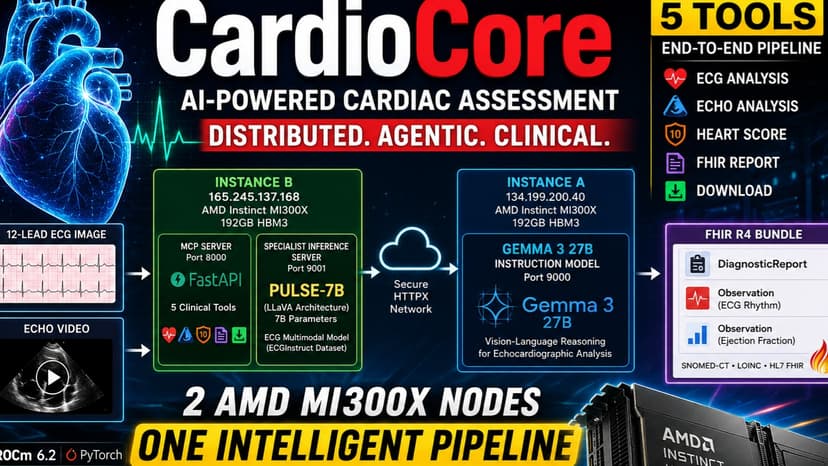
Cardiocore
CardioCore is a distributed agentic cardiac assessment system running across two AMD Instinct MI300X GPU nodes. Instance B hosts a FastAPI MCP server exposing five clinical tools, alongside a specialist inference server running PULSE-7B — a 7B multimodal LLM fine-tuned on ECG data — loaded directly into GPU memory. Instance A runs Gemma 3 27B via vLLM, acting as the vision-language reasoning engine for echocardiographic analysis. When a clinician uploads an ECG image, PULSE-7B classifies the cardiac rhythm into one of five SNOMED-CT categories: normal sinus rhythm, myocardial infarction, ST-T wave change, conduction disorder, or hypertrophy. For echocardiogram video, two frames are extracted and sent to Gemma 3, which estimates left ventricular ejection fraction, classifies heart failure severity, and identifies structural abnormalities. HEART score risk stratification runs in pure Python under 1ms, combining ECG results, echo findings, patient age, troponin ratio, and comorbidities into a validated 10-point triage score predicting 10-day major adverse cardiac events. Finally, all results are assembled into a schema-validated HL7 FHIR R4 Bundle containing a DiagnosticReport and two LOINC-coded Observations, ready for EHR submission. The browser UI orchestrates the entire pipeline — each tool passes its result directly into the next, with no separate pipeline infrastructure required beyond the two running FastAPI servers.
10 May 2026

