
🤓 Latest Submissions
Bridge — Autonomous CUDA to ROCm Migration Agent
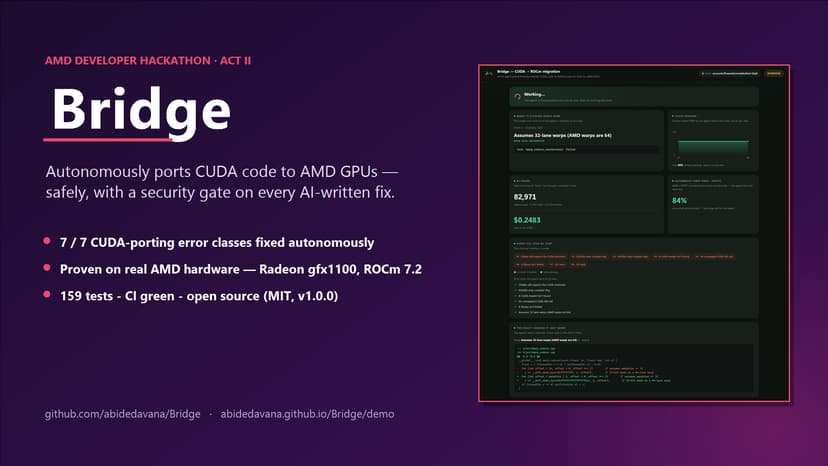
Most of the world's GPU code is written for CUDA, which locks it to a single vendor and keeps teams off AMD hardware they'd otherwise choose. HIPIFY converts about 90% of CUDA to AMD's HIP mechanically; the last 10% (build systems, warp-size assumptions, cuBLAS quirks, arch flags, link failures) is manual, and it's where migrations stall. Bridge is the agent that finishes the job. Point it at a CUDA repo and it builds, reads the compiler errors, asks an LLM for a fix, checks that fix through a mechanical policy gate, commits, and rebuilds — in a loop, until the code passes its tests on AMD, ending every run with an honest SUCCESS / PARTIAL / STUCK report. Proven, not promised. A recorded run with the open-weights Kimi K2.6 on Fireworks fixed all 7 CUDA-porting error classes autonomously, including the 64-bit CDNA warp-mask fix, for about $0.30. On AMD Developer Cloud hardware (Radeon gfx1100, ROCm 7.2), Bridge autonomously ported a real CUDA project to a passing ctest in 3 iterations. Both runs ship as replayable recordings, so "docker compose up" shows the full migration on any laptop — no GPU, no key. For the Gemma challenge we swapped the brain in one config line: Gemma 4 fixed 3 of 7 classes, honestly reported, and the security gate held identically. The differentiator is agentic security. Bridge runs untrusted repo code and applies LLM-written diffs — trust boundaries most coding agents just cross. Safety is mechanical, enforced on each diff before it applies: a writable-path allowlist, a forbidden-insertion denylist, no editing of tests, size caps. A red-team test proves the gate rejects a live prompt-injection payload. 159 tests, CI green, MIT, v1.0.0. ROCm's own platform lists porting CUDA to AMD as a core use case. Bridge automates it — and the migration cost is the moat it removes.
12 Jul 2026
