Top Builders

Explore the top contributors showcasing the highest number of app submissions within our community.

Qwen3-MT

Qwen3-MT is a machine translation model developed by Alibaba Cloud's Qwen team, released on July 25, 2025. It is fine-tuned from Qwen3 with a lightweight Mixture-of-Experts backbone and trained on trillions of multilingual tokens spanning formal, technical, and conversational text. The model covers 92 major languages and prominent dialects, reaching over 95% of the global population.

General
Release date25 Jul 2025
DeveloperQwen / Alibaba Cloud
TypeMachine translation model (MoE fine-tune)
LicenseCommercial API
DocumentationAlibaba Cloud Model Studio
APIDashScope via Qwen API Platform

Core Features

  • 92 languages: covers major world languages and prominent dialects, reaching 95% of the global population.
  • Terminology control: allows custom terminology dictionaries to keep brand names, technical terms, and product names consistent.
  • Domain prompting: a domain hint lets the model adapt output style for legal, medical, technical, or conversational text.
  • Translation memory: integrates past translation pairs so repeated segments stay consistent across large documents.
  • Competitive pricing: priced at $0.5 per million tokens, significantly lower than dense large models for translation workloads.

Performance

Qwen3-MT outperforms comparably-sized models on translation benchmarks, including GPT-4.1-mini and Gemini-2.5-Flash, while remaining competitive with larger models like GPT-4.1 and Gemini-2.5-Pro on translation quality metrics.


Tools and Resources


Ecosystem and Integrations

  • Served through Alibaba Cloud DashScope, accessible with the OpenAI-compatible endpoint or the native DashScope SDK.
  • Supports batch translation for high-volume document workflows.
  • Term dictionaries and translation memory integrate via API request parameters, requiring no custom fine-tuning.

Get started by generating an API key on the Qwen API Platform and following the Model Studio translation guide.

Qwen Qwen3-MT AI technology Hackathon projects

Discover innovative solutions crafted with Qwen Qwen3-MT AI technology, developed by our community members during our engaging hackathons.

Probably runs on Samsung S25

Probably runs on Samsung S25

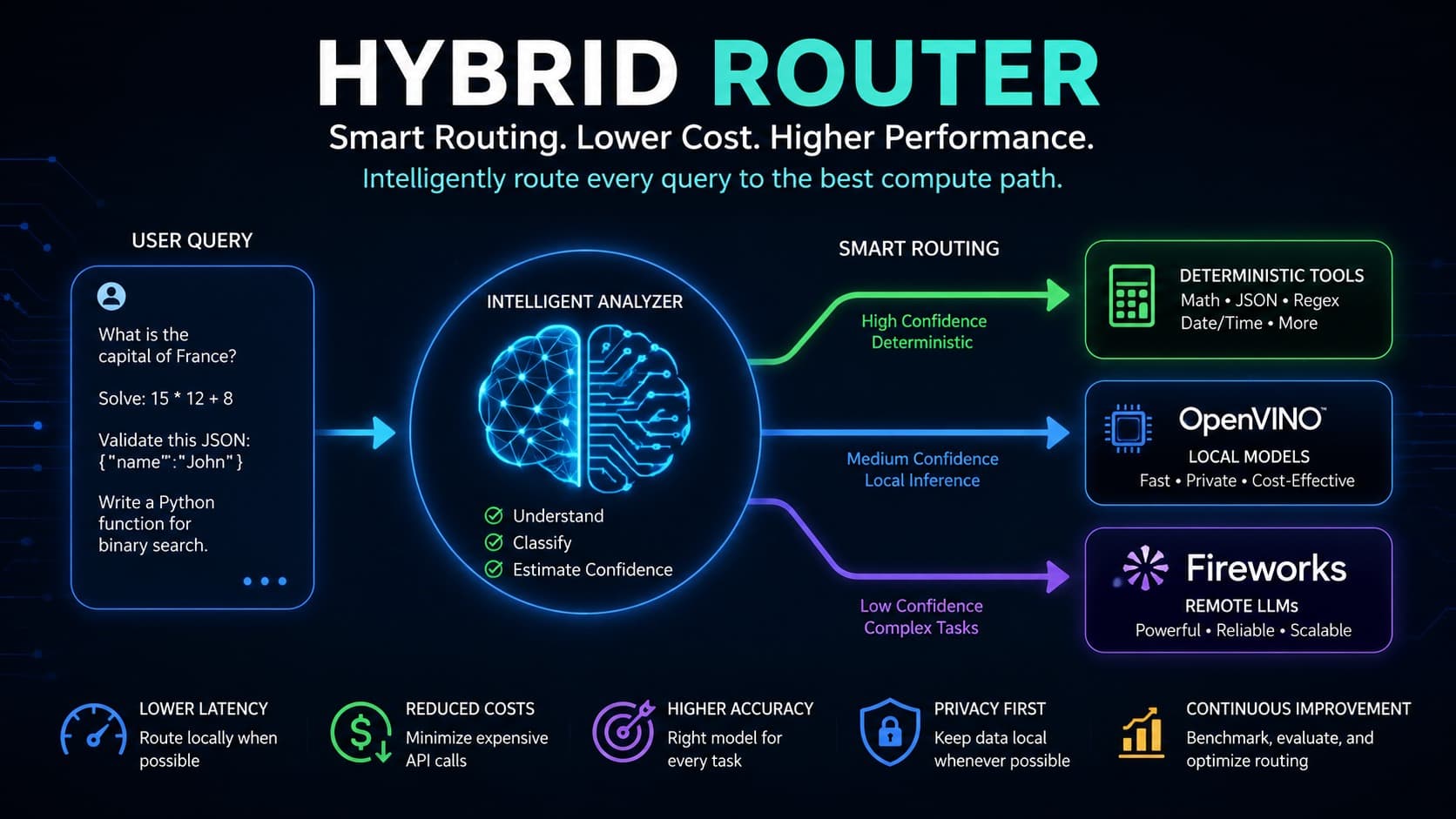
Hybrid Router is an intelligent AI inference system that dynamically selects the best execution path for each user query instead of relying on a single large language model. The system first analyzes the incoming prompt to identify the task type, estimate its complexity, and determine whether it can be solved deterministically or requires generative AI. For structured tasks such as mathematical calculations, JSON validation, regular expression verification, and date/time operations, the router invokes specialized deterministic tools that produce fast, accurate, and reproducible results without consuming LLM tokens. For more complex natural language and coding tasks, the router attempts local inference using OpenVINO-optimized models running on Intel hardware, reducing latency and API costs. If the local model is unlikely to provide a sufficiently reliable answer or the task exceeds its capabilities, the system automatically falls back to Fireworks AI models for high-quality remote inference. The routing decisions are driven by task classification, confidence estimation, and configurable thresholds, allowing the system to balance accuracy, response time, and operational cost. The architecture is modular, making it easy to add new tools, local models, or routing strategies in the future. The project also includes benchmarking and evaluation components that measure routing accuracy, latency, model utilization, and fallback frequency to continuously improve routing performance. By combining deterministic tools, local inference, and cloud-based language models into a single adaptive pipeline, Hybrid Router delivers efficient, scalable, and cost-aware AI inference while maintaining high response quality across a wide range of tasks.

AuraRoute: Token-Efficient Hybrid AI Router

AuraRoute: Token-Efficient Hybrid AI Router

AuraRoute is a cutting-edge hybrid AI orchestration framework engineered specifically for the AMD Developer Hackathon. Designed to excel under rigid wall-clock execution windows and tight scoring criteria, the system minimizes remote token overhead without sacrificing reasoning accuracy. The core architecture operates on a local-first paradigm. Low-compute workloads (such as sentiment analysis, basic entity extraction, and straightforward summarization tasks) are processed natively on a CPU-bound Docker container utilizing a heavily quantized Qwen2.5-1.5B-Instruct model. For maximum reliability, the framework enforces an innovative confidence-score parser coupled with strict JSON validation rules to safely isolate and execute tasks on the edge. When the local model exhibits low confidence, or when the specialized intent classifier flags a high-compute domain (such as advanced mathematics, code generation, logic puzzles, or general system failures), the agent executes a seamless fallback cascade to cloud-based serverless environments via the Fireworks AI API. To dominate the token-efficiency leaderboard, AuraRoute deploys a highly specialized token starvation strategy. By stripping conversational system prompts and appending precise 'anti-yap' structural suffixes to user queries, the model cuts out filler tokens completely. Furthermore, it leverages state-of-the-art API features like compressed reasoning effort constraints to limit invisible chain-of-thought overhead on remote reasoning backends. Fully crash-proof and timeout-resilient, AuraRoute provides the ultimate architecture for scalable, enterprise-grade AI routing.

VoiceHire: AI Recruitment Workspace

VoiceHire: AI Recruitment Workspace

Every recruiter knows the pain: dozens of CVs to screen, interview slots to coordinate, notes scattered across tools, and hiring decisions that rely more on memory than evidence. VoiceHire brings it all into a single workspace where AI does the repetitive work so recruiters can focus on what matters. Upload a batch of resumes and the platform extracts structured profiles with skills, experience, and education. Describe a role and it auto-generates a detailed job posting. With one click, the Candidate Matcher ranks every applicant against the requirements scoring on skills, experience, past performance, and culture fit and explains exactly why each candidate is a strong match or where their gaps are. The real breakthrough is the interview itself. When a candidate joins, six AI agents collaborate across three dedicated rooms. One builds a tailored competency rubric from the job and resume. Another generates probing questions targeting specific skill gaps. A voice agent delivers them naturally while transcribing every word. Two evidence extractors one technical, one behavioral analyze responses for genuine signals. A skeptic runs in the background challenging weak claims and flagging inconsistencies. After the interview, three agents deliberate as a committee, weighing evidence from both sides before reaching a hiring recommendation. Recruiters see everything live: competency coverage updating in real time, integrity flags appearing as suspicious behavior is detected, and multiple interviews running side by side. When it's done, there's a complete evidence portfolio with every question, every answer, every signal extracted, and the full deliberation transcript. No more "I think they were good" just auditable, defensible hiring.