Top Builders

Explore the top contributors showcasing the highest number of app submissions within our community.

Google's Generative AI Studio

Experience the power of Google's Vertex AI through Generative AI Studio, a managed environment that streamlines the interaction, customization, and deployment of foundation models for production applications.

General
Release date2023
AuthorGoogle
DocumentationLink
TypeGenerative AI Model Management

Start building with Generative AI Studio

Explore the best Generative AI Studio resources and libraries to help you get started with building projects using Google's Vertex AI today.

A curated list of libraries and resources to help you build outstanding projects with Generative AI Studio.


Google Generative AI Studio AI technology Hackathon projects

Discover innovative solutions crafted with Google Generative AI Studio AI technology, developed by our community members during our engaging hackathons.
AutoClaw - Self-Evolving Agent Economy

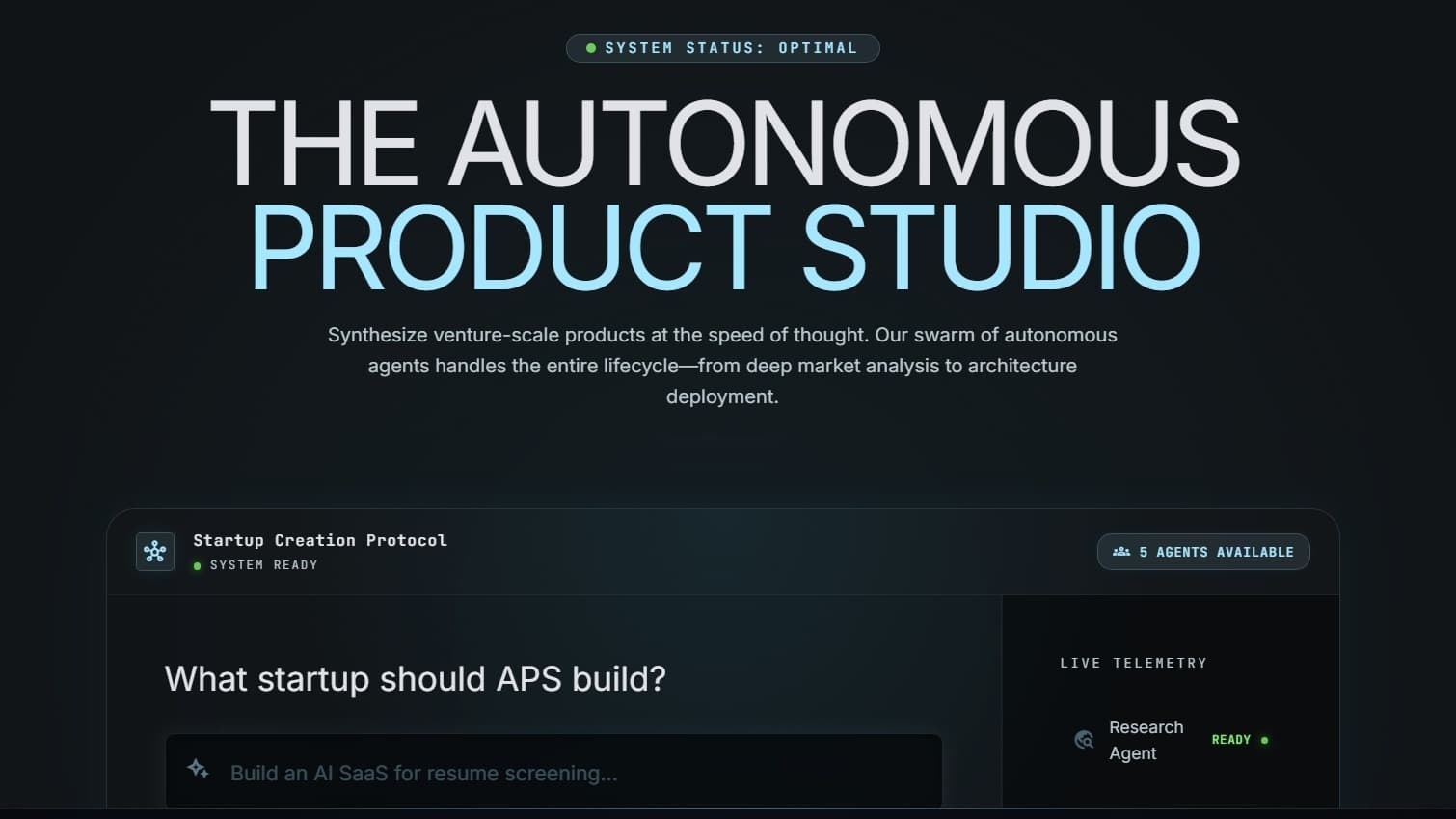
AutoClaw - Self-Evolving Agent Economy

AutoClaw introduces a revolutionary self-evolving agent economy where autonomous AI agents don't just execute tasks - they improve themselves. Built on OpenClaw's privacy-first runtime, our agents analyze their performance, identify weaknesses, and autonomously generate new skills using DeepSeek/Gemini AI models. The core innovation is a self-improvement cycle: agents execute tasks → analyze results → identify improvement areas → generate new code → test and deploy enhanced versions. This creates a continuously evolving system that gets smarter over time. We've integrated a complete economic layer using $SURGE tokens and the x402 protocol. Premium skills charge micro-payments (0.1-1.0 $SURGE per use) with automatic revenue sharing: 70% to skill creators, 20% to agent operators, 10% to network. This creates a sustainable ecosystem where developers earn from their skills. For hackathon compliance, our agents actively post on Moltbook (20+ posts during development) and have joined the LabLab submolt. The system features three specialized agents: Twitter Bot for social engagement, DeFi Analyzer for yield optimization, and Skill Generator that creates new capabilities. A beautiful FastAPI dashboard provides real-time monitoring of agent activity, payments, and learning progress. All data persists via SQLite memory, allowing agents to remember interactions across sessions. Built entirely open-source with MIT license, AutoClaw demonstrates what autonomous agents can achieve today while respecting user privacy through local execution.

Adaptifleet

Adaptifleet

Traditional warehouse automation has improved efficiency, yet many systems remain rigid, expensive, and difficult to adapt when workflows or layouts change. Even small adjustments often require specialized expertise or time-consuming reprogramming. This creates a disconnect between what operators need robots to do and how easily they can communicate those needs — a challenge we call the “Human Intent Gap.” AdaptiFleet was designed to close this gap by enabling intuitive, AI-driven fleet control. Instead of relying on complex interfaces or predefined scripts, users interact with autonomous robots using natural language. Commands such as “Get me three bags of chips and a cold drink” are interpreted and translated into structured robotic tasks automatically. At its core, AdaptiFleet leverages Gemini-powered Vision Language Models (VLMs) to understand user intent and visual context. Robots operate within a dynamic decision framework, allowing them to adapt to changing environments rather than follow rigid, pre-programmed routes. The platform integrates a digital twin simulation stack built on Isaac Sim, enabling teams to validate behaviors, test workflows, and optimize multi-robot coordination before live deployment. Once deployed, ROS2 and Nav2 provide robust navigation, dynamic path planning, and collision avoidance. The VLM orchestration layer continuously analyzes visual inputs to support scene understanding, anomaly detection, and proactive hazard awareness. When conditions change, AdaptiFleet autonomously re-plans routes and tasks, reducing downtime and operational disruption. By combining conversational interaction, real autonomy, and simulation-driven validation, AdaptiFleet simplifies robotic deployments while improving efficiency and visibility. The result is an automation system that is adaptive, scalable, and aligned with how people naturally work.

DAIA - Deriv AI Analyst

DAIA - Deriv AI Analyst

DAIA (Deriv AI Analyst) is a real-time enterprise observability platform built for Deriv's business operations. It monitors Active Daily Users, Trading Volume, Regional Performance, Platform Health, and Instrument Activity, automatically detecting anomalies requiring executive attention. The system uses a 4-layer intelligence pipeline: a Correlation Engine for streaming telemetry, an LLM Reasoning Agent for contextualizing deviations, a Severity Scorer using z-score analysis, and an Executive Briefing Generator for actionable reports. DAIA operates through three Gemini-powered agents: Agent 1 (Analyst): Performs statistical anomaly detection across regions (NA, EU, APAC), platforms (Trader, MT5), and instruments (Synthetics, FX, Stocks) using rolling baselines, percentage deviations, and z-scores. Agent 2 (Reporter): Generates executive briefing reports with Market Overview, Regional Drivers, Risk Commentary, and prioritized Action Items with timelines. Reports are downloadable. Agent 3 (Advisor): Interactive chat interface for follow-up questions, root cause analysis, and investigation path exploration using live analysis data. The platform features a healthy-to-anomaly state transition. By default, the dashboard shows all systems nominal. When new telemetry is uploaded, the system processes it in real-time — KPI cards turn red, trend charts reveal drops, regional charts expose impacted areas, and an investigation path traces the anomaly from region to platform to instrument. Key features: live CSV upload with Gemini analysis, 28-day ADU trend chart, dynamic regional and instrument charts, auto-generated executive reports, and persistent AI chat for deep-dive investigation. The backend uses Python/Streamlit with 3-tier anomaly detection. The frontend uses React, TypeScript, Recharts, and Gemini API via Google AI Studio. DAIA transforms raw business telemetry into executive intelligence — turning data noise into actionable decisions within seconds.