Top Builders

Explore the top contributors showcasing the highest number of app submissions within our community.

AI/ML API

The AI/ML API offers a comprehensive suite of advanced AI functionalities designed to meet a variety of needs, including text completion, image inference, speech-to-text, and text-to-speech capabilities. The API is engineered for seamless integration, exceptional performance, and secure API key management, ensuring a smooth and reliable user experience.

Key Features

  • Inference: Effortlessly evaluate and deploy models for a range of tasks including text generation, image analysis, and more. This feature allows users to leverage the power of advanced AI to draw meaningful inferences from various data types.
  • API Key Management: Securely generate, manage, and monitor API keys to ensure the safety and integrity of interactions with the API. This feature provides robust security measures to protect data and operations.
  • Broad Model Selection: Gain access to a diverse array of models tailored to various AI applications, allowing selection of the most appropriate model for specific tasks. This extensive model library supports a wide range of functionalities to address different AI challenges.

Start building with AI/ML API

To start using the AI/ML API, follow the detailed Quickstart guide which provides step-by-step instructions to set up the development environment and initiate the first API call. This guide is designed to help users quickly familiarize themselves with the API's capabilities and start leveraging its powerful features.

Authentication

API Key Management

To use the AI/ML API, an API key is required. This key is essential for authenticating requests to the API. API keys can be easily generated and managed through the account dashboard, ensuring secure access to the API services.

Sending Your First Request

After setting up the environment and obtaining an API key, proceed to send the first request. The API documentation provides detailed instructions and examples to help craft requests and understand responses, enabling full utilization of the AI/ML API's functionalities.

Authorization: Bearer YOUR_API_KEY

curl --location --globoff 'api.aimlapi.com/chat/completions' \
--header 'Content-Type: application/json' \
--header 'Authorization: Bearer YOUR_API_KEY' \
--data '{
    "model": "gpt-3.5-turbo",
    "messages": [
        {
            "role": "user",
            "content": "What's API?"
        },
    ],
    "max_tokens": 512,
    "stream": false,
    
}'

πŸ‘‰ Read the documentation to find out more: https://docs.aimlapi.com/

AI/ML API AI technology page Hackathon projects

Discover innovative solutions crafted with AI/ML API AI technology page, developed by our community members during our engaging hackathons.

ConsultIn

ConsultIn

Quantivo AI, also known as BOA (Business Opportunity Analysis), is an AI-powered SaaS platform that helps small business owners and entrepreneurs make data-driven decisions about their business opportunities. Given a business's context β€” category, location, growth stage, and goals β€” the system automatically scrapes real local market data, routes and filters it through a deterministic classification pipeline, and runs parallel sentiment and SWOT analysis using LLM agents orchestrated via LangGraph. The result is a comprehensive report featuring an executive summary, market insights, actionable recommendations, and a visual heatmap of the local competitive landscape. The platform is built around a contract-first architecture: a shared Pydantic schema and Protocol-based interface layer let independent workstreams β€” scraping, routing, retrieval, agent reasoning, and orchestration β€” develop and test against mocks in parallel before wiring in production components. Under the hood, Quantivo AI uses a hybrid dense-and-sparse retrieval system (Qdrant with BGE-M3 embeddings) fused via reciprocal rank fusion, and every confidence score is computed quantitatively from source count, agreement, and recency rather than left to subjective LLM judgment. The system is designed for graceful degradation: if any single data source or agent fails, the pipeline still produces a partial, clearly-labeled report instead of failing outright. Quantivo AI was built for the AMD Developer Hackathon (ACT II, Track Unicorn), with LLM inference and embedding generation running on AMD MI300X/MI350 GPU hardware via Fireworks AI and a self-hosted BGE-M3 embedding server, demonstrating a production-realistic AI pipeline built entirely on AMD's AI stack.

AI_lifeOS

AI_lifeOS

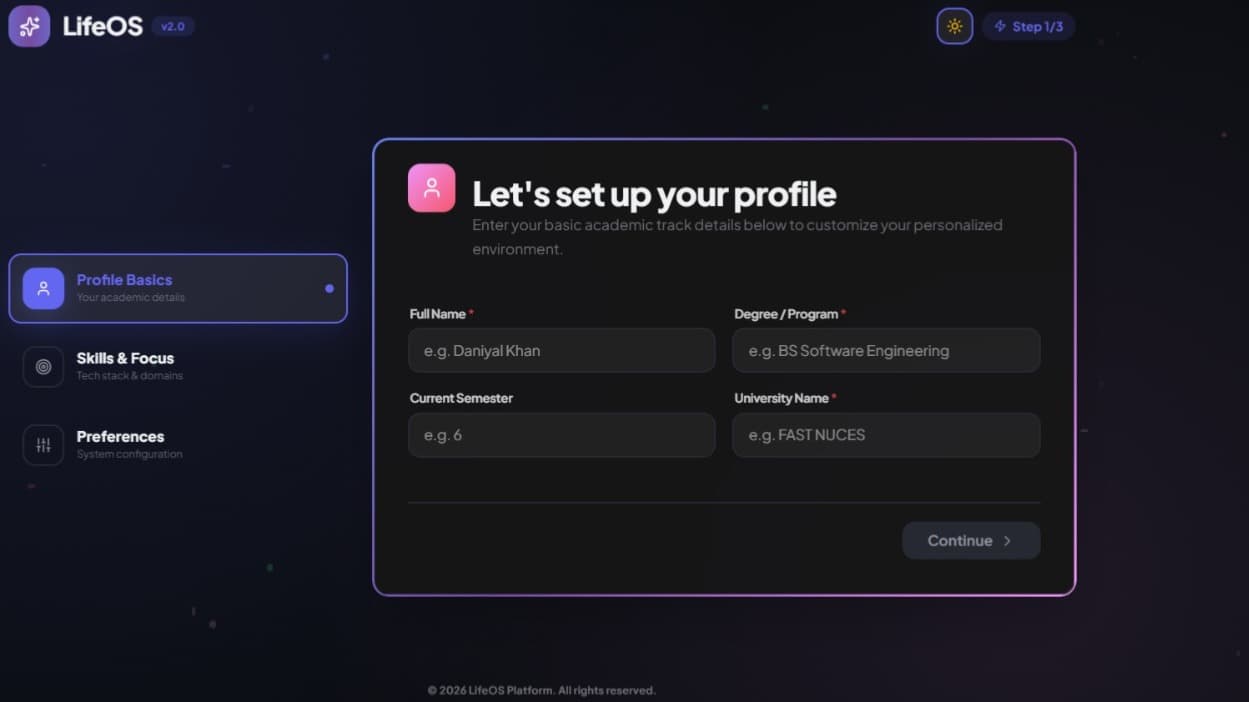
**AI LifeOS** is an AI-powered all-in-one student platform designed to simplify learning, career planning, and skill development. Many students struggle with using multiple websites and tools for studying, tracking progress, preparing for interviews, building resumes, and choosing the right career path. AI LifeOS solves this problem by bringing everything together in one intelligent platform. The platform uses artificial intelligence to create personalized learning roadmaps based on each student's goals, interests, and current skill level. It provides an AI study assistant that answers questions, explains concepts, recommends learning resources, and helps students stay on track. Students can also explore different career paths, compare opportunities, understand the skills required for each role, and receive a step-by-step plan to achieve their career goals. In addition, AI LifeOS supports project recommendations, resume building, interview preparation, skill assessment, and progress tracking. The platform continuously analyzes student performance and provides personalized suggestions to improve learning outcomes and job readiness. Our goal is to create a smart learning ecosystem where students can learn, practice, build real-world skills, and prepare for successful careersβ€”all from a single platform. By combining education, AI assistance, and career development, AI LifeOS empowers students to make informed decisions, stay motivated, and achieve their full potential.

Simple Video captioner

Simple Video captioner

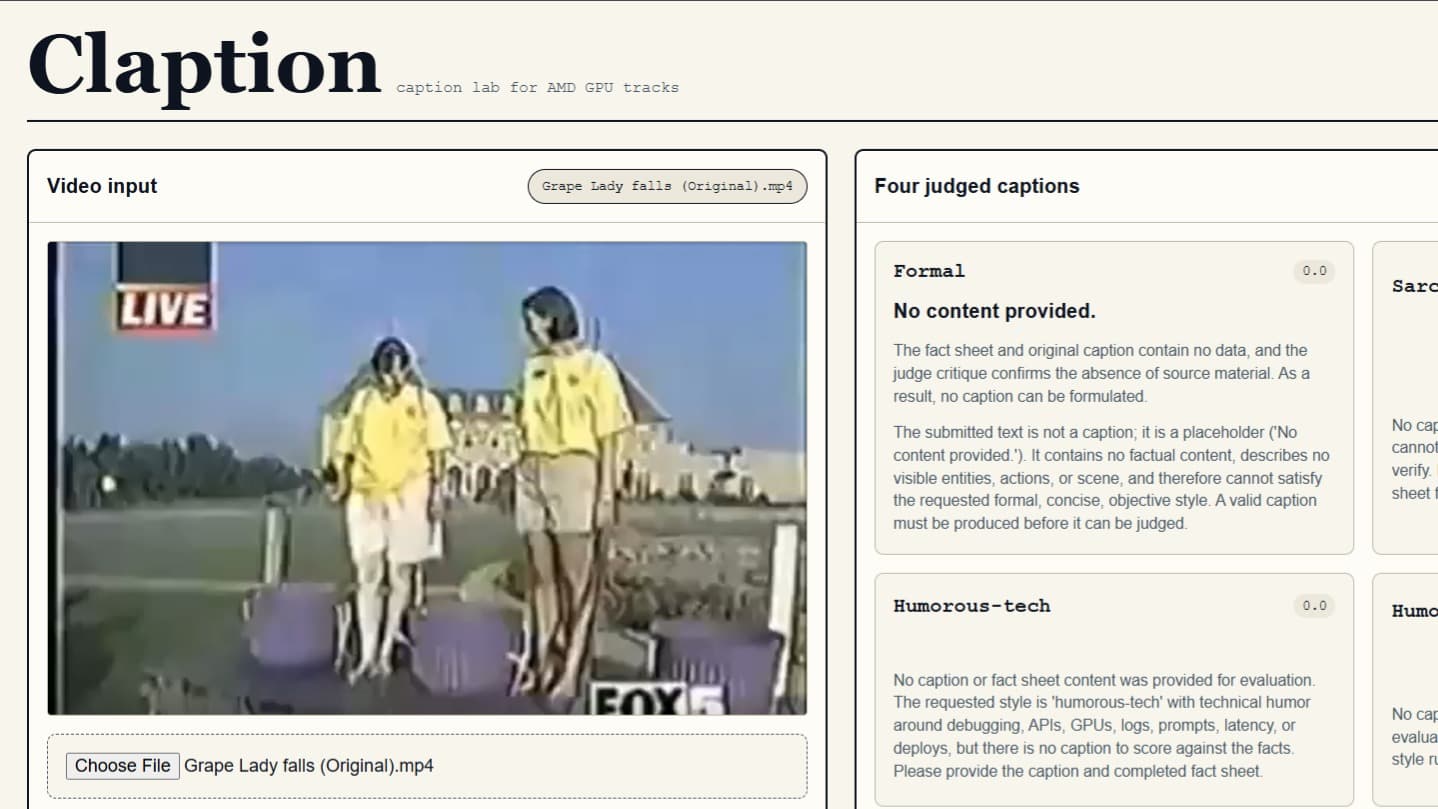
A two-stage video captioning agent, built reliability-first. Stage one samples keyframes from each clip and sends them to a vision-language model (Kimi K2.6 on Fireworks), which returns a dense, factual description β€” this is what the accuracy score is made of. Stage two turns that description into the four requested styles as a single JSON object β€” this is what the style score is made of. Splitting them means a caption can only be as accurate as what was actually seen, and the pressure to be funny never contaminates the grounding. Everything underneath is about not failing. A complete, valid results.json is written before the first network call, then each clip is atomically replaced as it finishes, so a crash or a hang still leaves a scoreable file behind. The agent enforces its own 540-second deadline and exits cleanly rather than waiting to be killed. Each stage walks a fallback ladder β€” API, then local model, then template β€” so no single failure is fatal. In testing, a real local-model outage still produced twelve valid captions with 292 seconds to spare. The local model is the part I most wanted to build. I distilled the teacher's style behaviour into Gemma 4 with LoRA on teacher-labelled examples, merged the adapter, and quantized it to a Q4_K_M GGUF β€” 5.3 GB, 2.86x smaller than bf16 β€” served by llama-server on CPU inside the container, no GPU required. It styles a clip in about 30 seconds on two cores. It ships as the fallback rather than the primary, because I measured instead of assuming. A blind, order-swapped LLM judge (n=19, minimum detectable effect +/-0.44) found the LoRA bought style (+0.61) but cost accuracy (-0.29), and the teacher still beat the student 10-3 on swap-surviving verdicts. The same judge found Q4_K_M statistically indistinguishable from bf16 β€” 4-bit quantization was free. So the distilled model earns its place by surviving an outage, not by going first.