🤝 Top Collaborators


🤓 Latest Submissions
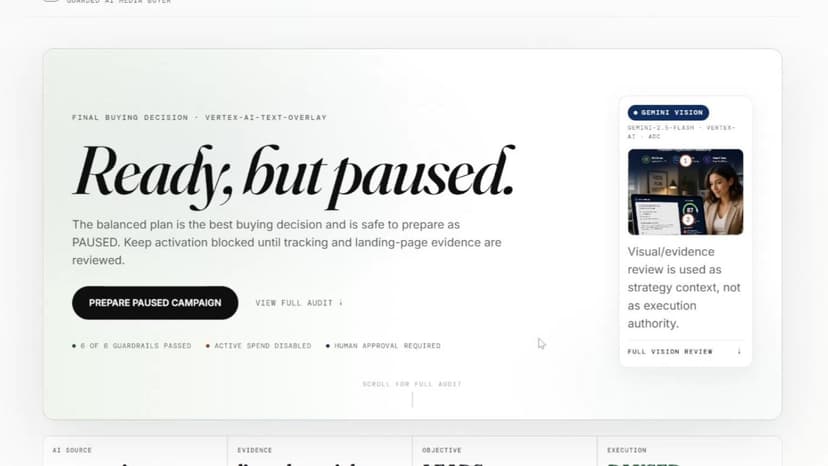
AdAudit: Guarded AI Media Buyer
AdAudit is a web-based enterprise AI agent for paid media teams. Instead of acting like a normal ad copilot that simply generates campaign ideas, AdAudit behaves like a guarded media buyer: it studies the product brief, audience, budget, landing page, and creative asset, then decides whether a campaign is safe enough to prepare. The agent collects evidence, applies paid-media playbooks, uses Gemini on Vertex AI for multimodal creative review, compares multiple Meta-style launch strategies, evaluates budget economics and delivery readiness, and then repairs unsafe plans before execution. If a creative contains risky claims such as guaranteed employment or unrealistic outcomes, AdAudit rewrites the claim into a safer proof-first angle. If the budget is too thin for too many ad sets, it consolidates the structure. If the pixel or conversion signal is not ready, it changes the objective to a safer first-flight signal. The key safety boundary is that AdAudit never creates an active campaign. Its executor only prepares Meta-compatible PAUSED campaign objects, with human approval required before any real spend. The system includes program-level causal guardrails, so safety checks are not just LLM self-reports. The app is deployed on a Vultr VM, served as a full-stack Node and React application, and integrates Google Gemini through Vertex AI Application Default Credentials. AdAudit targets real enterprise friction: AI agents can now plan and operate ad workflows, but businesses need a trustworthy layer that can research, reason, repair, and stop before money is spent. It demonstrates agentic workflows, enterprise utility, multimodal intelligence, and a production-style deployment.
19 May 2026

ASM - Agent Service Manifest for Circle x Arc
"Agents shouldn't shop. They should settle." ASM is the first open protocol that gives AI agents structured data to evaluate, compare, and select AI services — then route a sub-cent USDC payment to the winner via Circle Gateway x402 on Arc testnet, in one HTTP call. THE PROBLEM When an autonomous agent needs to call an API — translate text, generate an image, transcribe audio — it picks between providers with zero structured data. Result: blind selection, 3–10× cost overrun, non-reproducible decisions. A data problem, not a model problem. THE SOLUTION (3 LAYERS) 1. DISCOVER — Registry of 70 manifests across 47 taxonomies (LLM, image, video, TTS, embed, GPU, DB). Each declares pricing, quality, SLA, and on-chain payment address. 2. EVALUATE — TOPSIS multi-criteria engine ranks candidates by cost × quality × speed × reliability. 72% top-1 taxonomy accuracy. 3. PAY — Each /api/score call resolves a winner and settles $0.005 USDC directly to that provider's Arc address via Circle Gateway. One endpoint, N recipients, sub-second finality. REQUIREMENTS — ALL MET ✅ Per-action ≤ $0.01: $0.005 avg ✅ 50+ on-chain tx: 50/50 settled, 0 failed, 15 unique recipients ✅ Margin: off-chain authorize + on-chain batch settle. Same 50 on L1 = $25–$250 gas. ~5,000× overhead eliminated. ✅ Stack: Arc Testnet (eip155:5042002) + USDC + Circle Gateway GOOGLE TRACK Gemini 2.5 Flash drives the routing loop via Function Calling. Agent receives a task + 30 taxonomies and emits a structured select_taxonomy_and_score call that triggers Circle x402 settlement. 80% accuracy. PARTNER STACK AI/ML API as Provider 0 (google/gemma-3-27b-it) for reranking and intent parsing; Gemini Native as Provider 1. OpenAI-compatible drop-in. LIVE Demo: asm-arc-circle-2026.vercel.app Code: github.com/calebguo007/asm-arc-circle-2026 On-chain: testnet.arcscan.app/address/0xF5d426D5cdfaeB18Ea2cDec2F7c2CB88eEe6b038 MIT.
26 Apr 2026


