
Yashas Narayanan@yashasnarayanan29758
1
Events attended
1
Submissions made
India
1 year of experience
About me
I am a second year Computer Science and Engineering student at BMS College of Engineering (CGPA: 9.51/10), driven by a strong passion for problem-solving, Data Science, Machine Learning, and Quantitative Finance. In my first year, I have solved 500+ problems on LeetCode, worked on data science mini-projects, and earned industry-recognized certifications including Oracle Cloud Infrastructure. I enjoy applying theoretical knowledge into practice — whether through coding challenges, building ML models, or cloud-based implementations. My long-term goal is to combine strong foundations in algorithms and competitive programming with advanced skills in AI/ML and quantitative analysis to pursue high-impact roles in technology and quant firms. I am actively building expertise in C++, Python, machine learning libraries, and cloud platforms, while also working towards excelling in global competitions like ICPC, Kaggle, and quant hackathons. I thrive in deep work, disciplined learning, and continuous self-improvement, and I am always eager to collaborate on projects, research, and problem-solving opportunities. LeetCode Profile:https://leetcode.com/u/YASHAS1/
🤓 Latest Submissions
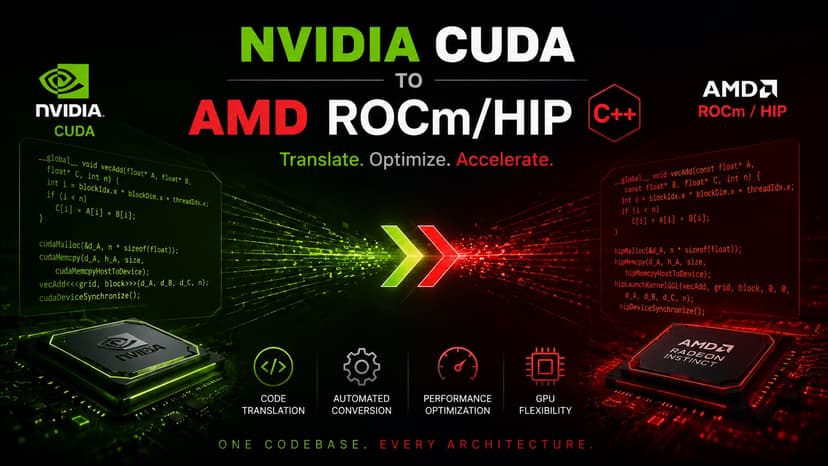
HIP-Hop: CUDA to AMD Migration Swarm
The Problem: The CUDA Lock-in For years, developers have written parallel computing and AI workloads using NVIDIA's CUDA. As AMD's ROCm ecosystem and powerful MI300X GPUs enter the market, companies want to migrate to avoid vendor lock-in and reduce compute costs. However, manually translating thousands of lines of legacy CUDA C++ into AMD's HIP (Heterogeneous-compute Interface for Portability) syntax is a massive bottleneck. It requires specialized engineers and hundreds of hours of manual code review. The Solution: HIP-Hop Swarm HIP-Hop is a multi-agent AI system built to automate the migration from NVIDIA to AMD infrastructure. Built using CrewAI, it leverages specialized agentic personas to handle the conversion pipeline end-to-end. How It Works (The Agentic Workflow): The Analyzer (Senior Architect): Scans legacy.cu files, mapping out proprietary NVIDIA APIs, memory allocations, and kernel launch syntaxes. The Translator (Migration Specialist): Uses RAG against official AMD HIPIFY documentation to accurately port the identified CUDA syntax into valid HIP C++ code. The Reviewer (QA Engineer): Validates the translation, ensures correct library imports, and generates a clean Markdown report detailing exactly what changed. By utilizing autonomous AI agents powered by a Llama 3.2 model running locally on an AMD MI300X droplet, HIP-Hop drastically reduces the friction of adopting AMD hardware, proving that intelligent workflows can solve complex enterprise infrastructure problems.
10 May 2026
