
Jose OSPINA@winsortf
winsortf
🤓 Latest Submissions
Smift
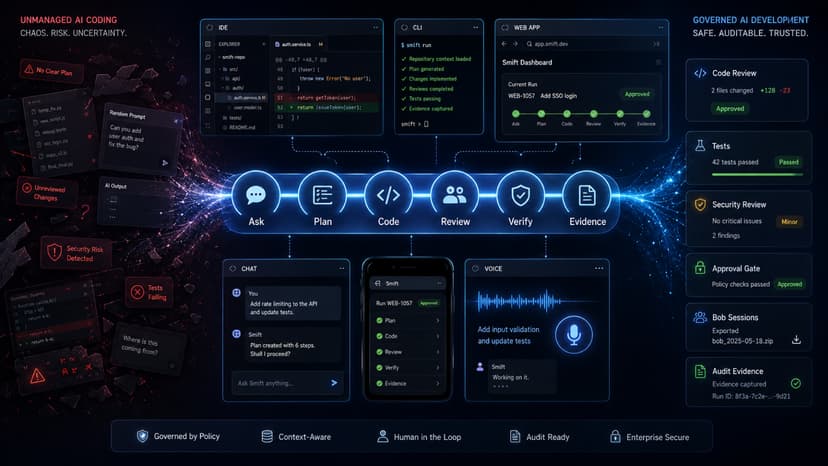
Smift turns IBM Bob into a governed AI development team that plans, codes, reviews, and proves software work across IDE, CLI, web, chat, and voice. Smift is primarily a painkiller for engineering teams that need faster delivery without losing control. It also functions as a vitamin for daily developer productivity once the governed workflow is already trusted. Main User Conflict Developers want to move quickly with AI, but unmanaged AI-assisted coding can skip planning, hide assumptions, miss security issues, and leave no evidence for reviewers or judges. Motivation Users look for Smift when they need repository-aware AI help that is not a black box. They want speed, but they also need control, reviewability, reproducible evidence, and a way to trigger work from the places they already use. Smift is a governed agentic development platform built for teams that want AI speed without losing engineering control. It uses IBM Bob as the visible development partner across the full software lifecycle: Ask mode for repository understanding, Plan mode for requirements and architecture, Code mode for scoped implementation, Review mode for quality and risk findings, Verify mode for tests and checks, and Evidence mode for exported proof. The project solves a core problem in AI-assisted development: many tools can generate code, but teams still need planning boundaries, review discipline, approval gates, test evidence, and a clear record of what the AI actually did. Smift turns IBM Bob’s repository context into safe developer action. It connects IDE, CLI, web, chat, mobile, and voice workflows through a governed architecture with workflow phases, policy checks, evidence exports, and reviewable outputs. For the IBM Bob Challenge, Smift demonstrates how Bob can improve everyday software delivery, not just by writing code, but by helping teams move from idea to planned, implemented, reviewed, verified, and auditable work.
17 May 2026
Wavf Qudit Qubic Track
WAVF Qudit: AI-Powered Smart Contract Auditing for the Qubic Network WAVF Qudit is an intelligent audit tool designed to accelerate Qubic Network adoption by making C++ smart contract development secure and intuitive. We solve the critical challenge of developer confidence by transforming security from a final hurdle into an interactive, ongoing part of the development lifecycle. Our platform connects seamlessly with a developer's GitHub or GitLab repository. At its core, WAVF Qudit's high-performance Rust backend uses the blazingly fast Groq API to power a Llama model, enabling deep analysis of C++ code. It identifies critical vulnerabilities (buffer overflows, reentrancy), checks for Qubic-specific best practices, and catches performance issues or typos. WAVF Qudit's standout feature is its interactive, conversational audit. Instead of a static report, developers see highlighted issues in their code and can use natural language to command the AI to apply suggested fixes, such as, "Apply the fix for the memory leak." The AI generates the corrected code in real-time and logs every change, creating a transparent audit trail. To enhance the ecosystem, WAVF Qudit integrates with key partners: a Coral Protocol "Watchdog Agent" to auto-audit new contracts, a Fetch.ai "Developer Reputation Agent" to build on-chain trust, and Snowflake to power an "Ecosystem Threat Intelligence Hub" with anonymized data. WAVF Qudit makes building on Qubic fundamentally safer, faster, and more collaborative.
8 Jul 2025


