.png&w=256&q=75)
🤝 Top Collaborators

🤓 Latest Submissions
MindForge AI: Mental Health Intelligence
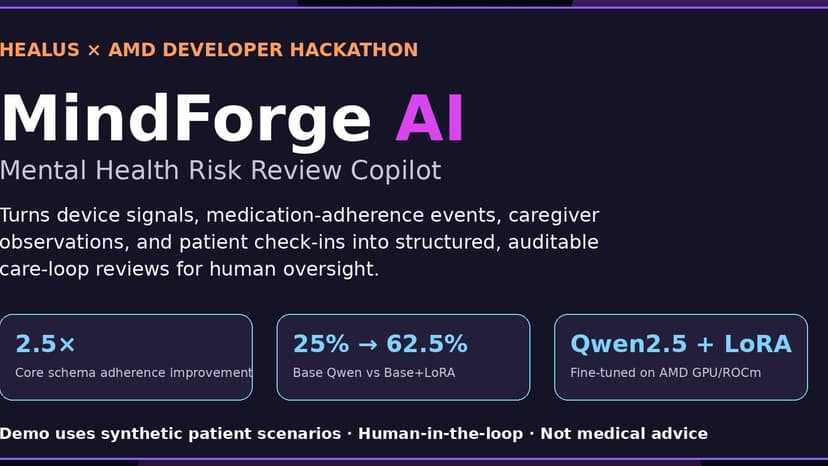
MindForge AI is a mental-health intelligence layer built from the Healus continuous-care vision. The project turns device signals, medication-adherence events, caregiver observations, and patient check-ins into structured, auditable care-loop reviews between appointments. For this hackathon, we built a working demo that analyzes synthetic mental-health scenarios and produces a structured review with risk level, risk score, medication/adherence concerns, sleep and mood flags, escalation recommendation, patient-safe response, care-team summary, missing information, and an audit-style JSON output. Technically, we used Qwen2.5-Instruct and performed LoRA supervised fine-tuning on AMD GPU infrastructure using ROCm, Hugging Face tooling, PEFT, and TRL SFTTrainer. We trained on synthetic structured chat JSONL data designed to teach the model the MindForge output contract, not generic free-form advice. We also compared Base Qwen against Base+LoRA on held-out synthetic eval cases. The LoRA adapter improved practical MindForge core-schema adherence from 25% to 62.5%, a 2.5x improvement in producing the structured care-loop output our application needs. The demo includes a schema validation and normalization layer so outputs can be made reliable, auditable, and easier to route into caregiver and clinician workflows. MindForge AI does not diagnose, prescribe, treat, or replace licensed care. The demo uses synthetic patient scenarios only and is designed as a human-reviewed intelligence workflow for continuous mental-health support between visits.
10 May 2026
