
🤝 Top Collaborators


.png&w=640&q=75)
🤓 Latest Submissions
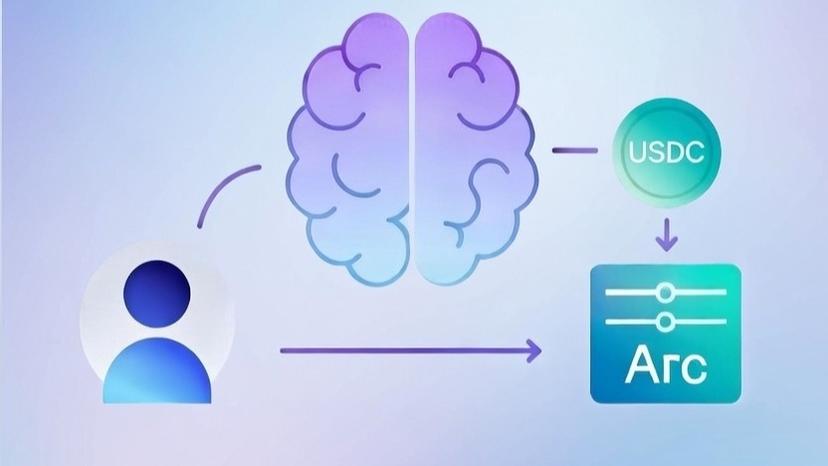
Trustless AI Agent for Pay-Per-Task on Arc
Trustless AI Agent is a demonstration of agentic commerce, showing how autonomous AI systems can transparently price tasks and settle payments in USDC on the Arc blockchain using Circle’s developer infrastructure. The project addresses a common problem in AI services: pricing trust. Users often do not know how much a task should cost, while developers struggle to implement fair, usage-based billing. This challenge becomes more important in agentic systems, where AI agents act autonomously and interact with financial infrastructure. In this system, a user submits a task through a simple frontend. The backend calls Gemini to analyze the input and classify its complexity as LOW, MEDIUM, or HIGH. Based on this classification, the AI suggests whether the task should be free or paid and proposes a USDC amount. To keep the system trustless, the AI never directly controls payments. The backend enforces deterministic guardrails using a fixed pricing table. Even if the AI output is incorrect or attempts to overcharge, the backend corrects it before any transaction occurs, ensuring predictable and auditable behavior. If payment is required, the backend executes a USDC transfer using Circle Developer-Controlled Wallets, settling the transaction on Arc Testnet. Wallet balances can be queried to verify that funds were transferred correctly, demonstrating real onchain settlement. Circle Product Feedback This project uses Arc Testnet, USDC, and Circle Developer-Controlled Wallets. Circle Wallets enable secure, programmable wallet management suitable for autonomous agents, while USDC provides stable pricing for pay-per-task models. Wallet creation, balance checks, and transfers worked well. The main challenge was limited Arc-specific end-to-end examples. More agent-focused reference implementations would improve the developer experience.
24 Jan 2026
AI Onboarding Agent
1️⃣ Purpose of the AI Onboarding Agent Your AI agent is designed to replace repetitive manager tasks when onboarding a new employee. Traditionally, a manager must: Welcome the employee Explain company rules, culture, and policies Introduce tools and accounts (email, Slack, project tools) Schedule meetings with team members Provide checklists and first-week plans Answer all onboarding questions This takes hours per new hire, is repetitive, and sometimes inconsistent. The AI agent automates all of this, acting like a virtual manager that works 24/7. 2️⃣ How It Works Step 1: Collect Employee Info From the frontend form, the AI agent receives: Name Role Department Manager Start date This information is enough for the agent to generate a personalized onboarding experience. Step 2: IBM watsonx Orchestrate Integration The AI agent calls a pre-built workflow in Orchestrate. The workflow handles: Generating a welcome message Creating a role-based onboarding checklist Scheduling introductory meetings Preparing Slack/Teams introduction messages Providing documents, tool instructions, and first-day plans Orchestrate links all these tasks in a chain, so everything happens automatically without manual intervention.
23 Nov 2025
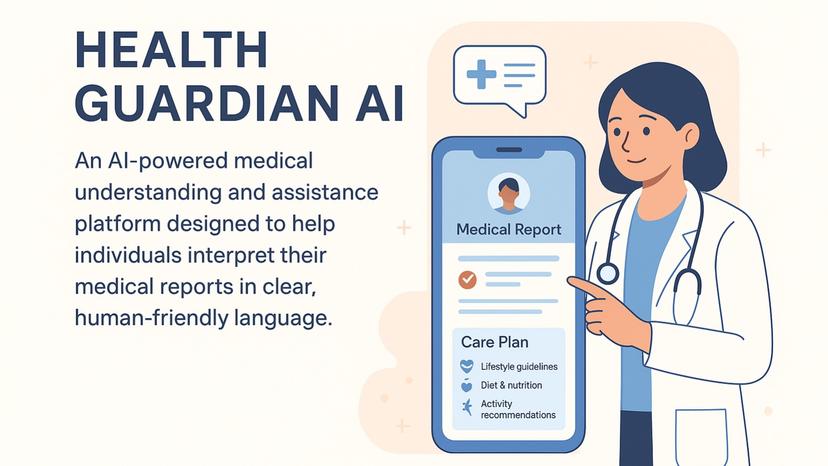
Health Guardian AI
Health Guardian AI is an AI-powered medical understanding and assistance platform designed to help individuals interpret their medical reports in clear, human-friendly language. Many patients receive lab results and diagnostic files full of medical terminology that can be confusing, stressful, or misinterpreted. Our application enables users to upload text or image-based medical reports, automatically extract and analyze content, detect key medical findings, identify associated risk levels, and present results in a simplified and structured format. The platform also generates personalized care plans, covering lifestyle guidelines, diet and nutrition, activity recommendations, and medical follow-up reminders, while clearly stating non-diagnostic safety disclaimers. It further offers an interactive AI health chat assistant trained to provide supportive and educational responses and guide users toward proper medical consultation when needed. Our mission is to empower users with medical awareness, reduce misunderstanding and anxiety, bridge the communication gap between patients and healthcare providers, and assist with informed health discussions, all while maintaining privacy, accuracy, and ethical responsibility.
19 Nov 2025


