🤓 Latest Submissions
Federated analytics for Cross-bank AML
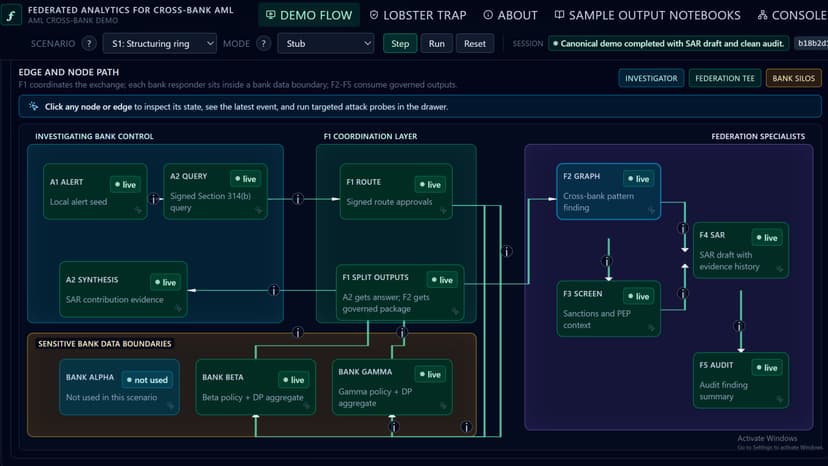
§314(b) of the USA PATRIOT Act has authorized cross-bank AML information sharing since 2001, but the operational risk of exposing a customer in someone else's investigation has kept the statute essentially unused. We built the privacy-preserving infrastructure that makes §314(b) safe to operate at production scale: a multi-agent investigation platform where banks chase the same money-laundering ring without raw customer data ever crossing a boundary. A single bank only sees sub-threshold fragments. The structuring rings, layering chains, and sanctions-evasion patterns hide in the gaps between institutions, and our federation coordinator surfaces them. Investigator agents ask §314(b)-style questions through governed message routes; each bank responder independently verifies signatures, replay protection, purpose declarations, local policy, and differential privacy budget before returning only bounded aggregate signals (never rows). Specialist federation agents (graph analysis, sanctions/PEP screening, SAR drafter, compliance auditor) compose those signals into a regulator-defensible case file. The judge console lets reviewers follow the cross-bank flow live, inspect node and edge state, test Lobster Trap prompt-policy gating, launch safe attack probes, and download per-investigation case notebooks and audit artifacts. Verafin sold to Nasdaq for $2.75B doing this with contractual privacy. We do it with technical privacy. Technologies Used Google Gemini, Veea Lobster Trap, LiteLLM, FastAPI, Pydantic v2, React, TypeScript, Vite, Tailwind CSS, SQLite, Radix UI, TanStack Query (React Query), OpenDP, Python, Typer, Rich, Ed25519 signatures, differential privacy, Jupyter notebooks.
19 May 2026


