.png&w=256&q=75)
🤝 Top Collaborators
.png&w=640&q=75)
🤓 Latest Submissions
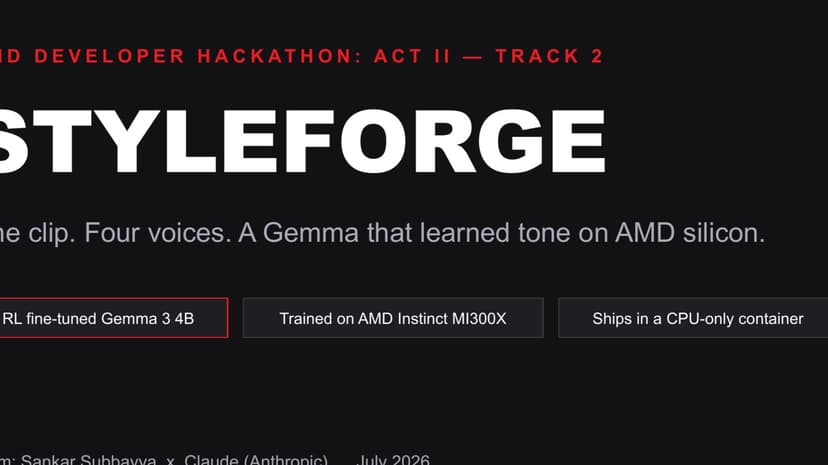
StyleForge — Four-Style Video Captioner
StyleForge captions video clips in four styles (formal, sarcastic, humorous_tech, humorous_non_tech) with a three-stage pipeline: Kimi K2.6 vision (via Fireworks AI) watches the clip and writes a dense factual description; a Gemma 3 4B — DPO-fine-tuned on AMD Instinct MI300X and quantized to run on CPU inside the container — writes candidate captions; an LLM judge reranks candidates per style. The RL story: we built a 1,200-cell training factory (300 synthetic scenes × 4 styles × 6 candidates, all judge-scored), then ran two measured DPO rounds on a single MI300X (~8 minutes each). Round 1 lifted sarcastic tone +0.54 over base; after inspecting failures we rebuilt preference pairs accuracy-weighted, and round 2 lifted formal +0.50 — bringing the 4B to exact parity with the ~1T-class frontier model on factual accuracy (7.62 vs 7.62 on our independent-judge eval). We ship the mode that measured best (best-of-N) and the tuned Gemma rides in-container as a zero-dependency fallback voice. Engineering for the 10-minute wall: a schema-valid results.json is written at startup and atomically upgraded per task; three-tier degrade (best-of-N → single-shot → fallback captions) means dead URLs, API outages, or malformed tasks never zero the run. The 3 example clips complete in 33 seconds. Built by a two-member team (Sankar Subbayya × Claude) on AMD Developer Cloud (ROCm 7.2.4), Fireworks AI, and Google DeepMind Gemma.
12 Jul 2026
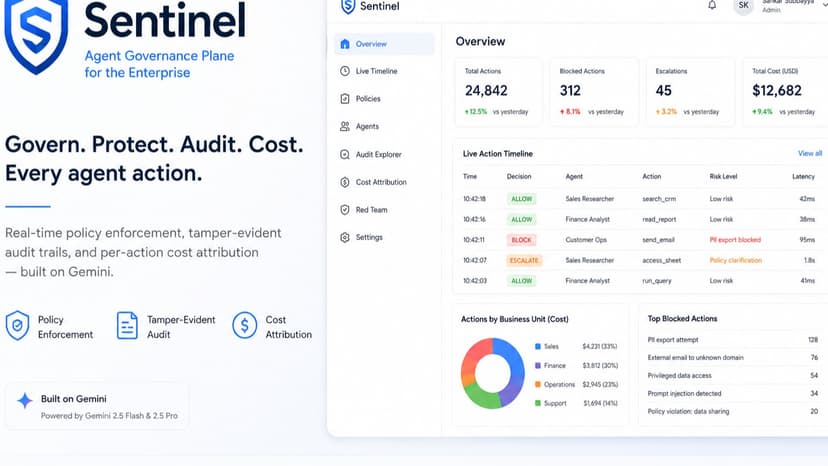
Agent Sentinel — Governance Plane for AI Agents
Enterprises deploying AI agents face three production blockers: no audit trail, no policy enforcement, no cost accountability. Agent Sentinel solves all three. Drop Sentinel in front of any MCP- or A2A-speaking agent. Every tool call passes through a four-stage pipeline: a sub-5ms static engine (regex denylists, role ACL, refund caps), a cheap drift detector for prompt-injection markers, an inline Gemini 2.5 Flash gate with structured output, and — for the ambiguous 20% — Gemini 2.5 Pro escalation that reads whole policy documents via Cached Content. No chunking, no RAG drift. Each decision becomes a hash-chained, HMAC-signed audit receipt that cites the exact policy version. The same loop emits a per-business-unit cost event for chargeback. Sentinel also publishes its own Google A2A agent card at /.well-known/agent.json so peer agents can discover the governance plane. Verified end-to-end with real Gemini: 96.8% accuracy across 155 labeled scenarios spanning 12 categories (happy path, PII variants, injection variants, role matrix, regulatory, edge cases, drift); 88 passing pytests; INTEGRITY: PASS on the hash-chained ledger after a tamper-injection test; 5,000 receipts load-tested at 800 req/s with zero chain breaks. Live at https://agent-sentinel.up.railway.app. Three buyers, one architecture: compliance officers get queryable evidence with cited policy versions, CISOs get inline enforcement plus prompt-injection defense, CFOs get per-BU cost attribution. Built end-to-end on Google's stack — Gemini 2.5 Flash + Pro, Cached Content, Files API, A2A, and a flagship adapter for Google ADK. Cloudflare for AI agents.
19 May 2026
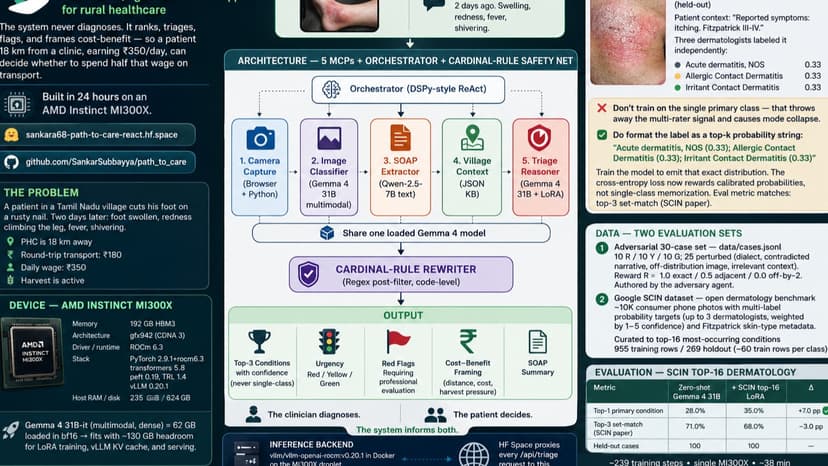
path_to_care
Path to Care is a multimodal, agentic decision-support system for rural healthcare — built in 24 hours on one AMD Instinct MI300X. A patient 18 km from the clinic, earning ₹350/day, faces ₹180 transport, an active harvest, and a swelling foot. Should he go? The system never tells him what's wrong — it helps him decide. **Cardinal rule (enforced in code).** Always "signs suggest", never "you have." Image output is always **top-3 with confidence** — single-class is impossible by construction. A regex post-filter rewrites diagnostic phrasing on every output, logged for audit. **What it does.** (1) Ranks skin conditions as top-3 + confidence; (2) assigns Red/Yellow/Green urgency; (3) flags red signs; (4) frames cost-benefit using local barriers (distance, wage %, harvest, drug-stock). Output: patient brief + pre-visit SOAP. **Architecture.** Five MCPs orchestrated by a DSPy-style ReAct loop: `camera_capture`, `image_classifier`, `soap_extractor` (Qwen-2.5-7B), `village_context`, `triage_reasoner`. Image-classifier and triage-reasoner share one loaded **Gemma 4 31B-it**. **Serving.** MI300X 192 GB, ROCm 6.3. `vllm/vllm-openai-rocm:v0.20.1` Docker, base + LoRA served simultaneously via `--enable-lora`. HF Space (Next.js/React) proxies every triage request to the droplet. **Fine-tuning.** LoRA on Google's SCIN dermatology dataset (top-16 conditions, top-k probability targets): **top-1 28.0% → 35.0% (+7.0 pp)** on a 100-case holdout. First positive delta after 3 documented failures — lesson: per-class samples > epochs. MedGemma 27B baseline scored 3 pp worse than Gemma 4 31B. **Frontend.** Patient / Clinician / Audit tabs · browser camera · Web Speech voice dictation · audit panel showing every MCP tool invocation. **v2.** Village fieldwork · 80-case set · physician review · Fitzpatrick-stratified bias audit · Tamil UX · GRPO/RLVR. 🤗 sankara68-path-to-care-react.hf.space · 💻 github.com/SankarSubbayya/path_to_care
10 May 2026

Midstream
Midstream solves a critical problem in AI: users pay upfront for output regardless of quality. Whether a research run drifts, code breaks, or an image is off-prompt, you've already paid full price. This wastes 30–70% of AI spending annually. Our solution: quality-gated streaming payments. The LLM generates output in 32-token chunks at $0.0005 each. Between chunks, the buyer's quality oracle (LLM, compiler, CLIP, etc.) assesses whether to continue paying. If quality drops below threshold, the buyer stops authorizing, the stream ends, and they pay only for the prefix that passed. We've built a working MVP on Circle Nanopayments + Arc testnet. Circle's batching achieves <1% overhead per chunk—impossible on Stripe ($0.30 minimum, 60,000% overhead) or Ethereum ($0.30 gas). Our demo shows: - Session 1: Full run, 31 chunks, $0.0155 - Session 2: Quality drop at chunk 13, killed, 60% saved - Session 3: Rapid drift at chunk 4, killed, 87% saved - Session 4: Compiler catches broken code at chunk 9, killed, 68% saved Total: 58 chunks paid, $0.0290 spent (vs. $0.0620 full run) = $0.0330 saved. We've verified 213 Circle Transfer UUIDs settled on Arc testnet via Circle Gateway batching. Every settlement is clickable on testnet.arcscan.app. The architecture is oracle-agnostic: works with any quality signal (text, code, image, video, schema validation, etc.). This is a platform, not a one-off.
26 Apr 2026


