.png&w=256&q=75)
🤓 Latest Submissions
EarningsPilot AMD
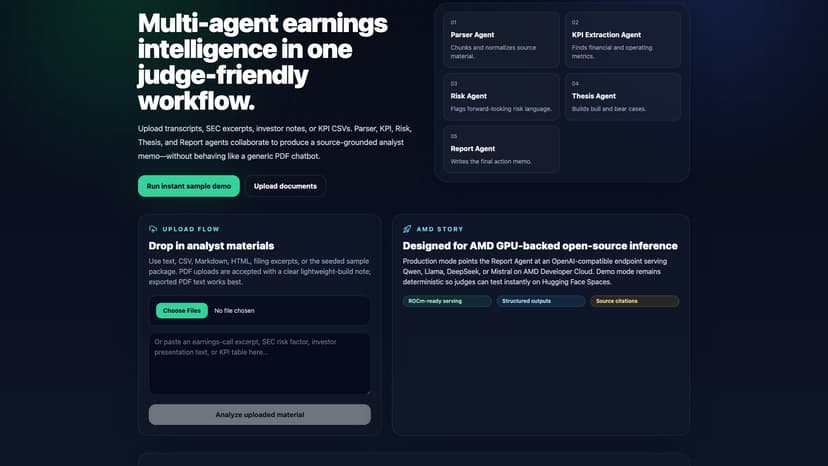
Financial analysts and researchers are currently drowning in a flood of unorganized financial data, ranging from quarterly earnings transcripts and SEC filings to complex investor presentations. Extracting actionable insights like key performance indicators, forward-looking risk factors, and balanced investment theses is an incredibly labor-intensive and error-prone process. Current AI tools often suffer from hallucinations and a lack of source-grounded evidence, making them unsuitable for high-stakes institutional research. EarningsPilot AMD solves this by deploying a high-performance, multi-agent pipeline designed to automate the complete research workflow. Our multi-agent architecture includes: Parser Agent: Normalizes and chunks massive, disparate document types (PDFs, CSVs, transcripts). KPI Extraction Agent: Precisely identifies and normalizes financial metrics with direct source citations. Risk Agent: Detects forward-looking risk flags and categorizes them by severity. Thesis Agent: Synthesizes balanced Bull vs. Bear cases based solely on grounded evidence. Report Agent: Synthesizes the final dashboard-ready executive memo. To meet the rigorous demands of professional finance, we leveraged the AMD Developer Cloud and the ROCm ecosystem. We fine-tuned an EarningsPilot-Qwen-7B-LoRA adapter on 15 hours of MI300X compute time to ensure high-fidelity structured JSON output. By deploying this on a ROCm-optimized vLLM stack, we achieved inference speeds that turn minutes of manual analysis into seconds of automated intelligence. Our system provides a deterministic fallback mode for reliability during public demos, while the primary AMD-backed path delivers the scale and performance institutional investors require. EarningsPilot AMD represents a shift from "chatting with PDFs" to an actual agent-driven investment research workflow, grounded in verifiable source evidence and accelerated by industry-leading AMD hardware.
10 May 2026
ArcTask
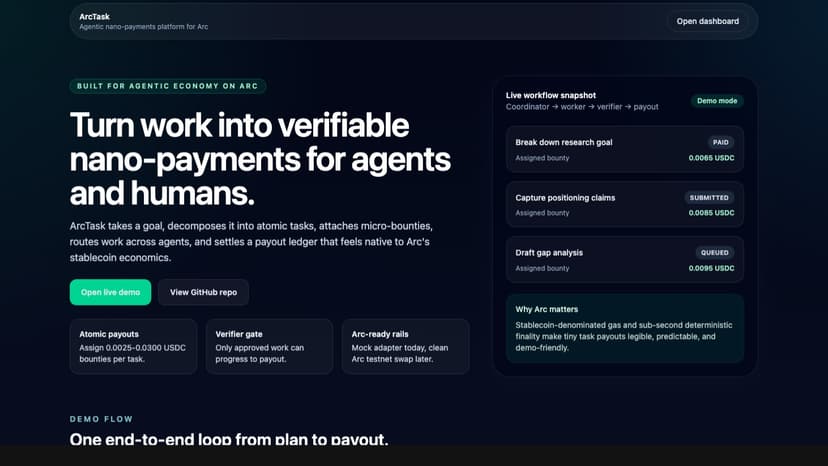
ArcTask is a demo-first platform for the Agentic Economy on Arc. A user submits a goal such as competitor research, campaign planning, or a workflow brief. The coordinator agent decomposes that goal into atomic work packages, assigns each task a priority and a USDC-denominated micro-bounty, and routes it through a visible workflow: queued, in progress, submitted, verified, and paid. The core idea is that agentic systems should not hide all value transfer inside one black-box request. In ArcTask, every unit of work becomes economically legible. Worker agents generate outputs, a verifier reviews them, and only approved work can release a payout receipt into the ledger. This makes accountability, task status, and economic flow understandable in one screen. The current hackathon build is optimized for a reliable live demo. It uses Next.js, TypeScript, Tailwind, server-side AI routes, seeded demo scenarios, browser-persisted workflow state, and a payment adapter abstraction. For stage reliability, the shipped prototype settles server-side demo receipts rather than claiming live onchain settlement, but the payout layer is intentionally structured so a real Arc and Circle-backed settlement adapter can replace the mock path cleanly. ArcTask is therefore both a polished demo and a credible architecture for software-native labor markets powered by nano-payments.
26 Apr 2026


