.png&w=256&q=75)
🤝 Top Collaborators

🤓 Latest Submissions
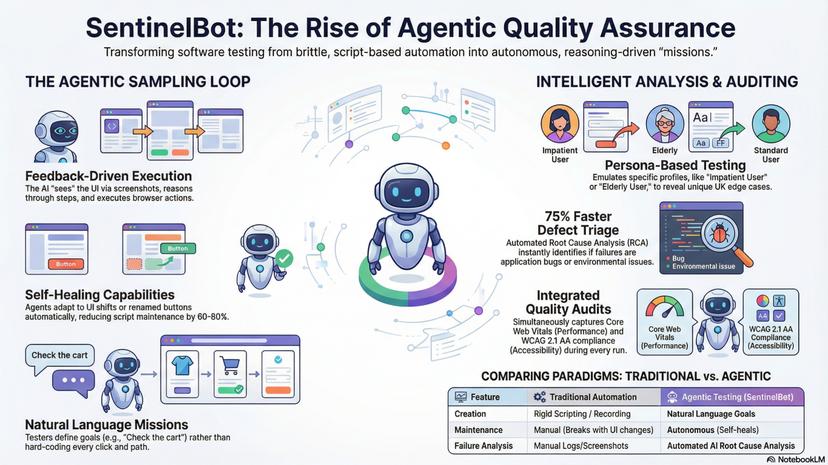
SENTINEL BOT - Autonomous QA Testing
SentinelBot addresses a fundamental limitation of traditional QA: brittle automation scripts and manual testing processes that fail to scale with modern, fast-moving web applications. Conventional test suites require constant maintenance, break with minor UI changes, and struggle to simulate real user behavior. SentinelBot replaces this approach with AI-driven, agentic testing that adapts dynamically as applications evolve. Instead of relying on predefined test cases, SentinelBot combines AI-based reasoning with Playwright browser automation to explore applications autonomously, making context-aware decisions about what to test next. The platform simulates multiple user personas including first-time users, elderly users, impatient users, and adversarial users to uncover usability issues, accessibility violations, performance regressions, and security edge cases that scripted tests and human testers frequently miss. Each test run navigates real workflows end-to-end, captures high-resolution screenshots and session videos as evidence, measures performance and accessibility metrics, and categorizes issues by severity with contextual root-cause analysis. SentinelBot also addresses a major pain point in QA automation: flaky tests. It intelligently detects unreliable failures, automatically re-runs critical scenarios, and validates results to distinguish genuine bugs from transient issues such as network instability. SentinelBot is built as a modular, production-ready system consisting of a React-based dashboard, a FastAPI backend, Supabase database and a scalable autonomous test runner. It supports continuous monitoring, historical regression detection by comparing results across runs, and real-time Slack alerts for critical issues. By reducing false positives, minimizing manual QA effort, and catching regressions early, SentinelBot enables engineering teams to ship higher-quality software faster and with greater confidence.
7 Feb 2026
