.png&w=256&q=75)
🤝 Top Collaborators


🤓 Latest Submissions
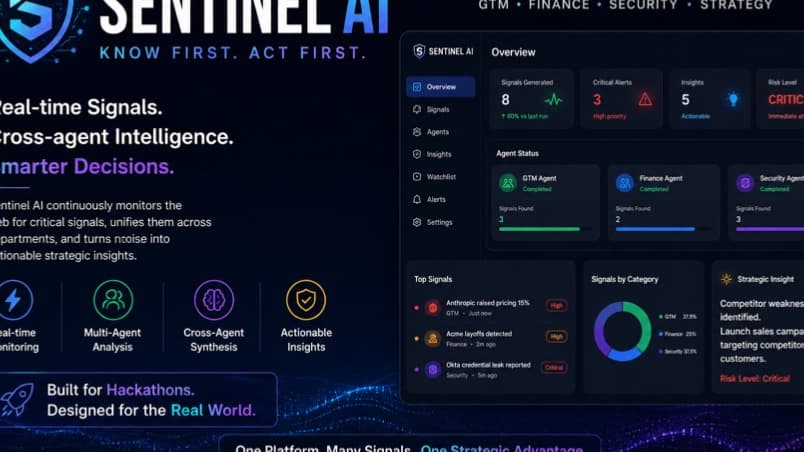
Sentinel AI — Unified Multi-Agent Intelligence
Sentinel AI is a sophisticated 24/7 autonomous platform designed to unify multi-agent intelligence for sales, finance, and security teams. This innovative system continuously monitors the web, providing crucial insights and automatically alerting the relevant teams when significant events occur. It addresses the common problem of companies spending over $13,500 per month on more than five siloed tools that fail to communicate with each other. Sentinel AI aims to replace these fragmented solutions, offering a more cost-effective alternative at $500 per month while effectively connecting the dots between different data streams. The platform's architecture is built around specialized agents: a GTM (Go-to-Market) Agent, a Finance Agent, and a Security Agent, each leveraging Bright Data for data acquisition and Featherless AI for open-source model inference tailored to their specific tasks. For instance, the GTM agent uses Mistral-7B for entity extraction, the Finance agent employs Phi-3-mini for numerical reasoning, and the Security agent utilizes Llama-3-8B for threat categorization. These agents feed into a powerful Cross-Agent Synthesis Engine, powered by Claude Opus and Cognee for agent memory, which identifies non-obvious cross-domain correlations that would be missed by individual tools. Sentinel AI's capabilities extend to automated workflows triggered by its insights. High-severity GTM signals can be pushed to the CRM with talking points, a churn score above 60 triggers Customer Success alerts and retention playbooks, and critical security events generate incident tickets and customer notifications. platform integrates deeply with partner technologies, utilizing all five Bright Data tools for various scraping and unlocking needs, Featherless AI for efficient open-source model hosting, Cognee for building a robust knowledge graph of signals, and TriggerWare for orchestrating automated workflows. /
31 May 2026

SAGE IDE — Adversarial Multi-Agent Code Engine
SAGE IDE is a browser-native AI coding environment built on one radical premise: code quality improves when AI systems argue. Unlike single-agent assistants, SAGE deploys four specialized agents into a live adversarial boardroom. The Architect designs. The Implementer builds. The Synthesizer integrates. The Red-Team attacks — mid-stream, without waiting for a review phase. A challenge bar fires in real time, quotes the vulnerable excerpt, and assigns a severity tag (Critical/High/Medium/Low) with CVE reference. The Nash Crucible then aggregates agent votes, detects equilibrium, and locks the final output as a signed, immutable Artifact. The adversarial layer is the core innovation, not an added feature. Every agent has a permanent seat and the authority to interrupt others mid-stream. The boardroom is the interface — not a sidebar, not a chat panel. Agents generate structured Artifacts (Design Plans, Diffs, Challenge Reports, Locked Outputs) that are reviewable, commentable, and auditable. Built on AMD Instinct MI300X via ROCm: four co-resident Qwen/Llama models sharing 184 GB VRAM through vLLM, locked into dedicated memory regions per agent. Backend: FastAPI + LangGraph (7-node graph) + Celery + Redis for async agent parallelism. Frontend: React + Monaco Editor with live WebSocket streaming and gutter attribution marks per agent. CPU fallback (sage-free) validated for non-GPU environments. Benchmarks: +12.4% HumanEval+, +8.2% SWE-Bench-Lite over single-agent baseline. Better process, not a bigger model. What ships: LangGraph multi-agent engine, WebSocket layer, React IDE with Monaco, Agent Boardroom with live challenge bars, Nash Crucible, and full Artifact system — demonstrated end-to-end, no mocks. GitHub: github.com/realruneett/Sage
10 May 2026


