.png&w=256&q=75)
Vivek Raj Singh@rajvivek04
rajvivek04
🤓 Latest Submissions
ARGUS: Pre-Action Authorization for Clinical AI
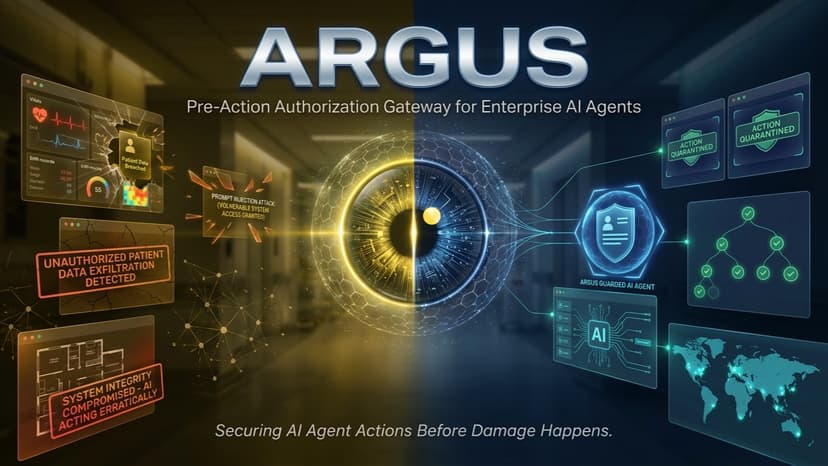
Clinical AI agents have moved past answering questions. They now read patient records, draft discharge summaries, and write back into the EHR with real authority. Tools exist to inspect the incoming prompt, but targeted verification of the outgoing actions, specifically for a clinical context, does not. ARGUS closes that gap by implementing safe healthcare disclosure logic for discharge agents. A discharge agent is supposed to send PHI outside the hospital. The next treating physician needs it. An insurer may be entitled to it by legal basis or by the patient's own authorization. Telling a legitimate disclosure apart from an exfiltration of the same data to the same external address is a HIPAA judgement, not a domain check. An example attack ARGUS prevents: an agent imports a file while preparing a patient's discharge records. Its free-text body carries an instruction a human never sees. The prompt looks clean, so every prompt-layer filter passes it. The agent, now manipulated, tries to send that patient's discharge data to an outside address. ARGUS works at the action layer. When a clinician gives an instruction, ARGUS turns it into a structured intent manifest using Gemini Flash. Veea Lobster Trap then inspects each proposed action, extracting the PHI involved, the authorized recipients, and a risk score. ARGUS ships with a predefined clinical policy engine that a hospital can extend with its own rules. Gemini Pro explains any blocked action in plain language and points to why it was unsafe to execute. Every decision lands in an immutable audit trail.
19 May 2026
ROCm Forge: 9-Agent CUDA to AMD Migration Engine
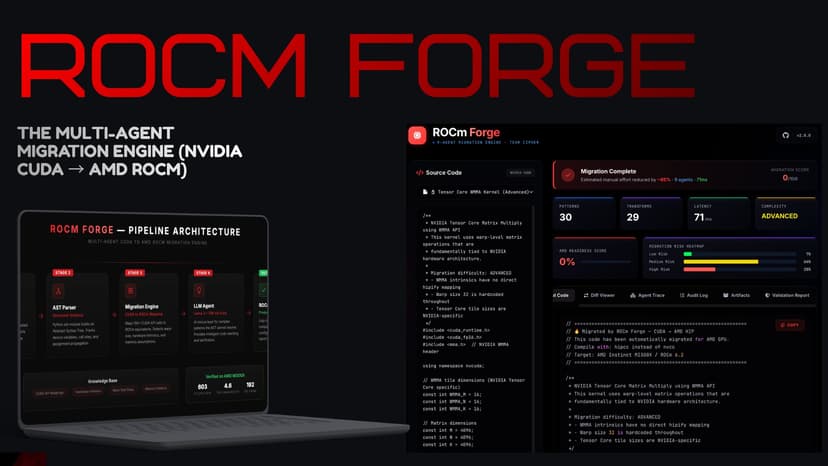
The main hurdle to the widespread adoption of AMD GPUs (such as the MI300X) is not the hardware itself, but the huge ecosystem of AI workloads that are hardcoded to NVIDIA’s CUDA. Moving these codebases to AMD’s ROCm is notoriously difficult. Simple python scripts may just need a regex find and replace. Enterprise grade AI infrastructure calls for deep architectural translation. Introducing ROCm Forge, Team Cipher’s compiler-level, 9-Agent AI Copilot that automates the most difficult parts of CUDA-to-ROCm migration. Unlike the simple hipify scripts or black-box LLMs that hallucinate code, ROCm Forge is based on a deterministic multi-agent architecture: Hardware-Aware Scanner: Identifies implicit hardware assumptions that may lead to silent mathematical failures (e.g., hardcoded Warp Size 32 vs. AMD's 64-wide wavefront). Build Error Copilot: Scans code proactively against a run book of common ROCm build errors, suggesting required libraries automatically before compilation fails. AST Refactorer: Safely maps CUDA APIs, Dockerfiles and dependencies to their ROCm 6.2 equivalents, rating each change as Safe, Review or Manual. Health Monitor: Quantifies drift as an AMD Readiness Score and visualises in a Risk Heatmap. Deployer Agent : Generates deployment-ready artefacts optimised for the AMD Developer Cloud. We even take on the “Final Boss”: translating low-level C++ Tensor Core kernels (NVIDIA WMMA intrinsics) directly to AMD Matrix Cores. An integrated AI explainer (Llama 3.1 via Groq) delivers human-readable insights into every transformation, and developers trust the process. ROCm Forge uses compiler-level analysis and explainable AI to reduce migration effort by an estimated 65%. It doesn’t just replace strings. It saves engineers days of debugging hardware-level compiler errors, dramatically accelerating the adoption of the AMD AI ecosystem.
10 May 2026


