.png&w=256&q=75)
🤝 Top Collaborators

.png&w=640&q=75)

.png&w=640&q=75)
🤓 Latest Submissions

PulseIntel — Enterprise Web Intelligence Platform
PulseIntel is a dual-track enterprise web intelligence platform built for modern security and revenue teams. Every company has two critical blind spots. First, competitors are quietly hiring machine learning engineers and fraud analysts — revealing their next product move months before any announcement. Nobody has time to read thousands of job postings and connect the dots manually. Second, phishing pages, fake domains, and credential dumps appear on the open web daily. Security teams find out only after customers start complaining because internal tools cannot monitor what lives outside the firewall. PulseIntel solves both problems with one unified platform. Track 1 — GTM Intelligence: Enter any company name and PulseIntel uses Bright Data MCP Server to scrape job postings across LinkedIn, Greenhouse, Lever, and company career pages in real time. Groq AI running LLaMA 3.3 70B analyzes the hiring patterns and generates a structured competitive strategy brief — what the company is building, which departments are growing, which competitors should be concerned, and an expected timeline. Track 3 — Security and Compliance: Enter any brand name and PulseIntel scans paste sites, social media, and the open web for brand mentions using Bright Data MCP Server. Groq AI scores each finding by risk level from 1 to 10 and categorizes threats as phishing, credential leak, lookalike domain, or impersonation. Each alert includes a recommended action for the security team. The entire data pipeline runs on Bright Data MCP Server which bypasses bot detection, handles JavaScript rendering, and returns clean markdown directly consumable by the AI layer. The dashboard is built on Streamlit with a dark enterprise aesthetic, real-time metrics, and risk-level filtering. PulseIntel was built in 4 days by WeCoders for the Web Data UNLOCKED Hackathon 2026.
31 May 2026
TaskMiner_AI
Managing multiple tasks without clear priorities is one of the most common yet underestimated challenges in software development and project management. When deadlines overlap, dependencies are unclear, and sprint planning is done manually, teams lose valuable time to decision paralysis and avoidable blockers. The Task Input & Storage System was built to eliminate exactly that friction. Built with Python, Streamlit, and JSON, this tool provides a clean and intuitive interface for capturing, organizing, and prioritizing tasks from a single place. Each task stores rich metadata — including title, description, priority level, status, estimated effort, labels, dependency IDs, and notes — ensuring nothing important is ever lost or ambiguous. The system supports full CRUD operations and lets users search and filter tasks by priority, status, or keyword. Every change is auto-saved to a local JSON file, keeping the setup lightweight with zero database overhead. Where the system truly stands out is its Bob AI Integration. Users can export their entire task list as structured, LLM-ready text that captures all metadata and relationships. This export is then analyzed by Bob, a custom Task Prioritizer AI mode, which returns four types of actionable intelligence: dependency mapping to understand what blocks what, step-by-step execution order recommendations, proactive risk and blocker identification, and automated sprint planning that groups tasks into logical delivery phases. Bob also generates color-coded visual flow diagrams as PNG files, giving teams an instant overview of their workload. Getting started requires just three commands — install, launch, and export. The codebase is modular and well-structured, making it easy to extend or integrate into existing workflows. Future plans include native integrations with Jira, GitHub Issues, and Linear, along with team collaboration features and a mobile app. Stack: Python 3.9+ · Streamlit 1.32.0 · JSON · Bob AI
17 May 2026
Acumen AI - Business Intelligence Reinvented
Acumen AI addresses complex AI integration barriers preventing organizations from accessing advanced conversational AI due to technical complexity and expensive infrastructure. Our solution democratizes AI through an intelligent platform combining Groq's high-performance inference, Llama-3.3-70b-versatile model, MCP agents and Streamlit interface deployed on Vultr’s cloud server. The 4-layer architecture features asynchronous processing, persistent memory, and advanced error handling, enabling natural language conversations with 10-step reasoning capabilities. Users interact through a responsive web interface, initializing AI agents, engaging in real-time conversations, and managing memory without technical expertise. The Total Addressable Market (TAM) for conversational AI reaches $32.6 billion globally, with our Serviceable Addressable Market (SAM) targeting $8.4 billion in enterprise AI assistants. Revenue streams include SaaS subscriptions, API usage fees, premium features, white-label licensing, and consulting services. Unlike competitors such as ChatGPT Enterprise or Microsoft Copilot, Acumen AI offers open-source flexibility, superior MCP agent reasoning, cost-effective Groq infrastructure, and specialized conversational AI focus rather than general-purpose tools. Future prospects include horizontal scaling, knowledge base integration, multi-modal capabilities, and vertical-specific solutions, positioning Acumen AI as a foundational platform for next-generation accessible conversational systems.
8 Jul 2025
Aleph-Tav Healthcare Safety Agentic
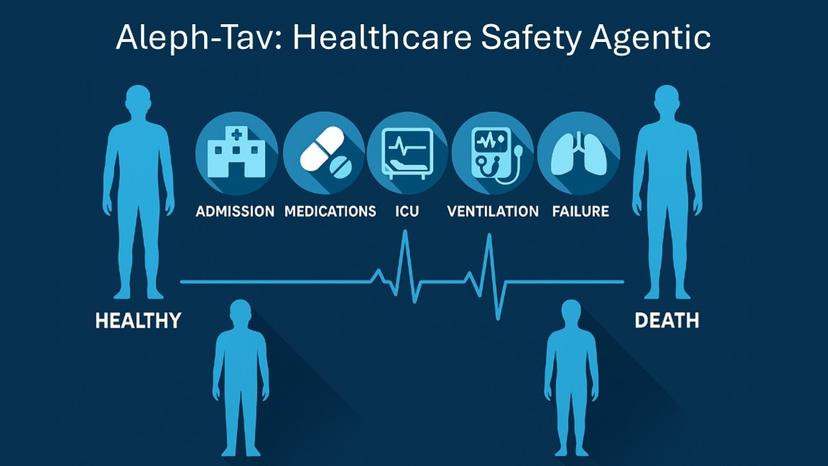
Our team built an agent-driven Healthcare Safety Platform designed to arrest James Regen’s “Swiss-cheese” iatrogenic cascades by unifying disparate hospital data into a Databricks Lakehouse and surfacing real-time risk insights. We began by defining the problem scope—10 percent of inpatients suffer preventable harm when latent system flaws align with active errors—then organized our work around four specialized personas. Agentic Maya Thompson led a strategic analysis of EHR admission/discharge records, incident and near-miss logs, and staffing schedules to prioritize the failure modes that most undermine patient safety and throughput. Carlos Reyes ingested data streams from EHRs, medical devices, wearables, and clinical protocols via Auto Loader into Bronze, Silver, and Gold Delta tables, codified transformation logic in Delta Live Tables, and enforced data governance with Unity Catalog to ensure compliance and lineage traceability. Dr. Priya Singh developed and rigorously validated predictive models—combining lab values, time-series vitals, protocol deviation flags, and staffing ratios—to flag patients at highest risk of cascading harm, audited model fairness across units, and registered top-performing versions in MLflow. Finally, Olivia Chen translated complex risk scores and incident trends into an intuitive dashboard using Databricks SQL and an embedded React interface, designing sliding-scale gauges, alert workflows tied to staff schedules, and drill-down incident timelines that guide timely, targeted interventions. Over multiple iterations, the team tagged each other on data-readiness checks, schema clarifications, feature requests, and prototype refinements in our integrated chat system, converging on a production-ready solution that continuously monitors care pathways, predicts misalignment in advance, and closes the “holes” in our clinical defenses—turning fragmented hospital data into life-saving insights.
1 May 2025
Customer Review Improvement Agency
Long-term Vision: The long-term vision for the Customer Review Improvement Agency includes the following: Scalability and Expansion: Continuously enhance the platform with advanced features such as AI-driven predictive analytics, advanced sentiment analysis, and multilingual support to cater to global businesses. Partnerships and Integrations: Form strategic partnerships with major review platforms, e-commerce sites, and social media networks to provide seamless integration and real-time data synchronization. Educational Resources: Develop educational resources and training programs for businesses to better understand the importance of customer reviews and how to manage them effectively. AI and Machine Learning Enhancements: Integrate machine learning algorithms to predict trends in customer feedback and provide actionable insights for businesses to preemptively address potential issues. Global Outreach: Expand our services to international markets, adapting our platform to cater to different cultural and linguistic needs, ensuring a global presence. Customer Loyalty Programs: Develop and manage loyalty programs that not only incentivize positive reviews but also foster long-term customer relationships through rewards and recognition. Comprehensive Analytics: Provide businesses with in-depth analytics and reports that offer a holistic view of their online reputation and customer feedback, enabling data-driven decision-making
7 Aug 2024