.png&w=256&q=75)
🤓 Latest Submissions

Aegis AI
As enterprises and industrial sectors rapidly deploy autonomous AI agents and edge robotics, they expose themselves to novel, critical attack vectors such as advanced prompt injections, data exfiltration, and model denial-of-service (DoS) poisoning. Traditional security perimeters are insufficient for inspecting these dynamic, semantic payloads. Aegis AI bridges this critical security gap as an enterprise-grade SecOps firewall and autonomous edge proxy. Engineered in Go and Python, Aegis AI delivers sub-millisecond local enforcement, ensuring high-speed security without compromising operational latency. The platform's architecture is built on four core pillars: Edge-Native Proxy: Leveraging Veea's Lobster Trap, I deployed a high-performance local proxy that intercepts and sanitizes traffic directly at the edge, a crucial requirement for real-time robotics and localized AI agents. Autonomous Fuzzing Engine: Powered by Gemini, Aegis features a self-healing, continuous testing pipeline. It autonomously red-teams AI agents, proactively identifying vulnerabilities and dynamically generating defensive rules before zero-day exploits can be weaponized. Real-time Semantic Filtering: The system deeply inspects inbound and outbound payloads to neutralize complex prompt injection attacks and prevent unauthorized data exfiltration. Human-in-the-Loop Governance: A dedicated CISO staging queue quarantines highly anomalous or critical security events for manual oversight, ensuring strict enterprise governance and compliance. By combining proactive autonomous defense with robust edge-level proxying, Aegis AI provides the foundational security layer necessary for the safe, scaled adoption of AI agents in mission-critical environments.
19 May 2026
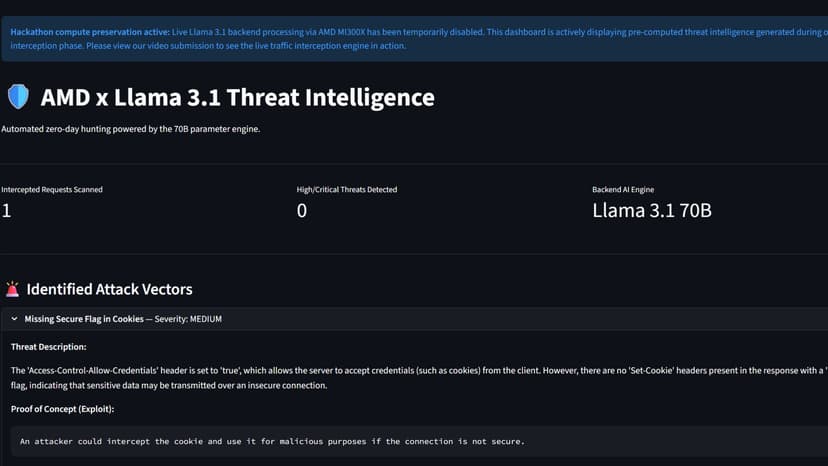
AppSec Hunter: Llama 3.1 70B Scanner
Application Security requires massive compute to analyze raw HTTP traffic intelligently. I wanted to build a tool that uses the reasoning capabilities of Llama 3.1 70B to hunt for vulnerabilities like IDOR, SSRF, and Path Traversal, but I didn't want to pay for a 24/7 cloud GPU. AppSec Hunter automates the intelligence extraction and then instantly destroys the backend infrastructure to freeze billing. I built a custom Python API bridge that pipes raw intercepted network traffic from a local environment directly into Llama 3.1 70B running on an enterprise AMD MI300X cloud instance. The AI acts as a programmatic scanner, structuring its findings into strict JSON. To optimize cloud economics, I designed a "Ghost Backend" architecture: the exact second the intelligence is extracted, the cloud instance is destroyed. The data is then visualized on a zero-cost Streamlit dashboard, which I deployed to Hugging Face Spaces for community access.
10 May 2026


