
🤓 Latest Submissions
Ascended v.56
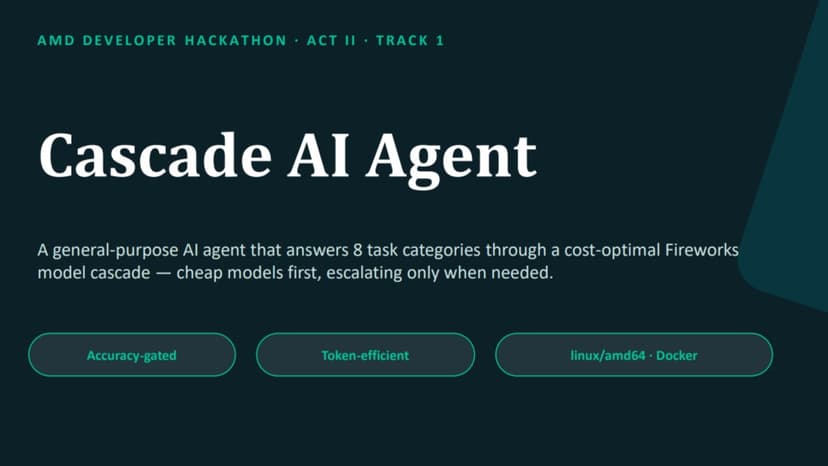
This project is a Dockerized general-purpose AI agent built for Track 1 of the AMD Developer Hackathon: ACT II. It reads batches of natural language and coding tasks from /input/tasks.json and writes structured answers to /output/results.json, handling all eight required capability categories factual knowledge, mathematical reasoning, sentiment classification, text summarization, named entity recognition, code debugging, logical/deductive reasoning, and code generation. The agent's core design goal is token efficiency without sacrificing accuracy. Each incoming task is classified into its category using a fast, dependency-free heuristic classifier. Easy categories (factual knowledge, sentiment, summarization, NER) are first attempted using the cheapest capable model from the allowed Fireworks model set, escalating to a stronger model only on validation failure. Harder categories that reliably require more reasoning power mathematical reasoning, logical/deductive reasoning, code debugging, and code generation are routed directly to the most capable allowed model for that task type, avoiding wasted attempts on weaker models. All remote inference is routed exclusively through the harness-provided FIREWORKS_BASE_URL using models read dynamically from the ALLOWED_MODELS environment variable at runtime no model IDs or credentials are hardcoded. The agent includes per-category output validators (JSON schema checks for entity extraction, label-set checks for sentiment, length constraints for summarization, syntax checks for code), resilient error handling with automatic retries on transient API failures, and safeguards to guarantee every task receives a valid answer even under network issues, ensuring the container always exits cleanly with valid JSON output. The container is built for linux/amd64, stays well under the 10GB image size limit, starts in under 60 seconds, and completes each task well within the 30-second per-task limit and 10-minute total batch limit.
13 Jul 2026
AXIOM: The Autonomous SRE Agent
Every engineer knows the pain of being paged at 3 AM for a production incident. Usually, it takes 40 minutes just to read through logs, understand the state of the system, and find the root cause, followed by 5 minutes to actually write the fix. AXIOM does the 40 minutes for you, so you only have to do the 5. We built AXIOM because current AI coding assistants only suggest fixes based on snippets. When production breaks, the bottleneck is context. You need to load massive amounts of codebase context, real-time metrics, and log histories simultaneously. Standard GPUs suffer from memory swapping and KV cache bottlenecks when trying to process this much context, leading to fragmented reasoning. By running Qwen2.5-72B on the AMD Instinct™ MI300X, we unlocked the ability to use the massive 192GB of VRAM to maintain full system context without truncation. AXIOM operates on a high-speed OODA Loop (Observe, Orient, Decide, Act) using the new Model Context Protocol (MCP). It observes telemetry via an MCP LogDB server, orients itself using the massive context window to form a hypothesis, and acts by executing live terminal diagnostics and pushing code fixes. Crucially, before any destructive action (like modifying code or opening a PR), it pauses at a Human-in-the-Loop safety gate for approval. To prove it works, AXIOM generates a "War Room Packet" for every incident—a structured audit trail of its evidence chain, hypothesis progression, and before-and-after metrics recovery. We benchmarked it against industry DORA metrics, and AXIOM consistently turns a cascading failure alert into a verified GitHub Pull Request in under 90 seconds.
10 May 2026


