

🤝 Top Collaborators


🤓 Latest Submissions
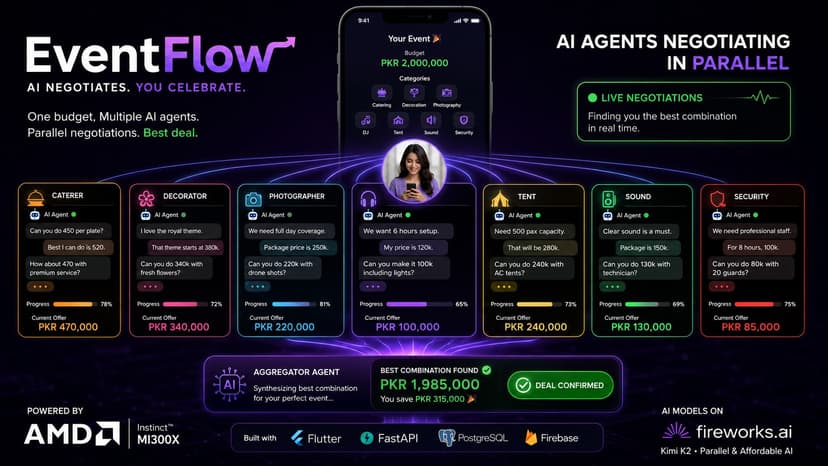
EventFlow – Parallel AI Vendor Negotiation
EventFlow automates the procurement of event vendors in Pakistan's $50 billion wedding industry, which lacks structured tools. In this market, deals are typically negotiated via phone calls and WhatsApp, with no APIs, no pricing data, and no way to compare offers. To use EventFlow, customers input their total budget, specify event categories, and set a range for negotiation flexibility within a Flutter app. An Analyzer Agent (powered by a large language model) then optimally distributes the budget across the selected categories. A Matchmaker service calculates dynamic, category-specific pricing—such as per-head costs for catering, guest-threshold scaling for decorators, and flat rates for photographers and DJs. Instead of negotiating with each vendor one at a time, EventFlow activates a separate Negotiation Agent for each matched vendor, allowing all negotiations to run in parallel and in real-time within the app. Every negotiation utilizes Fireworks AI's Kimi K2 model, running on AMD’s MI300X. This setup enables fast and cost-effective handling of five to eight simultaneous negotiations per event, avoiding the delays associated with a sequential queue. On the backend, FastAPI and PostgreSQL serve as the authoritative source for every change in negotiation state. A state synchronization service mirrors every write operation to Firestore in real-time, ensuring that both customer and vendor applications remain in sync. Trust is enforced on the server-side: each counter-offer is validated against a floor price established during the matchmaking process and is never accepted from the client side. Any attempts to bypass this will result in an instant HTTP 400 error. Finally, an Aggregator Agent synthesizes the best combination of finalized deals across all vendor categories into one confirmed booking.
13 Jul 2026
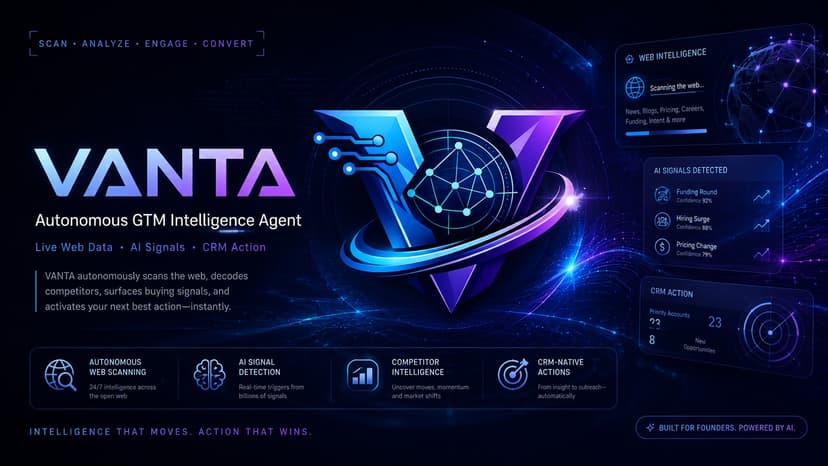
VANTA: Autonomous GTM Intelligence Agent
VANTA is an autonomous GTM intelligence agent built for revenue teams that need real-time competitor and buyer intelligence. Instead of manually searching Reddit, G2, Trustpilot, Glassdoor, HackerNews, and search results for customer complaints, VANTA uses Bright Data tools to collect live public web signals at scale. The agent identifies dissatisfaction signals such as pricing frustration, support issues, feature gaps, migration intent, and competitor alternatives. After collecting data, VANTA uses Claude Opus through AIML API to analyze each signal, extract pain points, score buyer intent, and generate personalized GTM battle cards. These battle cards include account summaries, talking points, objection handling, and outbound email drafts that sales teams can use immediately. The platform includes a FastAPI backend, PostgreSQL/Supabase persistence, real-time SSE streaming, and a React/Vite dashboard. The dashboard shows live agent activity, intent signal cards, competitor vulnerability radar charts, ROI calculations, and CRM actions. Users can enrich leads, find decision makers, and push qualified opportunities into HubSpot. VANTA solves a real enterprise problem: GTM teams often miss buying signals because they are scattered across the open web. By combining Bright Data’s live web infrastructure with AI reasoning and CRM automation, VANTA turns unstructured web data into actionable revenue intelligence.
31 May 2026
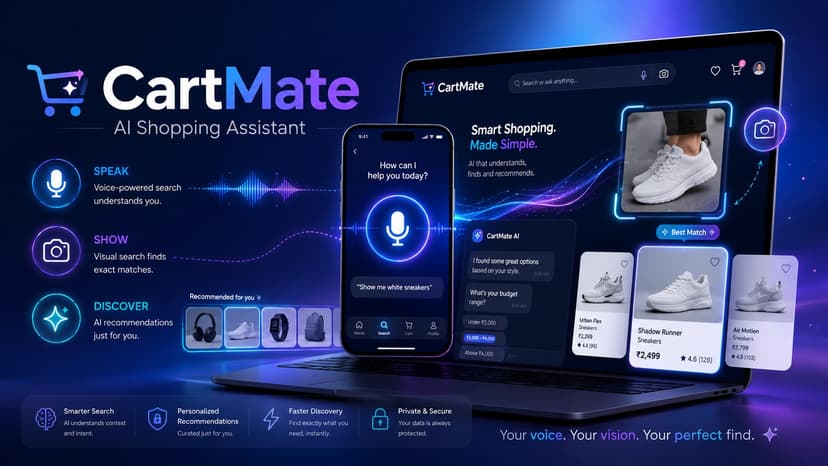
CartMate AI Shopping Assistant
CartMate is an AI-powered conversational commerce assistant designed to make online shopping easier, faster, and more accessible. Many users struggle with traditional text-based search because they may not know the right keywords, product category, brand name, or technical terms. CartMate solves this problem by allowing users to simply speak what they want in natural language. The system understands the user’s intent, asks smart follow-up questions, and recommends suitable products from the catalogue. CartMate also includes visual product matching. Users can show a physical item or upload an image, and the AI analyzes its category, color, material, style, and visible branding. Based on this analysis, CartMate finds visually similar products and displays ranked recommendations. This is especially useful for elderly users, low-literacy users, non-technical shoppers, and customers who can recognize a product visually but cannot describe it accurately. The project uses real-time speech-to-text, conversational AI reasoning, text-to-speech output, and AI vision to create a smooth shopping experience. For businesses, CartMate improves product discovery, reduces search frustration, increases customer engagement, and can help improve conversion rates. It can be integrated as an intelligent shopping layer for e-commerce platforms, marketplaces, and online stores.
19 May 2026
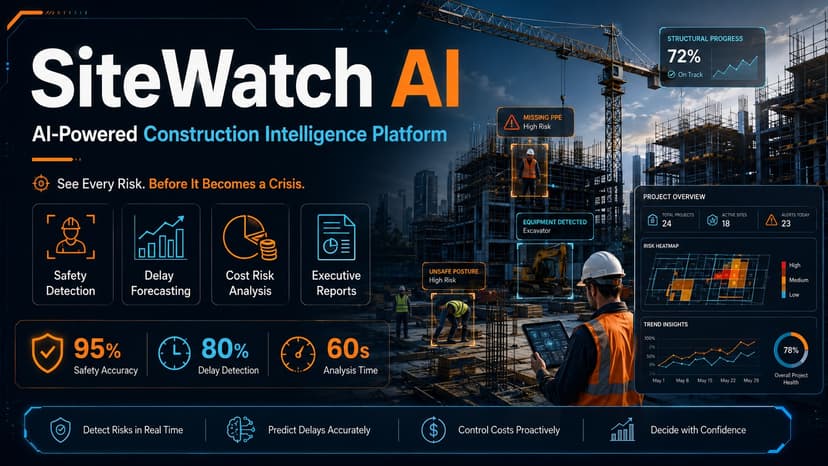
SiteWatch AI
SiteWatch AI is an AI-powered construction intelligence platform built to solve one of the construction industry’s biggest challenges: lack of real-time visibility into safety risks, project delays, and cost overruns. Most construction companies still rely on manual inspections, spreadsheets, and delayed reporting processes. These outdated methods often lead to workplace accidents, missed deadlines, financial losses, and slow decision-making. SiteWatch AI modernizes construction monitoring using multimodal Gemini AI agents that analyze visual and operational data in real time. The platform allows users to upload construction site photos, project schedules, XLSX/CSV files, and daily reports. After upload, three specialized AI agents collaborate to generate actionable insights for project managers and stakeholders. The Vision Agent uses Gemini Vision AI to analyze site images and detect PPE violations, unsafe scaffolding, electrical hazards, open trenches, and other safety risks. It also estimates project progress and generates a safety score. The Risk Agent processes schedules and operational data to predict delay probability, identify major risk factors, estimate days behind schedule, and forecast potential cost overruns before they become critical. The Report Agent combines outputs from all AI agents and automatically generates executive audit reports containing summaries, safety findings, risk analytics, delay forecasts, and recommendations in downloadable PDF format. The platform features a modern dashboard with live analytics, charts, uploads, and AI-generated insights. SiteWatch AI is built using Gemini API, Gemini Vision API, Next.js, React, TypeScript, Tailwind CSS, and Recharts. Our solution helps construction companies improve worker safety, reduce delays, automate reporting, and make faster data-driven decisions using AI-powered enterprise intelligence.
19 May 2026
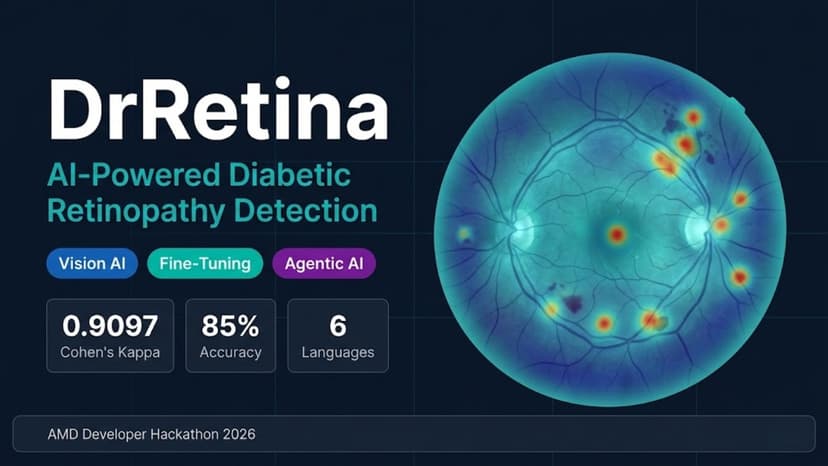
DrRetina — AI Diabetic Retinopathy Agent
DrRetina is an end-to-end AI diagnostic system for Diabetic Retinopathy (DR) detection, built for ophthalmologists and medical professionals. DR affects over 537 million diabetics worldwide and is the leading cause of preventable blindness, yet most clinics in South Asia and Africa lack access to specialist screening tools. Our system solves this through three integrated layers: VISION ENGINE: A fine-tuned ViT-MAE (facebook/vit-mae-base) model trained on the APTOS 2019 dataset using AMD Instinct MI300X GPUs via ROCm. The model achieves Cohen's Kappa of 0.9097 — surpassing the WHO DR screening benchmark of 0.80 and our own target of 0.85. GradCAM heatmaps highlight the exact retinal lesions driving each diagnosis, building clinical trust. AGENTIC LAYER: A LangChain ReAct agent powered by Qwen3-8B with 5 specialized clinical tools. The agent generates structured diagnostic reports and answers follow-up clinical questions with full diagnosis context. Reports are automatically generated in 6 languages — English, Urdu, Arabic, Hindi, Spanish, and French — with RTL text support for Urdu and Arabic via WeasyPrint and Google Noto Fonts. AMD INFRASTRUCTURE: The entire fine-tuning pipeline runs on AMD Instinct MI300X via ROCm 7.2 and PyTorch. Training completes in approximately 5.3 minutes per 50 epochs. The system is deployed as a Hugging Face Space with a FastAPI inference microservice backend. DrRetina is a three-track submission covering Vision & Multimodal AI, Fine-Tuning on AMD GPUs, and AI Agents & Agentic Workflows — making it one of the most complete medical AI systems in this hackathon with verified, quantified accuracy metrics.
10 May 2026
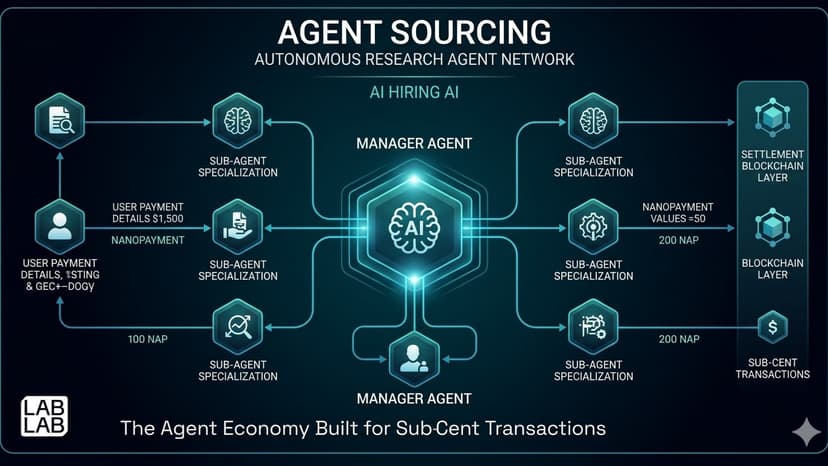
AgentSourcing: Autonomous AI Research Network
AgentSourcing is a multi-agent research network built on the Arc blockchain, powered by Circle Programmable Wallets and Nanopayments. A user submits a research task with a small USDC deposit. A Manager Agent — powered by LLaMA 3.1 70B via Featherless AI — decomposes the task into specialized sub-tasks and autonomously hires 6 Specialist Agents. Each specialist is paid $0.002 USDC per task. These specialists, in turn, purchase premium data from external APIs using the x402 payment standard at $0.0005 per call. The entire pipeline — from task intake to final report delivery — generates approximately 50 on-chain USDC transactions per run, all verifiable on the Arc Testnet Block Explorer. On-Chain Trust Layer: Every agent maintains a reputation score tracked by a custom ERC-8004 smart contract written in Vyper and deployed on Arc Testnet. The Manager uses these scores to select the best available specialist for each task. Why this is impossible without Arc: On Ethereum, each micro-payment of $0.002 would incur $2+ in gas fees — a 100,000% overhead. On Polygon or L2s, gas still ranges from $0.01 to $0.05, making sub-cent payments unprofitable. Arc's USDC-denominated gas makes this model economically viable for the first time. Tech Stack: Arc Testnet (settlement), Circle Programmable Wallets (agent treasury), Circle Nanopayments + x402 (per-API monetization), Featherless AI (LLaMA 3.1 70B Manager + Qwen/DeepSeek/Mistral Specialists), ERC-8004 Vyper Smart Contract (reputation), FastAPI backend, React + TypeScript frontend.
26 Apr 2026


