.png&w=256&q=75)
Akshatha K S@ksakshatha12637670
1
Events attended
1
Submissions made
India
1 year of experience
About me
I'm an AI/ML engineering student at Brindavan College of Engineering, Bangalore, specialising in building practical machine learning and GenAI applications. Over the past year I've built and shipped: • SubZap – a subscription tracker with smart spend insights • Veritas – a fact-checking tool powered by Google Gemini • Mood Tracker – an NLP-based emotional analysis dashboard • A fraud detection model using supervised learning techniques My stack: Python · Pandas · Scikit-learn · Streamlit · SQL · Git · Google Gemini · Google Cloud I've completed hands-on internships at YBI Foundation (AI/ML) and CodSoft (Machine Learning), and hold certifications from Google x Kaggle, SAP, and the Code Universe initiative. Currently open to AI/ML internships, research collaborations, and project opportunities where I can build things that matter.
🤝 Top Collaborators
.png&w=640&q=75)
🤓 Latest Submissions
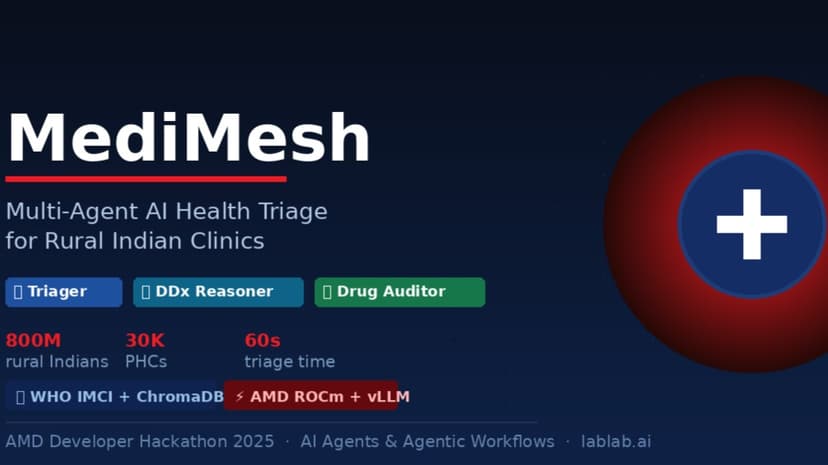
MediMesh — AI Triage for Rural Clinics
India has 30,000 Primary Health Centres serving 800 million rural people — most running without a full-time doctor. A nurse alone must decide: send this patient home, or emergency referral? A wrong call costs lives. MediMesh gives that nurse an AI second opinion in under 60 seconds. How it works: Three specialized AI agents run sequentially and in parallel over every patient case: - Agent 1 — Triager: Reads symptoms and vitals, identifies WHO IMCI danger signs, assigns GREEN / YELLOW / RED severity - Agent 2 — DDx Reasoner: Generates top 3 differential diagnoses ranked by probability with supporting evidence - Agent 3 — Drug Safety Auditor: Checks current medications against proposed treatment for dangerous interactions All agents are grounded in a RAG layer over WHO IMCI guidelines (25 indexed chunks) and an Indian drug interaction database (30 high-risk pairs) stored in ChromaDB — pre-indexed, local, no live internet required during inference. The system is built on CrewAI + Llama 3.2 1B Instruct, designed for deployment on AMD Developer Cloud via vLLM and ROCm. The Streamlit UI supports both Hindi and English labels for nurse usability. We evaluated on a 10-vignette clinical test set with ground-truth severity labels covering severe pneumonia, dehydration, neonatal sepsis, malaria, and dangerous drug combinations (rifampicin + OCP, digoxin + amiodarone).
10 May 2026
