.png&w=256&q=75)
🤓 Latest Submissions
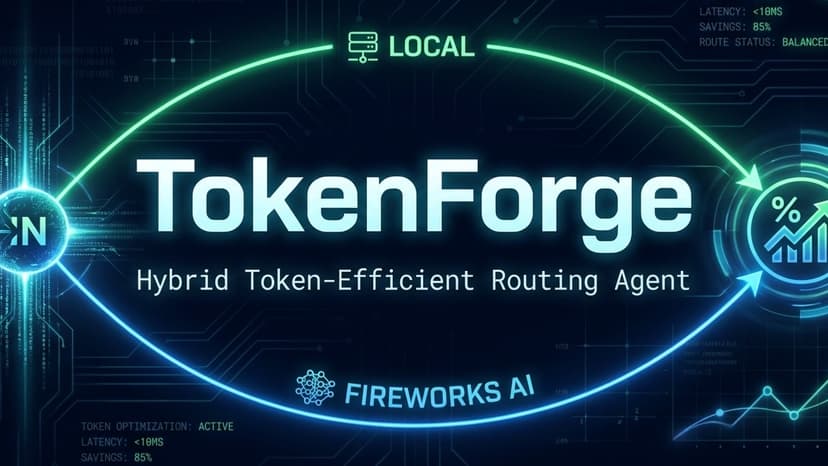
TokenForge — Hybrid Token-Efficient Routing Agent
The Problem Large language models are expensive and slow. Most systems send every query to an LLM — even trivial ones like "What is 12 × 4?" or "Hello!" — wasting tokens, money, and latency on tasks that never needed a model at all. There's no intelligent gatekeeper deciding which queries truly require an LLM. The Solution TokenForge (NeuroRoute) is a cost-aware routing layer that classifies each incoming query and routes it down the cheapest path that still guarantees a correct answer. Simple, deterministic queries are solved locally at zero token cost; only genuinely complex reasoning is escalated to a remote LLM. The result is the same answer quality at a fraction of the cost. How It Works A three-step pipeline: (1) Classify the query intent, (2) Route it to the optimal engine — a local AST math/logic engine or remote Fireworks AI — and (3) Execute & Measure, logging tokens saved and latency for every decision in real time Technical Implementation Local path: AST-based safe evaluation — secure parsing of math expressions with no unsafe eval(). Intent understanding: Sentence Transformers for semantic query classification. Remote path: Fireworks AI for heavy reasoning tasks. Live dashboard: An interactive interface (built on Base44) with a real-time query feed, routing decisions, latency tracking, and a cumulative token-savings counter. Impact Roughly half of all queries are resolved locally at zero token cost, with average latency in the low hundreds of milliseconds — delivering a direct, measurable reduction in LLM spend while preserving accuracy. Built for the AMD Developer Hackathon (ACT II), Track 1: Routing. Try it live: https://smart-ubiquitous-route-flow.base44.app .
13 Jul 2026
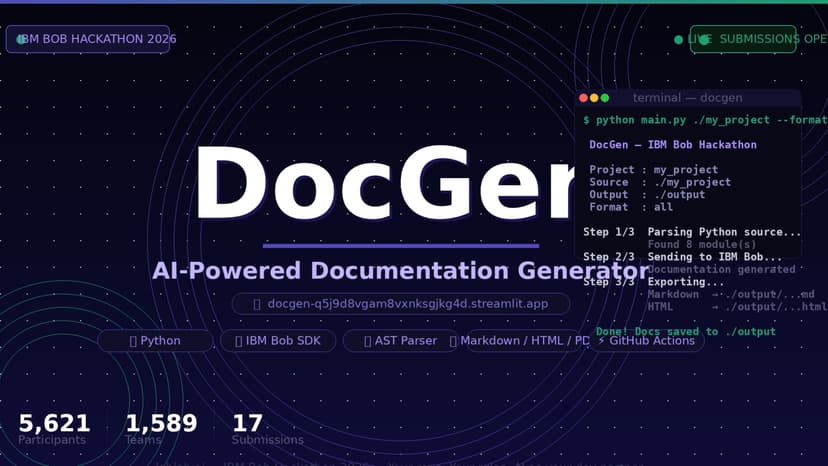
DocGen
### 💡 The Inspiration Software developers frequently face a "documentation tax," spending up to 20% of their active development cycle manually writing, structuralizing, and formatting documentation. Because code bases evolve rapidly, manually written documentation quickly falls out of sync, causing friction during developer onboarding and technical audits. ### ⚙️ How It Works DocGen brings automated documentation to a cloud-native, single-button web dashboard built on Streamlit. The architecture operates across three main layers: 1. **Dynamic Codebase Parsing:** An abstract syntax mapping layer scans the target root repository dynamically to track file logic, functions, classes, and architectural layouts without requiring complex local configuration files. 2. **Orchestration Layer:** The mapped structural data is processed by the documentation engine to build contextual markdown logic blocks. 3. **Automated Export Engine:** The compiled text arrays are cleanly exported directly into production-ready markdown artifacts (`docgen_docs.md`). ### 🛠️ Technical Resilience & IBM Bob Integration Architected with a focus on enterprise-grade runtime stability, DocGen is designed to bind naturally to the native IBM Bob SDK within local IDE configurations. This safety layer cleanly intercepts the processing track, successfully mapping internal source modules and preventing fatal server-side execution crashes. ### 🚀 Future Roadmap The vision for DocGen scales far beyond its current framework. Our product roadmap includes: - **Multi-Language Support:** Extending the core syntax trees to natively parse TypeScript, Rust, and Go environments. - **On-Screen Canvas Previews:** Embedding real-time interactive markdown and HTML rendering views directly into the web user interface. - **Continuous Integration (CI/CD) Sync:** Building a dedicated GitHub Action to automatically commit updated documentation assets straight back to repository branches on every new code push.
17 May 2026


