.png&w=256&q=75)
🤓 Latest Submissions
Vesper — Autonomous Incident Post-mortem Agent
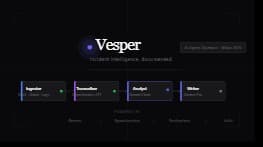
Vesper is an autonomous multi-agent system that eliminates the most painful part of incident management: writing the post-mortem. Engineering teams lose critical institutional knowledge after every incident because post-mortems are manual, slow, and consistently skipped when teams are exhausted. Vesper solves this with a four-agent pipeline that runs automatically the moment an incident is triggered. The Ingestor Agent connects to Slack and Gmail, pulling every signal from incident threads, alerts, and email chains into a unified context. The Transcriber Agent submits war-room call recordings to Speechmatics, which returns a speaker-diarized transcript — identifying who said what, when. The Analyst Agent feeds the full context to Gemini Flash, which reasons across all signals to extract root cause, contributing factors, timeline, impact, and severity score as structured data. The Writer Agent then uses Gemini to compose a complete post-mortem document in Markdown, which is automatically indexed into a pgvector knowledge base for semantic search. The entire pipeline streams live to the frontend via WebSocket — judges and users can watch each agent step complete in real time on the incident detail page. Built on FastAPI, Next.js 15, PostgreSQL with pgvector, Redis, and Celery, Vesper is a production-grade system deployed on Vultr. The frontend features a glassmorphism dark UI with live agent feed, full post-mortem editor with inline editing, audio file upload, knowledge base search, and integration management for Slack, Gmail, and Speechmatics. Featherless provides an optional open-source model toggle — switching the Analyst Agent from Gemini to L
19 May 2026

Vaidya: Citation-Grounded Ayurvedic RAG System
The internet is flooded with decontextualized and often dangerous "Ayurvedic" advice. Meanwhile, genuine classical texts like the Charaka-Samhita remain largely inaccessible due to the language barrier (Sanskrit) and dense formatting. Vaidya bridges this gap by acting as a highly disciplined, citation-grounded Retrieval-Augmented Generation (RAG) system. When a user asks a medical or philosophical question in English, Hindi, or Sanskrit, Vaidya does not rely on the LLM's internal weights. Instead, it retrieves the exact relevant verses from the digitized Charaka-Samhita. Under the hood, we built a custom pipeline to parse Devanagari OCR, extract semantic chunks, and map exact structural metadata (Sthana, Adhyaya, Verse number). These were embedded using multilingual-e5-large into a Qdrant vector database. For generation, we deployed Qwen2.5-72B-Instruct using vLLM on an AMD MI300X GPU via DigitalOcean. Vaidya’s defining feature is its strict integrity. Every factual claim in the response is followed by a precise citation. Furthermore, it employs confidence-gating: if the vector search yields low-relevance results, the system is programmed to admit it lacks a source rather than fabricate an answer. Vaidya represents a trustworthy AI gateway to classical Indian medicine for researchers, students, and practitioners.
10 May 2026


