🤓 Latest Submissions
Pusdatin AI Agents: Public Health Intelligence
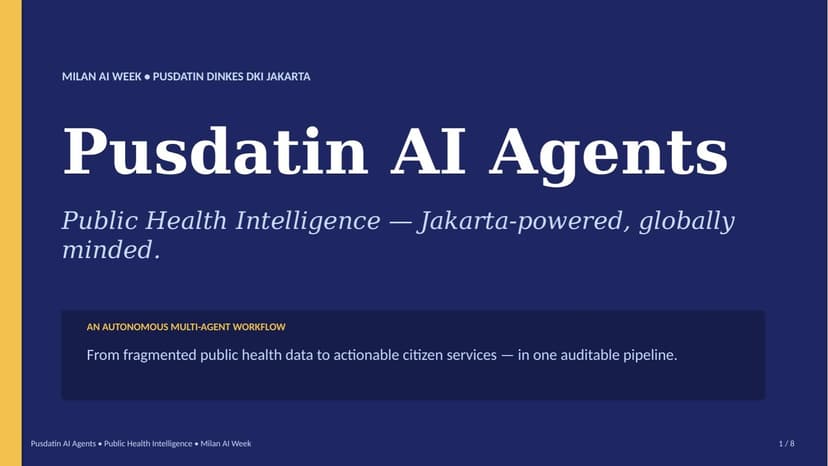
Public health teams in Jakarta and many other cities still spend an outsized share of their time on fragmented, manual, and error-prone data workflows. Records arrive from many channels with inconsistent formats, validation and cleaning are still mostly manual, privacy and compliance checks happen late, insights are slow to produce, and citizen services do not always receive actionable, real-time signals. Our project addresses this with an autonomous multi-agent system that streamlines the entire public health data-to-action cycle. Five specialized agents collaborate inside one orchestrated workflow: 1) Ingestion Agent standardizes incoming records from CSV files, APIs, web forms, and batch sources into a normalized schema with consistent value mappings. 2) Quality Agent validates required fields, runs outlier checks, flags invalid categories, and produces a transparent quality score for every record. 3) Privacy Agent enforces a mandatory redaction gate that masks names, phone numbers, addresses, and national identifiers before any downstream processing happens. 4) Insight Agent computes risk indicators, trend summaries, and service priority from the redacted records and quality metadata. 5) Citizen Service Agent turns those insights into actionable service recommendations with urgency levels and routing hints for local field teams. The architecture is built on privacy-by-default principles: raw data stays in restricted storage, only redacted data flows into analytics, and every transformation is traceable through per-step metadata for audit. The coordinator runs the agents sequentially for transparency and auditability, and the workflow is designed to extend into event-driven or parallel execution in future versions. Schema adapters, language-localized templates, and jurisdiction-specific policy packs make the system portable from Jakarta to other cities globally.
19 May 2026
