🤓 Latest Submissions
Model Court
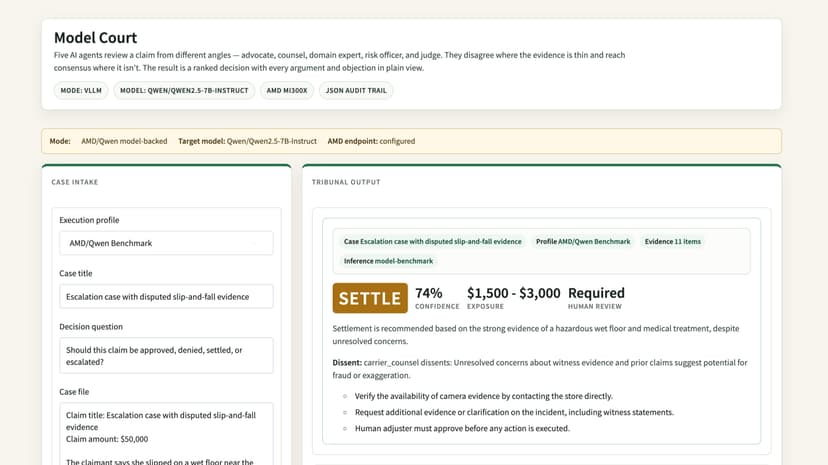
Model Court is an AI-powered tribunal system for insurance claim review. Instead of letting a single model make a flat recommendation, Model Court separates the decision into multiple agent roles that examine the claim from different perspectives. The system includes an Evidence Clerk, Claimant Advocate, Carrier Counsel, Risk Officer, Domain Expert, Agreement Clerk, and Judge. Each agent receives the same claim file but has a different responsibility: extracting evidence, arguing for the claimant, challenging weak points, identifying risk, reviewing domain-specific concerns, mapping disagreement, and producing a final ranked recommendation. The output is structured for auditability. Model Court returns cited evidence items, role-specific arguments, cross-examination results, agreement and dissent, confidence scores, recommended next steps, latency traces, and a full JSON audit trail. Every final verdict includes a human approval gate, so the system is decision support rather than automated claim execution. The project is built around Qwen models served through vLLM on AMD Developer Cloud MI300X using ROCm. The Gradio interface can run model-backed review through the AMD endpoint and preserve deterministic fallback behavior if an agent fails validation. This makes the system practical for live demos while still showing a real agentic compute path. Model Court is designed for insurance teams, claims reviewers, compliance teams, and builders exploring multi-agent decision workflows. Its core idea is that high-stakes AI systems should not only produce an answer, but also show who argued for it, who disagreed, what evidence was cited, and where a human must intervene.
10 May 2026


