
Gunasekara Raj@guna
🤝 Top Collaborators


.png&w=640&q=75)
🤓 Latest Submissions
PM PLUS
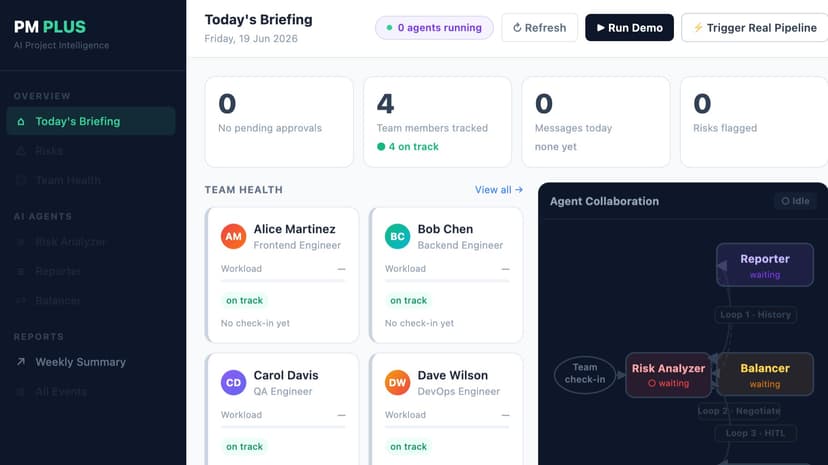
PM PLUS transforms project management from a passive, administrative burden into a self-optimizing, autonomous ecosystem. Traditional enterprise workflows suffer from constant status-chasing and reactive bottleneck detection, causing preventable delays and distracting leaders from high-level strategy. Our solution replaces static tools with an intelligent, multi-agent workforce. Powered by the Band coordination layer, these agents proactively manage project health, negotiate resource reallocation, and maintain deep historical context. By resolving systemic issues and optimizing workflows in the background, PM PLUS ensures that project managers transition from chasing updates to driving strategy. With human oversight maintained through a real-time, intuitive dashboard, PM PLUS delivers unprecedented efficiency, moving beyond mere task tracking to intelligent, automated project success.
19 Jun 2026
.png&w=828&q=75)
PharmaNexus
Pharma teams don't lack data — they lack a connected decision layer. We built a deterministic GTM engine that correlates live signals across six modules — market access, messaging, hiring, regulatory, KOL influence, and a cross-module decision engine — into one verdict: ACT, PREPARE, or MONITOR. Bright Data scrapes the live web (Web Unlocker, SERP, LinkedIn Jobs). AI/ML API routes three tiers — GPT-4o-mini extraction, Claude Sonnet 4.5 reasoning, text-embedding-3-small drift. TriggerWare.ai is the event bus (push) and hospital connector (pull) for the KOL Target Finder. Phases 4 and 5 use zero LLM — every number is auditable. Claude only writes the "so what." Repo: github.com/guna2k4/pharma-gtm
31 May 2026
TrialNexus
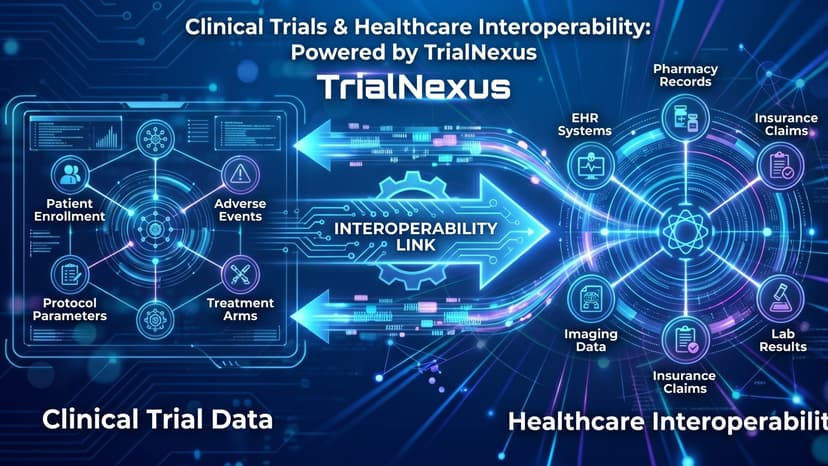
TrialNexus is an AI-native clinical trial recruitment platform built to solve one of medicine's hardest problems: finding the right patients for the right trials, fast. Pharmaceutical companies lose millions every month when trials recruit slowly. Clinicians spend hours manually reviewing patient records. TrialNexus automates both sides. At its core, TrialNexus uses Google Gemini multimodal embeddings to encode both MRI brain scan images and clinical text together into a single vector, enabling semantic patient search that understands medical context — not just keywords. Patients are ranked by match percentage against trial inclusion/exclusion criteria. Phase 2 Lab Screening goes deeper: an AI agent runs each candidate through a structured SQL-based eligibility gate, automatically disqualifying patients who fail criteria and explaining exactly why — with full lab detail visible on click. The Commercial Intelligence module runs a 4-agent pipeline using Server-Sent Events for real-time streaming. It synthesizes competitive landscape data, KOL insights, site feasibility, and market opportunity into a downloadable report — powered by Featherless.ai's Qwen2.5-72B model. The entire stack is self-hosted: FastAPI backend, React 18 frontend, and Elasticsearch 8 running on Vultr — fully deployed via Docker Compose on Coolify with zero cloud lock-in. TrialNexus turns weeks of manual patient screening into seconds of AI-assisted matching.
19 May 2026
Diagnosis assitant for icu team
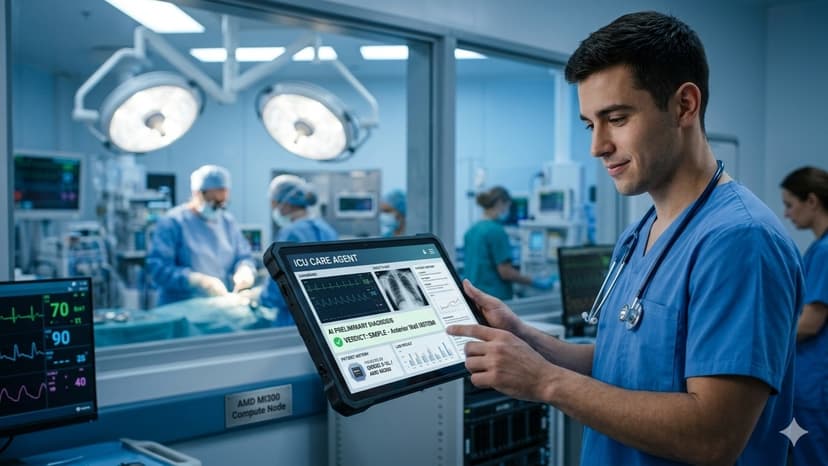
Cardiology ICUs run on a painful bottleneck: the senior cardiologist spends most of the day in surgery, while nurses and junior doctors at the bedside wait for them on every decision. Patients wait. Care is delayed. AMD Cardio Agent removes that wait time. A nurse enters the patient's current state and vitals, then uploads cardiac imaging — 12-lead ECG, chest X-ray, echocardiogram, and cardiac CT. The agent bundles that with simulated EHR data including labs, patient history, and a 6-hour vitals trend. It then runs Qwen2.5-VL-7B on an AMD MI300 GPU via vLLM and produces a structured preliminary diagnosis with recommended bedside actions and key supporting evidence. The junior doctor reviews everything on a visual board: all uploaded imaging displayed side-by-side, a Plotly vitals trend chart over the last six hours, a cardiac biomarker chart with abnormal values flagged against reference limits, an accordion of patient history, and the AI's draft diagnosis. The junior approves it as-is or edits it. Both actions feed a sentence-transformer RAG knowledge base — approvals save as confirmations that validate the pattern, edits save as corrections that override it. The next similar case retrieves these and injects them into the prompt, so the agent gets smarter every shift, learning from both juniors and seniors with no fine-tuning required. The frontend is a Gradio Space on Hugging Face. Inference runs entirely on the open-source AMD stack — Qwen2.5-VL-7B-Instruct, vLLM, ROCm, MI300 — fully self-hosted, with no cloud dependency for the model itself. The architecture mirrors how a real Dutch cardiology team would deploy this in production: imaging, labs, and history flow in; a structured draft flows out; every doctor interaction trains the system.
10 May 2026


