🤝 Top Collaborators
.png&w=640&q=75)
🤓 Latest Submissions
Vinculum
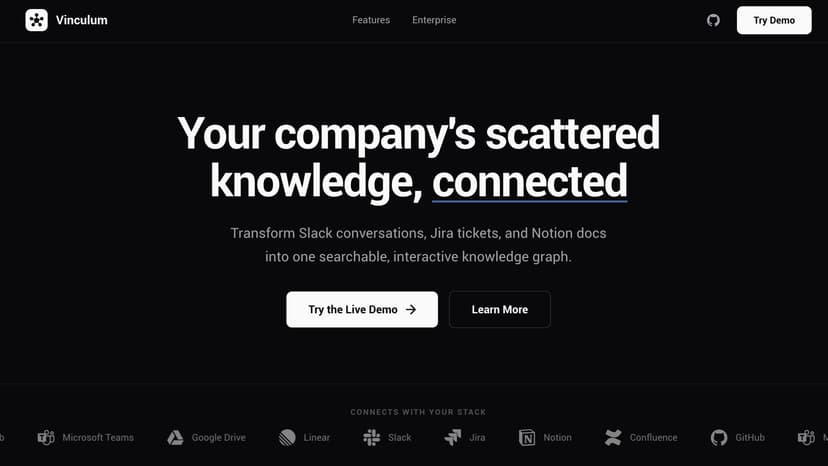
Every organization suffers from the same problem: critical knowledge is trapped in silos. A decision made in Slack, a bug tracked in Jira, a spec written in Notion. All disconnected, unsearchable across platforms, and invisible to the people who need them most. Vinculum solves this by ingesting data from your existing tools and using GraphRAG to automatically extract entities, relationships, and context. The result is a living 3D knowledge graph where every person, project, issue, and concept is a node, and every connection between them is visible and queryable. IBM Bob played a central role throughout development. We used Bob as our AI pair-programming partner to architect the GraphRAG ingestion pipeline, design the entity extraction schemas, implement the React frontend components, and debug complex data parsing issues with Parquet file formats. The full Bob session transcript is included in our repository as proof of collaboration. The technical architecture uses a FastAPI ingestion pipeline that processes webhooks from Slack, Jira, and Notion. An LLM-powered Graph Transformer extracts Entity-Relation-Entity triplets from raw text, storing structured relationships in Neo4j and semantic embeddings in Qdrant. A hybrid query engine combines graph traversal with vector similarity search, enabling both precise lookups and natural language questions. The frontend renders the knowledge graph using react-force-graph with real-time 3D visualization. Users can search nodes, zoom into clusters, and explore connections interactively. All GraphRAG processing happens locally in the browser. Zero data leaves the user's machine, making Vinculum viable for organizations with strict data residency requirements. Vinculum does not just store information. It reveals the hidden structure of how your organization actually works.
17 May 2026
