.png&w=256&q=75)
Faza E Badar@fazaebadar
2
Events attended
2
Submissions made
Pakistan
1 year of experience
About me
I am a Software Engineering student at UMT with a strong passion for Artificial Intelligence, Machine Learning, and Software Development. I enjoy building practical applications ranging from desktop systems in Python and C# to research-based projects in Natural Language Processing and Sentiment Analysis. My interests include developing AI-powered solutions, chatbot systems, and data-driven applications. I actively participate in hackathons and collaborative projects to sharpen my problem-solving skills and learn new technologies. My goal is to contribute to impactful AI innovations and grow as a developer by connecting with like-minded individuals in the lablab.ai community.
Socials
🤝 Top Collaborators

.png&w=640&q=75)
.png&w=640&q=75)
.png&w=640&q=75)
🤓 Latest Submissions
SonicGuide AI-Immersive Global Audio Tour Agent
SonicGuide.AI is an advanced audio tour generation platform that transforms travel and exploration into immersive storytelling. Leveraging multiple specialized agents—such as History, Architecture, Culinary, and Culture—SonicGuide crafts rich, engaging audio tours tailored to the user’s interests. The system uses a Streamlit interface for easy user interaction, where users input a destination, select their preferred topics, adjust settings like duration and voice style, and generate a complete audio tour that can be listened to or downloaded as an offline MP3. With AI-powered content generation (using OpenAI models and real-time web search) and text-to-speech, SonicGuide.AI delivers tours in under 60 seconds, covering any location globally. It aims to bridge gaps in existing solutions by offering dynamic, personalized, and multi-topic audio content, while also addressing accessibility and cultural engagement. Under the MIT license, SonicGuide is open for contributions and enhancements, including support for additional languages, accents, greater customization, and mobile / offline-first applications.
21 Sep 2025
End-to-End AI-Powered Medical Chatbot
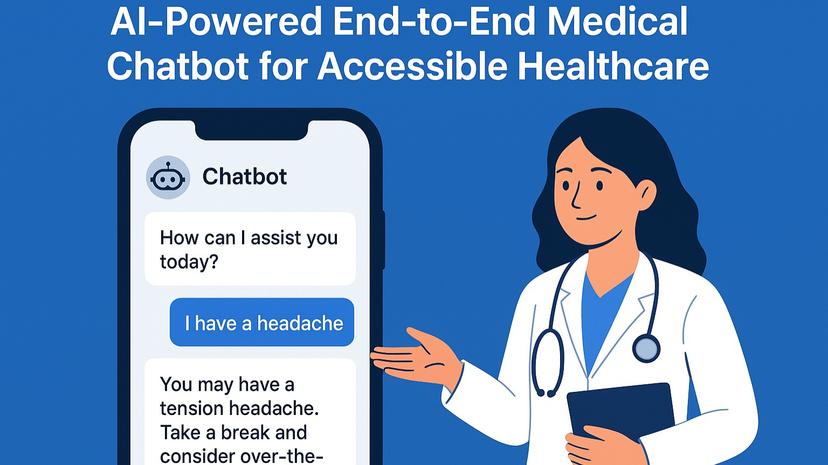
This project is an end-to-end medical chatbot designed to assist users with medical inquiries by providing accurate and reliable health information. The chatbot uses advanced natural language processing (NLP) and machine learning to understand user queries, identify intent, and deliver meaningful, personalized responses. Built with Python, TensorFlow, and NLTK, and integrated with APIs for real-time medical data, the system ensures robustness, scalability, and adaptability. It is supported by a comprehensive medical knowledge base covering diseases, symptoms, and treatments, continuously updated to maintain reliability. Users can interact with the chatbot via a simple interface across websites, mobile apps, and social media, making healthcare information accessible anytime, anywhere. Through contextual understanding and conversational flow, the chatbot provides a human-like experience, encouraging users to confidently seek medical guidance. The development process involved data collection from trusted medical sources, model training and fine-tuning, testing with user feedback, and deployment to live platforms. Looking ahead, the project envisions: Incorporating deep learning for enhanced understanding of complex queries Integration with telemedicine and healthcare services for appointment booking and actionable healthcare steps Multilingual support to reach diverse global communities A user feedback loop to continuously improve accuracy and user satisfaction By delivering instant, reliable responses, this chatbot can reduce the burden on healthcare professionals, promote self-care, and expand healthcare accessibility. It sets the stage for future innovations in AI-powered medical assistants, making quality healthcare information available to everyone.
24 Aug 2025


