🤓 Latest Submissions
RepoSense: Instant Codebase Insights
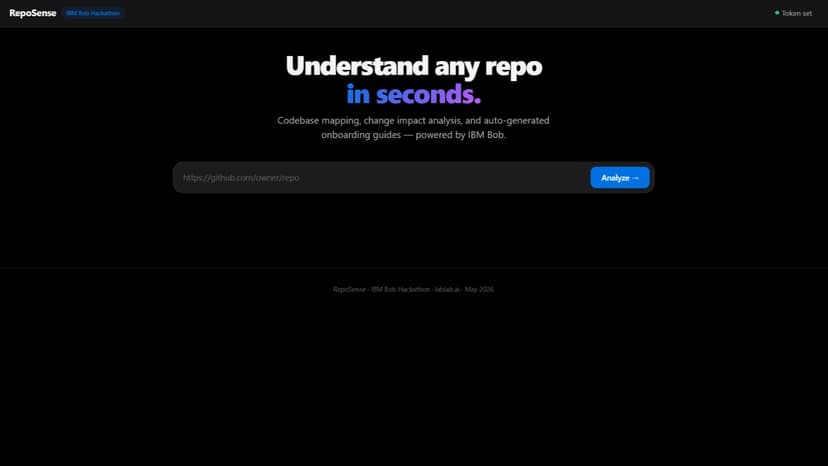
Diving into a new or massive codebase is often overwhelming. Developers spend countless hours simply trying to understand how files connect, where the entry points are, and what breaking changes might occur if they modify a core utility. RepoSense was built to solve exactly this problem for the IBM Bob Hackathon. By simply inputting a GitHub repository URL, RepoSense instantly analyzes the project's internal structure. It maps out file architectures, traces complex import graphs, and provides a clear breakdown of project languages and key directories. But it goes beyond simple file mapping—RepoSense performs deep change impact analysis. If you select a specific Python file you want to modify, RepoSense traverses the dependency graph and calculates the "blast radius," showing you exactly which other files, critical routes, and test suites will be affected by your changes before you write a single line of code. Additionally, RepoSense automatically generates a customized developer onboarding guide, intelligently extracting setup commands, identifying key application entry points, and highlighting critical project architecture details so new contributors can get up to speed in seconds. The backend is built for extreme speed and concurrency with FastAPI, while the clean, zero-dependency vanilla frontend provides a beautiful, responsive interface to visualize the repository data.
17 May 2026
SentinelMesh
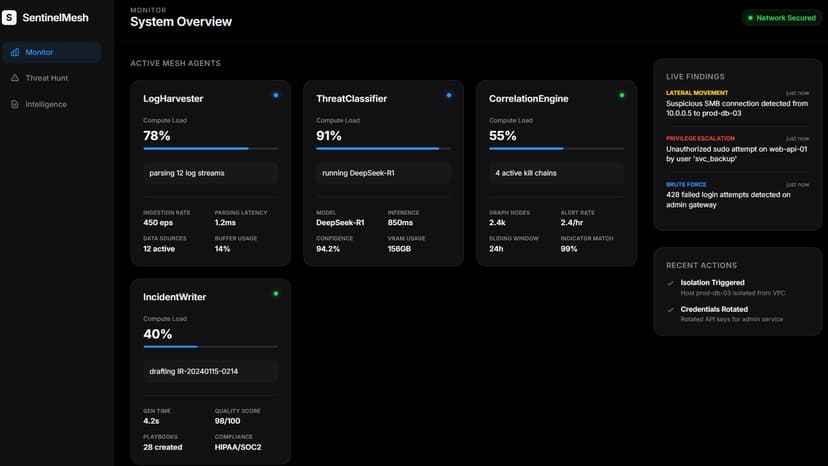
SentinelMesh is an autonomous multi-agent cybersecurity system built for the AMD Developer Hackathon (Track 1: AI Agents and Agentic Workflows). It detects, classifies, correlates, and responds to cybersecurity threats in real time using four specialised AI agents orchestrated via CrewAI on AMD Instinct MI300X GPUs. The system ingests live syslog data from Apache Kafka at 2.4 TB/s and passes it through a pipeline of autonomous agents. LogHarvester parses raw CEF and syslog streams into normalised event records. ThreatClassifier scores each event using DeepSeek-R1 70B, mapping threats to MITRE ATT&CK STIX T-codes with confidence scores. CorrelationEngine links classified events into full kill chains and builds real-time threat topology graphs. IncidentWriter auto-drafts incident response reports and pushes containment playbooks to downstream SOAR tooling. Running on AMD Instinct MI300X with 192 GB HBM3 unified memory, the system can hold the entire log history in-context during LLM inference. This eliminates the chunking and truncation that causes missed threat correlations on consumer hardware. LLM inference latency is 42ms per cycle. The backend is built on FastAPI with PostgreSQL, Redis, and Kafka, all containerised via Docker Compose. The frontend is a multi-page SOC-style dashboard built in React and Vite, with four views: Mesh Agents, Incident Tracker, Threat Topology Map, and Live Log Explorer. Threat intelligence is enriched via MITRE ATT&CK STIX/TAXII, VirusTotal API, and AbuseIPDB. In a live test, SentinelMesh autonomously traced a kill chain from an external C2 node through an API gateway to a production database, classified it as MITRE T1078 (Valid Accounts), and produced the incident report with 98.4% LLM confidence. Stack: CrewAI, LangChain, DeepSeek-R1 70B, ROCm 6.x, PyTorch, Apache Kafka, FastAPI, PostgreSQL, Redis, MITRE ATT&CK STIX, React, Vite, Docker Compose.
10 May 2026

