🤓 Latest Submissions
Memoria Civica
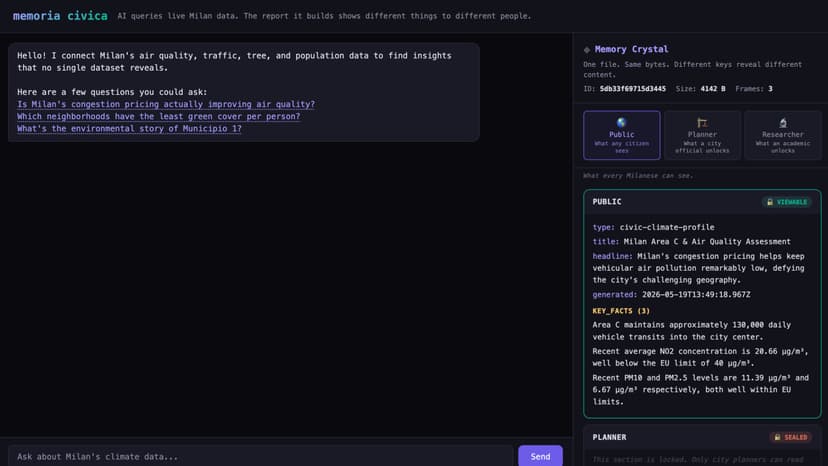
Every neighborhood in Milan has publicly available data -- air quality sensors, congestion zone entries, 251,000 georeferenced trees, demographic records across 88 micro-neighborhoods. But no one connects them. A citizen can't ask "is congestion pricing actually improving my air?" and get a real answer. AI agents have no way to access or reason across this data. That's what Memoria Civica does. A Gemini 2.5 Flash agent queries four live public APIs simultaneously, cross-references the results, and finds insights that no single dataset reveals -- like the fact that traffic into Milan's center has increased since 2019 while particulate matter stayed low, suggesting fleet modernization matters more than congestion pricing alone. The agent then packages its findings into a memory crystal -- a single 2KB binary file (.mem format) with three encrypted frames for different audiences. A citizen sees the headline. A city planner's cryptographic key unlocks policy-level sensor data and correlations. A researcher's key unlocks methodology notes and raw statistics. Same file, same bytes, same hash. No server decides who sees what. The cryptography does. The crypto is deliberately simple: Ed25519 for signatures, X25519 key exchange, XChaCha20-Poly1305 for encryption, HKDF-SHA256 for all key derivation. Everything is deterministic -- no randomness anywhere -- which means you can content-address encrypted data. The entire project is 12 source files, one Cloudflare Worker, 60KB gzipped. Open source. Built solo in one sprint for the AI Agent Olympics hackathon.
19 May 2026
