
Emmanuel Akinfulubi@emmanuelakbi
2
Events attended
2
Submissions made
Nigeria
6+ years of experience
About me
Hi, I'm Emmanuel. I'm a Developer and Designer with years of experience helping clients bring ideas to life. I build unique Websites, Web applications, and Mobile Apps that blend creative design with powerful functionality. I also provide AI Automation and Data Engineering services, helping businesses streamline workflows, scale efficiently, and make smarter decisions.
🤓 Latest Submissions
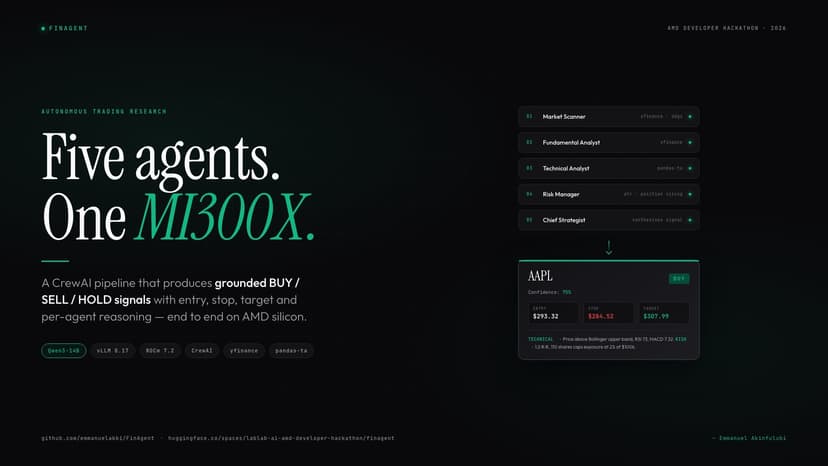
FinAgent: AI Trading Research on AMD MI300X
Retail traders face a daily triage problem: which of these ten tickers deserves attention today? Most AI tools answer with a single-shot prompt into a general-purpose model, confident, shallow, indistinguishable across tickers. Real analysts don't work that way. They divide the labour: one reads the news, another digs into financials, another reads charts, another sizes the trade, then a head of strategy synthesises. FinAgent reproduces that division with five CrewAI agents running against ONE locally-hosted Qwen3-14B instance on an AMD Instinct MI300X GPU. Market Scanner, Fundamental Analyst, and Technical Analyst run in parallel; Risk Manager consumes technical output to compute ATR-based position sizing; Chief Strategist synthesises the final signal. Every output is grounded in real yfinance quotes, with sanity guards that clamp runaway stops and re-ground the signal if the LLM drifts from the live price. The entire pipeline is self-hosted inference, no OpenAI, no Claude, no API bills. vLLM 0.17 on ROCm 7.2 exposes an OpenAI-compatible endpoint; CrewAI agents talk to it through the `hosted_vllm/` litellm provider with native tool-calling. The $100 AMD Developer Cloud credit is the entire compute budget. The frontend is a dark-themed Gradio 5 Space under the hackathon org, with a live agent-activity feed driven by structured callback events. Ten keyless tool functions wrap yfinance, DuckDuckGo news (via ddgs), and pandas-ta — no API keys anywhere in the demo. 309 unit + property-based tests (Hypothesis) pass on every commit, verifying correctness invariants end-to-end. Outcome: institutional-grade research, retail-friendly pricing, 100% open source.
10 May 2026
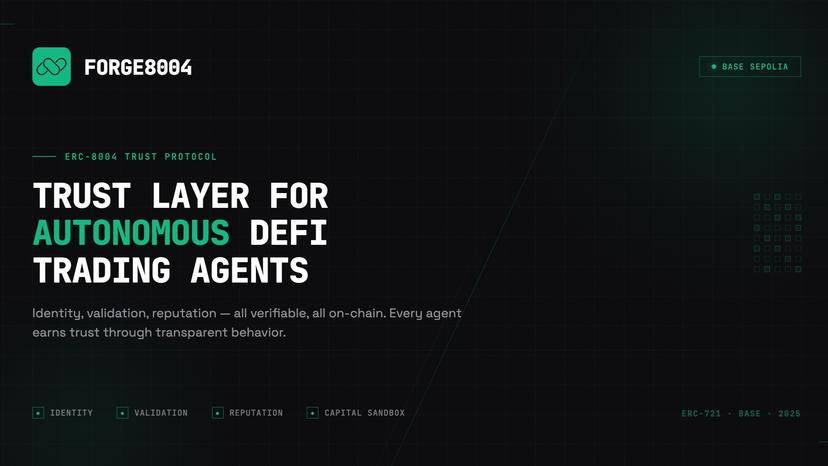
Forge8004
Forge8004 solves a fundamental problem in autonomous DeFi: how do you trust an AI agent with capital? Today, trading agents operate without proving who they are, what rules they follow, or whether their track record is real. There is no standard for agent trust. Forge8004 changes that. Every agent is registered as an ERC-721 token on Base Sepolia, linking its operator, strategy, and wallet to a verifiable on-chain identity. When the agent makes a trading decision, the system produces structured trust artifacts — signed trade intents with side, asset, size, stop-loss, take-profit, and AI reasoning. Every intent passes through a risk router that enforces allocation caps, daily loss limits, duplicate exposure checks, and kill switches before capital moves. The platform supports 8 autonomous trading strategies: range trading, spot grid bot, momentum, mean reversion, arbitrage, yield accumulation, spread trading, and risk-off. Each strategy has tuned decision logic, trailing stops, and reassessment thresholds. A Bybit-style spot grid bot automates buy/sell ladders across configurable price ranges with AI-advised parameters. Performance builds durable reputation: stablecoin-denominated PnL, Sharpe-like scoring, max drawdown tracking, and validation pass rates — all tied to the agent's on-chain identity. Operators see exactly what the agent decided, which checks it passed or failed, and how each outcome affected its trust score. Built with Next.js 15, React 19, Firebase, Groq AI (GPT OSS 120B), and Solidity on Base Sepolia. Live market data from Binance powers real-time multi-timeframe analysis across 12 assets.
12 Apr 2026


