.png&w=256&q=75)
🤓 Latest Submissions
AstroAudit
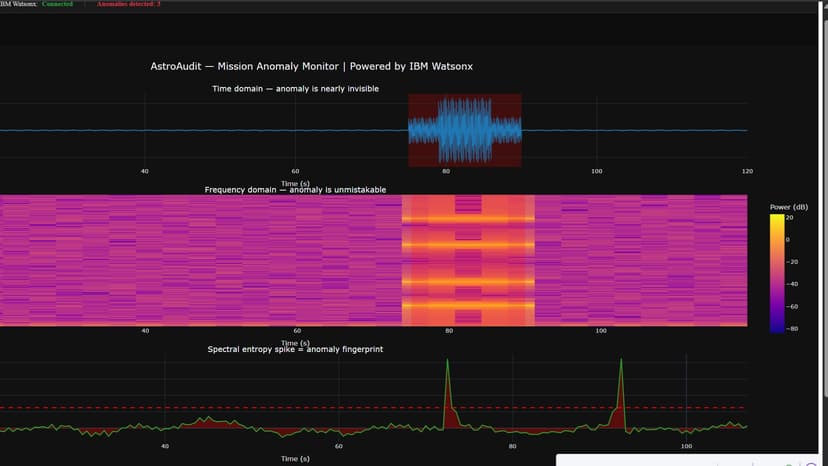
Short description AstroAudit is an AI-powered spacecraft telemetry anomaly detector that uses FFT spectral analysis to catch mission-critical events invisible to time-domain monitoring, classified in real time by IBM Watsonx AI. Long description Space missions generate continuous streams of telemetry data including power levels, magnetic field readings, and solar wind parameters that human operators monitor around the clock. Traditional monitoring looks at raw signal amplitude over time. Many critical anomalies, particularly high-energy particle events like coronal mass ejections, do not show up as obvious spikes in the time domain. They manifest as subtle shifts in frequency composition, detectable only through spectral analysis. AstroAudit builds a two-layer detection pipeline. The first layer is a signal processing engine using SciPy's Fast Fourier Transform and Welch power spectral density estimation. Every telemetry window is decomposed into frequency components and spectral entropy is computed in real time. A healthy spacecraft signal has low spectral entropy. A CME shock front causes simultaneous power bursts across multiple bands, spiking entropy by several standard deviations above baseline. The second layer sends this feature vector to IBM Watsonx AI, which classifies each window as nominal or anomalous with a confidence score and generates a plain-English incident report for operations teams. Results are visualized in a three-panel Plotly Dash dashboard showing the time-domain signal, a frequency spectrogram where anomalies light up unmistakably, and a spectral entropy trace spiking above the detection threshold. The system detected three anomalous windows with z-scores reaching 8.97. AstroAudit is fully software-based, runs on IBM Cloud, and generalizes to any periodic spacecraft signal, making it applicable to ISRO, NASA, and ESA operations at scale.
17 May 2026
