
🤓 Latest Submissions
RugPullRadar
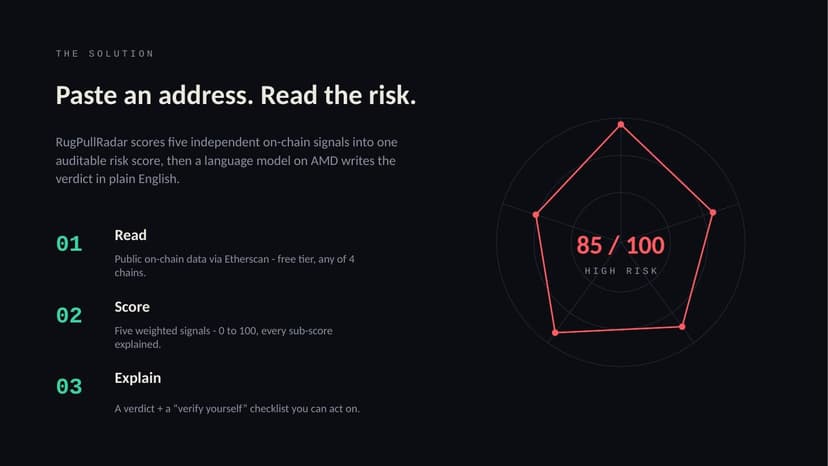
Rug pulls drain billions of dollars from crypto buyers every year, and the warning signs are almost always sitting in public on-chain data before the collapse - concentrated ownership, un-renounced ownership, dangerous contract functions, serial-deployer wallets, unlocked liquidity - but they are scattered across a block explorer and unreadable to a non-technical buyer. RugPullRadar takes a token contract address on Ethereum, BNB Chain, Base or Arbitrum and reads that data through the free Etherscan V2 API. It scores five independent, individually-explained risk signals into a single 0-100 composite (LOW / MODERATE / HIGH RISK), shown as a five-axis radar whose shape communicates the risk profile at a glance. A language model - Qwen2.5-7B-Instruct served through vLLM on AMD Instinct (ROCm) - then writes the verdict in plain English and produces a concrete "verify-yourself" checklist. If the model is offline the app falls back to a deterministic template, so it never hard-fails. The scoring is transparent, deterministic math on CPU; the language reasoning - the part that genuinely needs a model - runs on AMD hardware. The whole app is a containerized FastAPI service with a single-page frontend and a JSON API. Built for the AMD Developer Hackathon: ACT II, Track 3 (Unicorn).
13 Jul 2026
ROCmPilot
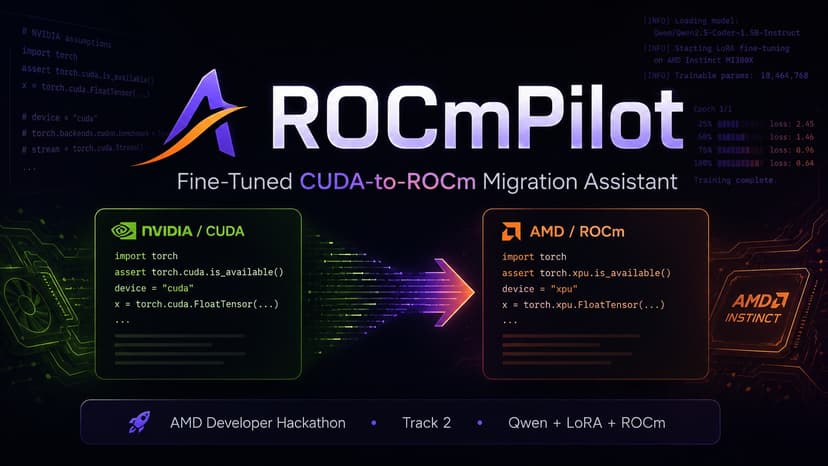
ROCmPilot is a fine-tuned AI code migration assistant for developers moving CUDA-first machine learning workloads to AMD ROCm. The project targets a real adoption barrier for AMD GPUs: many Python scripts, Dockerfiles, and error logs still assume NVIDIA/CUDA tooling, even when the workload itself could run on AMD Instinct accelerators. ROCmPilot is built on Qwen/Qwen2.5-Coder-1.5B-Instruct and fine-tuned with PEFT LoRA on an AMD Instinct MI300X instance using ROCm and PyTorch. I created a synthetic instruction dataset with 240+ CUDA-to-ROCm migration examples covering hardcoded CUDA devices, NVIDIA Docker base images, nvidia-smi vs rocm-smi checks, PyTorch ROCm verification, quantization dependency issues, and common migration errors. The final system is deployed as a Hugging Face Space. For reliability on free CPU hosting, the public demo uses a deterministic migration engine by default, while the actual fine-tuned LoRA adapter is published separately and can be enabled through live model mode. The goal is to make AMD ROCm migration faster, clearer, and less intimidating for ML engineers, DevOps teams, and developers adopting AMD GPUs.
10 May 2026


