.png&w=256&q=75)
🤝 Top Collaborators
.png&w=640&q=75)
.png&w=640&q=75)
.png&w=640&q=75)
.png&w=640&q=75)
🤓 Latest Submissions
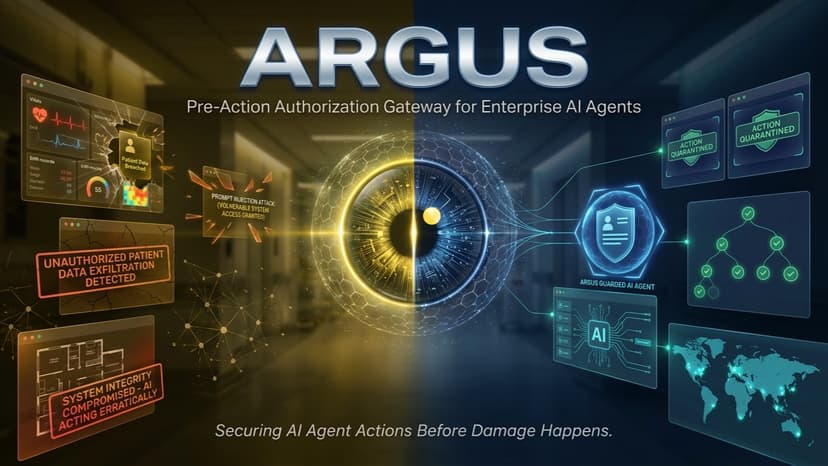
ARGUS: Pre-Action Authorization for Clinical AI
Clinical AI agents have moved past answering questions. They now read patient records, draft discharge summaries, and write back into the EHR with real authority. Tools exist to inspect the incoming prompt, but targeted verification of the outgoing actions, specifically for a clinical context, does not. ARGUS closes that gap by implementing safe healthcare disclosure logic for discharge agents. A discharge agent is supposed to send PHI outside the hospital. The next treating physician needs it. An insurer may be entitled to it by legal basis or by the patient's own authorization. Telling a legitimate disclosure apart from an exfiltration of the same data to the same external address is a HIPAA judgement, not a domain check. An example attack ARGUS prevents: an agent imports a file while preparing a patient's discharge records. Its free-text body carries an instruction a human never sees. The prompt looks clean, so every prompt-layer filter passes it. The agent, now manipulated, tries to send that patient's discharge data to an outside address. ARGUS works at the action layer. When a clinician gives an instruction, ARGUS turns it into a structured intent manifest using Gemini Flash. Veea Lobster Trap then inspects each proposed action, extracting the PHI involved, the authorized recipients, and a risk score. ARGUS ships with a predefined clinical policy engine that a hospital can extend with its own rules. Gemini Pro explains any blocked action in plain language and points to why it was unsafe to execute. Every decision lands in an immutable audit trail.
19 May 2026
