.png&w=256&q=75)
🤝 Top Collaborators
.png&w=640&q=75)
.png&w=640&q=75)
🤓 Latest Submissions
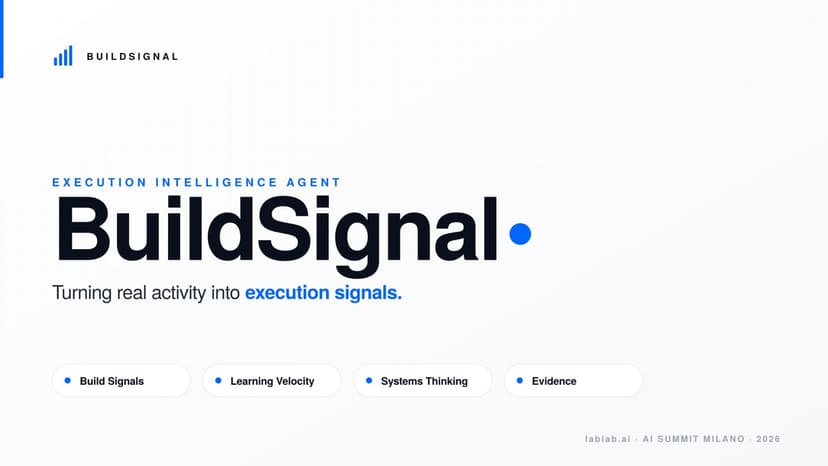
BuildSignal — Execution Intelligence Agent
Today, talent is evaluated through static representations like resumes, job titles, and credentials. These systems were designed for a more stable world, where roles were clearly defined and career paths were predictable. However, this model is no longer sufficient. Even in formal roles, past experience does not reliably reflect current capability. A mechanical engineer or marketer may have years of experience, but that does not guarantee they have developed the skills required to operate in today’s rapidly evolving, AI-driven environments. Also, many individuals are developing those capabilities outside traditional systems — through experimentation, building across domains, participating in online communities, and learning in real time. These signals of execution exist, but they are fragmented, unstructured, and invisible to existing evaluation systems. BuildSignal is an AI agent that analyzes real-world activity and transforms it into structured execution signals. Instead of relying on titles or credentials, the system performs multi-step reasoning over activity inputs — such as projects, behaviors, and learning patterns — to infer how a person actually operates. The output is a structured execution profile that includes signals such as Build Signals, Learning Velocity, Systems Thinking, and Evidence. Each signal is grounded in observable behavior and supported by reasoning, making the evaluation consistent, interpretable, and useful. This enables a new layer for evaluating talent — one based on how people build, learn, and adapt in real environments. Companies already describe what they are looking for in terms of capabilities like execution, learning speed, and problem-solving, but these remain subjective and difficult to measure. BuildSignal converts these into structured, comparable signals. By turning unstructured activity into a system of execution signals, BuildSignal provides a new foundation for understanding modern talent in an AI-native world.
19 May 2026
