.png&w=256&q=75)
🤓 Latest Submissions
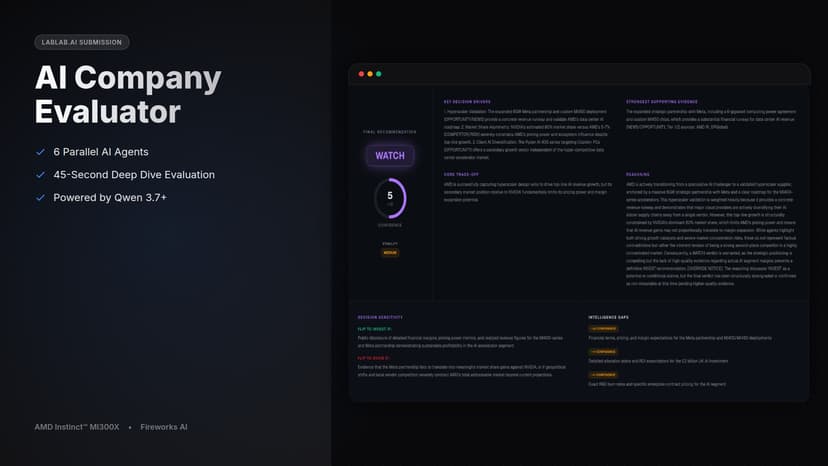
AI Company Evaluator
The Problem In Venture Capital, Private Equity, and Corporate M&A, initial company screening and triage (Enhanced Due Diligence) typically takes an analyst anywhere from 1 to 4 hours per case, while reading through dense financial filings and industry reports to build a baseline comprehension can consume a full day (8+ hours) before formal analysis even begins. This manual research process is slow, biased, and expensive. Our Solution We built an evaluation system of 6 parallelized AI agents that compresses this grueling, multi-hour workflow into under 60 seconds. When a user searches for a company, our system deploys a Gatekeeper to validate the entity, followed by a concurrent evaluation: News Agent: Scans for recent breaking news and catalysts. Competitor Agent: Maps the competitive landscape and moats. Business Model Agent: Evaluates pricing and unit economics. Risk Agent: Identifies downside vectors and impact scores. Opportunity Agent: Surfaces growth catalysts. Verdict Agent: Synthesizes the findings into a final, scored recommendation (Invest / Partner / Watch / Avoid). We also built a deterministic Evidence Engine that mathematically scores sources (Tier 1 vs. Tier 4) to prevent hallucination, alongside a Context-Aware Memory Chat that can autonomously launch fresh web searches if asked about new topics. ⚡ Use of AMD Platforms Because our multi-agent architecture relies on firing 5 to 6 LLM queries simultaneously alongside live search API calls, ultra-low latency is mandatory. To solve this, we integrated the Fireworks AI API, running Qwen 3.7+ directly on AMD Instinct™ MI300X accelerators. This AMD-powered hardware infrastructure provides the massive throughput required to run our parallel routing logic concurrently. Without the speed of the AMD MI300X accelerators, sequential reasoning would leave the user waiting minutes; instead, the entire evaluation pipeline streams and completes its synthesis in roughly 45 seconds.
13 Jul 2026

Lokr Assistant: Multi-Agent Code Intelligence
Lokr Assistant is a multi-agent AI pipeline that acts as a senior engineering copilot — diagnosing bugs, reviewing diffs, and gating deployments using verified evidence from your actual codebase. Unlike generic AI tools that hallucinate fixes, Lokr Assistant is grounded in Lokr — a Graph-RAG static analysis engine. It uses Tree-sitter to parse codebases into ASTs, maps dependencies into a NetworkX graph, and indexes nodes via ChromaDB for semantic retrieval. Every diagnosis references real code paths, not guesses. The system runs a 4-agent pipeline with cascading skepticism: Analyzer — Diagnoses bugs using verified context from Lokr's dependency graph. Starts with ~800 tokens and autonomously requests more via Graph-RAG. Action Agent — Generates patches or blocker lists. Cross-references raw input against the Analyzer to catch dropped details. Safety Agent — Evaluates risk with go/no-go decisions. Provides targeted revision suggestions routed directly back to Action, saving ~70% of tokens vs full restart. Validator Validates fixes through execution tracing or generates deploy checklists. Triggers revision loops on failure. Key achievements: Deterministic Security Pre-Scan: Regex-based backdoor scanner catches debug headers and hardcoded role bypasses before the LLM runs impossible to hallucinate away. Mental Execution of Boolean Logic: Detects when || → && weakens validation, catching regressions that pass syntax checks. Strict Schema Validation: Agents raise errors on malformed LLM output — no silent stub data polluting the pipeline. Programmatic Safety Net: Hardcoded orchestrator rules override LLM decisions when security blockers are detected. Agentic Context Discovery: Analyzer autonomously fetches file details via Graph-RAG instead of dumping 21k+ tokens upfront. Tested across 6 scenarios IDOR flaws, logic regressions, performance degradation, validation weakening, migration failures, and multi-blocker deployments passing all with a 7B model on 6GB VRAM.
10 May 2026


