.png&w=256&q=75)
🤝 Top Collaborators
.png&w=640&q=75)

🤓 Latest Submissions
TALOS
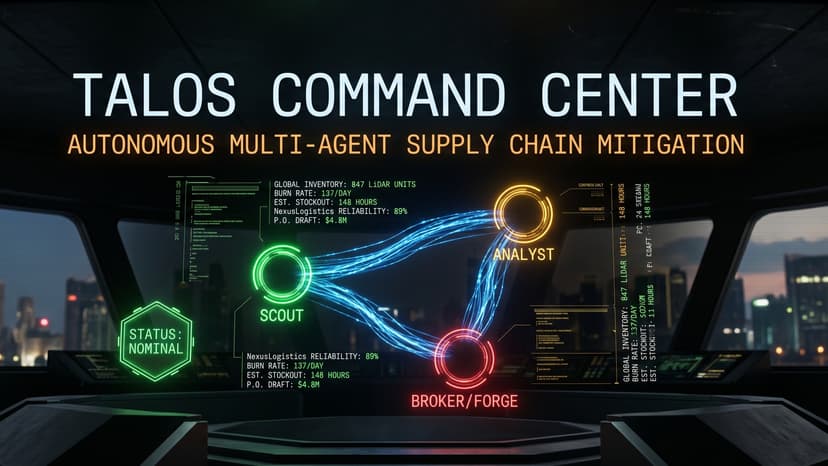
TALOS is an autonomous multi-agent AI system that defends manufacturing supply chains from real-time vendor disruptions — without human intervention until the moment it matters. The system runs a continuous Scout Agent that monitors live vendor data streams every 1.5 seconds, checking for HTTP failures, corrupted payloads, and zero-quantity anomalies. When 3 consecutive failures are detected, it escalates and triggers a full remediation pipeline powered by Google Gemini 1.5 Flash on Vertex AI. The pipeline runs four specialized agents in sequence: → Scout detects the anomaly and triggers escalation → Analyst queries the live inventory database and calculates hours until factory stockout and projected daily financial loss (e.g. $694K/day) → Broker evaluates all backup vendors by reliability, cost, and lead time — then drafts a Purchase Order → Forge generates the infrastructure patch — the exact API endpoint to switch the vendor stream The system then pauses at a Human-in-the-Loop gate. The operator reviews the full agent output and clicks AUTHORIZE MITIGATION. The new vendor URL is written atomically to a Cloud SQL circuit breaker config. The stream switches on the next 1.5-second poll cycle. Crisis resolved in under 60 seconds. Built on Google Cloud Run, Cloud SQL (PostgreSQL), FastAPI, and Vertex AI. Features a terminal-aesthetic command center dashboard with live agent feed, audit log, financial exposure HUD, and an AI Oracle chatbot. TALOS directly addresses the Collaborative Systems and Agentic Workflows categories — four specialized agents coordinate autonomously to solve a problem no single LLM could handle alone.
19 May 2026
CancerLens AI — Cancer Detection AI
CancerLens AI is an oncological triage platform built for the IBM Bob Hackathon 2026. IBM Bob was our core development partner for the entire project. Every component was generated, debugged, and refined through Bob — from the Flask backend architecture to the AMD MI300X GPU integration and Google Cloud Run deployment. What Bob built for us: → Complete Flask backend with 3 REST endpoints → 3-agent AI pipeline from scratch → All oncological analyst prompts → AMD MI300X vLLM endpoint integration → Google Cloud Vertex AI authentication → Frontend to backend API connection → Google Cloud Run deployment configuration → AMD toggle system for switching between GPU and fallback mode instantly The 3-Agent Pipeline: Agent 1 — Extractor: Qwen2-VL running on AMD MI300X with 192GB HBM3 analyzes the medical scan and extracts detailed visual observations at full precision with zero quantization. Agent 2 — Analyst: Gemini 2.0 Flash processes imaging findings alongside patient context and blood report values to generate a structured clinical report including cancer type, TNM staging, Early vs Late Stage classification, and risk scoring. Agent 3 — Validator: An independent AI pass cross-checks the entire report for logical consistency and assigns a reliability score before results reach the user. Additional features include stage-specific survival statistics pulled dynamically for any cancer type, a nearest oncologist finder via Google Maps, direct links to specialist hospitals, and a context-aware AI health assistant chatbot. Tested on real clinical teaching cases — correctly identified Stage III Osteosarcoma from a knee X-ray, cross-referenced elevated ALP and LDH from a blood report, and detected Glioblastoma from a brain MRI with 9-10 out of 10 reliability scores. CancerLens AI makes radiologist-level cancer detection accessible to anyone, anywhere — in seconds, not weeks. Built by Team Noxis.
17 May 2026
CodeMentor
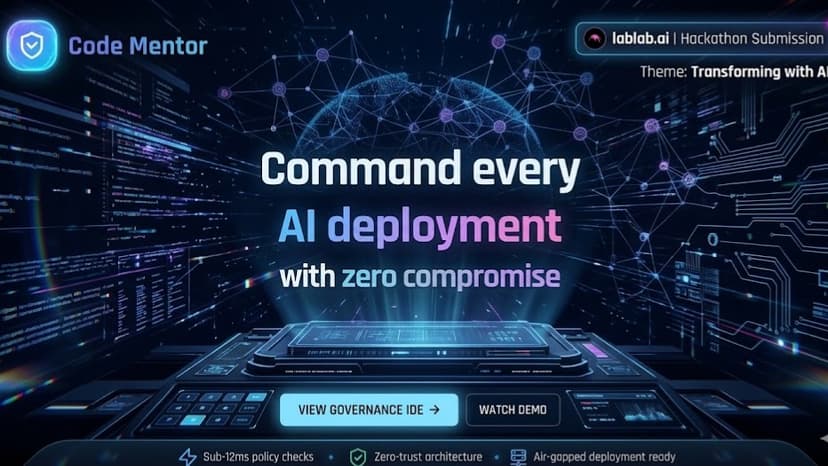
Code Mentor is a cloud-native DevSecOps environment that acts as an automated security architect sitting inside your IDE. As AI code assistants like Copilot ship code faster than ever, they're also shipping vulnerabilities at record speed — and traditional SAST/DAST tools are too slow and too noisy for developers to act on. Code Mentor solves this with four core capabilities: 🔍 Real-Time AI Scanning — Powered by Gemini 2.5 Pro on Google Vertex AI, the scanner performs context-aware semantic analysis on your code, flagging structural vulnerabilities like SQL injection, hardcoded secrets, and insecure patterns the moment you open a file. 🧠 Triple-Tier Explainability — Every vulnerability is explained three ways: an Analogy for quick intuition, a Technical deep-dive for senior engineers, and a Meme for culture-driven retention. This is the first security tool designed for how developers actually think. ⚡ 1-Click Live Fix — Unlike legacy scanners that stop at alerts, Code Mentor finishes the job. It rewrites your vulnerable code with a single click using the suggestedPatch from the AI response, then logs the fix to an audit trail for compliance reporting. 🏛️ Enterprise Policy Governance — A built-in Policy Studio enforces HIPAA, GDPR, and SOC2 compliance standards, giving enterprise teams real visibility into what policies are being violated across their codebase. The architecture runs on Next.js 14 with a Monaco Editor frontend, backed by serverless Next.js API routes deployed on Google Cloud Run via a multi-stage Alpine Linux Docker build — cutting cold starts by ~80%. The backend communicates with Vertex AI over IAM-governed service accounts, with zero user code cached or persisted, making it stateless and breach-resistant by design. A Vulnerability Sandbox ships with three pre-loaded production-flawed blueprints (auth-service.ts, query-engine.ts, env-config.yaml) so judges can experience the full scan-explain-fix pipeline instantly, with zero setup.
19 May 2026

CancerLens AI
CancerLens AI is an advanced oncological triage platform built for the AMD Developer Hackathon 2026. The platform uses a 3-agent AI pipeline running on AMD MI300X GPUs with 192GB of HBM3 memory to detect, classify, and stage cancer from medical imaging scans. Agent 1 — Extractor: Qwen2-VL running at full precision on AMD MI300X analyzes the uploaded scan and extracts detailed visual observations. Agent 2 — Analyst: Gemini 2.0 Flash cross-references imaging findings with patient context and blood report values to generate a structured clinical report including cancer type, TNM staging, and risk scoring. Agent 3 — Validator: An independent AI pass audits the report for logical consistency and assigns a reliability score before the result reaches the user. The platform was tested on real clinical teaching cases — correctly identifying Stage III Osteosarcoma from a knee X-ray, cross-referencing elevated ALP and LDH from a blood report, and detecting Glioblastoma from a brain MRI with 9-10 out of 10 reliability scores. Features include stage-specific survival statistics pulled dynamically for any cancer type, a nearest oncologist finder via Google Maps, direct links to cancer specialist hospitals, and a context-aware AI health assistant chatbot. CancerLens AI makes radiologist-level cancer detection accessible to anyone, anywhere — in seconds, not weeks. Built by Team Noxis.
10 May 2026


