
🤝 Top Collaborators

.png&w=640&q=75)

.png&w=640&q=75)
🤓 Latest Submissions
O(1) Agent
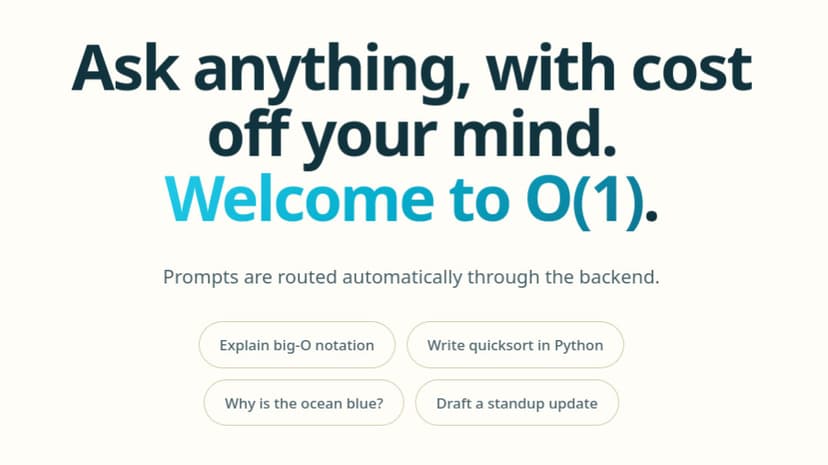
O(1) is a hybrid AI orchestration platform that intelligently routes every request to the most efficient execution path, balancing accuracy, latency, and operational cost. Instead of treating every prompt equally, the system analyzes task complexity and dynamically selects the optimal execution strategy. The routing pipeline begins with T0, a deterministic Python engine capable of solving structured, factual, mathematical, classification, and rule-based tasks instantly without invoking an LLM, resulting in zero LLM inference cost. Requests requiring language understanding are automatically escalated to T1, where multiple Gemma 4 models are served locally on AMD GPUs using ROCm and vLLM. This provides responses that are fast and of same accuracy while spending less on premium models. When local inference is insufficient or a request exceeds predefined routing criteria, does the router escalate to T2, a cloud-hosted LLM, where prompts are optimized to minimize token consumption while preserving response quality. Beyond routing, the platform includes automatic task classification, adaptive model selection, token-efficiency profiling, latency benchmarking, structured request logging, performance analytics, response caching, and real-time streaming using Server-Sent Events (SSE). Built-in benchmarking and monitoring provide detailed insights into throughput, latency, GPU utilization, cache performance, and routing decisions, making the system suitable for both production deployments and research workflows.
12 Jul 2026

Sentiment Analysis of a Stock Data on News
We built an end-to-end AI stock signal pipeline that turns live market data and news headlines into explainable trade signals — fully accelerated on AMD Instinct MI300X via ROCm + PyTorch. The system runs three cooperating agents in an agentic workflow: 1. Signal Agent — pulls live OHLCV and headlines via yfinance, computes rolling-volatility regimes (LOW/MED/HIGH), and runs batched market inference on GPU. 2. Sentiment Agent — a fine-tuned DistilBERT classifier from Hugging Face Hub (POS/NEU/NEG with signed scores) running batched ROCm inference for thousands of headlines per second. 3. Reasoning Agent — Qwen3-8B generates a natural-language explanation for each BUY / SELL / HOLD decision, with entry, stop-loss, and target levels. A simulated execution engine then runs an OPEN-to-CLOSED trade lifecycle with slippage and P&L, surfacing win-rate, average return, and a cumulative P&L curve. The Streamlit dashboard exposes a live GPU diagnostics banner, KPI tiles, signal table, sector heatmap, sentiment analytics, and CPU-vs-GPU throughput charts. Verified on AMD Developer Cloud (ROCm 6.2 + PyTorch 2.5.1+rocm6.2): 17.0x speedup on 100-batch market pipeline, 208.0x on 1000-batch market pipeline, 14.49x on sentiment batch — all from the exact same code path that runs on CPU. AMD-first, IP-safe, judge-friendly, and built to scale to multi-GPU MI300X clusters.
10 May 2026

Autonomous Treasury Management Dashboard
AutoPilot is a full-stack platform designed to monitor, manage, and audit autonomous treasury rebalancing agents. The dashboard interface allows users to oversee critical system metrics such as active agents, queue depth, execution success rates, and error rates. By presenting each metric in an intuitive, analytics-driven UI, AutoPilot improves operational awareness and decision-making for teams managing automated treasury workflows. The platform includes dedicated sections for tasks, executions, approvals, audit logs, agent health checks, and system settings. Each module is structured to streamline oversight of automated processes while providing transparency, accountability, and performance insights. The system also includes real-time status indicators, activity trends, and agent-level health reports to ensure reliability at scale. The goal of AutoPilot is to provide a unified operational interface for teams working with autonomous financial or treasury automation agents, reducing human error while enhancing control, efficiency, and visibility across the entire automation pipeline.
7 Dec 2025

Llama Proxy
We propose using the LLaMA 3.1:1B model as a local proxy server to manage caches with JSON responses. Here's how the llama model can help us do just that: Query analysis and optimization Smart data management in the cache Optimization of communication with API Create intelligent cache management policies. Enrich responses and adding a layer of security and privacy to the application. Understand user behavior and tailor data to their needs. We can also approach the problem using the cloud model, when we do not have enough RAM to be able to run llama 3.1:1B. We can then send queries from time to time to the server, which would decide on the cache hierarchy, which would be the most important, and which items would already have a deletion time.
20 Oct 2024