.png&w=256&q=75)
🤝 Top Collaborators
.png&w=640&q=75)
.png&w=640&q=75)
🤓 Latest Submissions
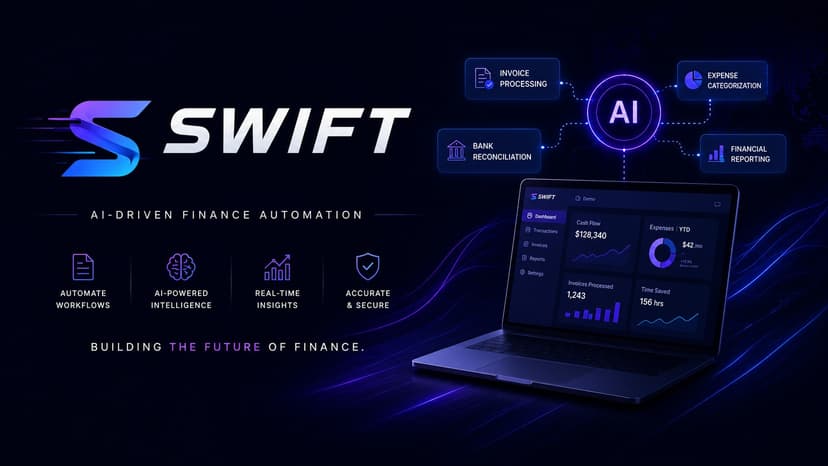
Swift
Traditional payment platforms stop at syncing your financial data. Today, enterprises integrate with third-party software to unify accounting and payment operations. This results in added software costs, fragmented workflows, and ongoing maintenance overhead. Swift embeds accounting automation directly into the payment infrastructure, eliminating manual bookkeeping and reducing operational complexity. Swift embeds an accounting layer directly within the gateway, automatically categorizing transactions, reconciling payments, generating ledger-ready records, and keeping financial data synchronized in real time. Instead of relying on disconnected tools and middleware, businesses manage payments, accounting, and financial operations through a single unified infrastructure. The infrastructure can be seamlessly integrated into ecommerce checkout pages, online marketplaces, subscription platforms, mobile applications, and POS terminals, enabling businesses to unify payment processing and accounting across both digital and physical commerce environments. Every payment processed through Swift is instantly reflected within the accounting layer, creating a synchronized financial ecosystem without additional integrations. By combining payment processing with embedded accounting intelligence, Swift reduces reconciliation errors, shortens month-end closing cycles, and removes the need for costly third-party integrations. Finance teams gain real-time visibility into cash flow, balances, settlements, and transaction histories without switching between multiple systems. This creates a seamless financial operating environment where every transaction is automatically recorded, organized, and reflected across the business ecosystem. With Swift, enterprises move beyond simple payment acceptance into fully integrated financial automation.
19 May 2026

PulseGuard
PulseGuard: Powered by the HIPAA-Halt Engine. An enterprise-grade AI governance and privacy orchestrator built for zero-trust data compliance is an automated HIPAA compliance auditing platform that secures sensitive patient data through a unique hybrid "Air-Lock" architecture. It intercepts and redacts medical records locally before utilizing AI The Problem Healthcare organizations are trapped between AI innovation and absolute data liability. Unprotected Patient Health Information (PHI) entered into public AI models leads to permanent exposure and catastrophic HIPAA violations, with data breaches costing healthcare systems an average of $10.93M per incident. Security teams routinely ground high-value AI initiatives out of sheer "black-box" anxiety. The Solution PulseGuard is an enterprise-grade AI Governance and Zero-Trust Data Privacy Orchestrator that acts as a real-time compliance shield right at the local network edge. Before a single byte of data leaves the internal network, PulseGuard intercepts unstructured clinical text via a 5-Layer Secure Pipeline. It runs high-speed regular expressions alongside an advanced local Named Entity Recognition (NER) engine to strip out all 18 HIPAA identifiers, replacing them with anonymous tracking tokens while preserving the underlying text utility for deep AI analysis. To guarantee absolute data sovereignty, all token-to-data mappings live entirely in-memory within a thread-safe .NET Core repository. With a zero-persistent footprint on disk or cloud databases, these sensitive links evaporate the split second the session closes.
19 May 2026

