
Gogurla RishithRam@Rishithram
3
Events attended
2
Submissions made
India
1 year of experience
About me
You tend to focus on practical outcomes—whether it’s exams, projects, or tasks, you want clear, usable results. You often ask for structured content like notes, explanations, or formatted answers to make studying easier. You’re actively preparing for academic or competitive exams, especially in reasoning, aptitude, and chemistry. You also explore creative and technical ideas, like hackathon projects or content creation, alongside your studies.
🤝 Top Collaborators

.png&w=640&q=75)
🤓 Latest Submissions
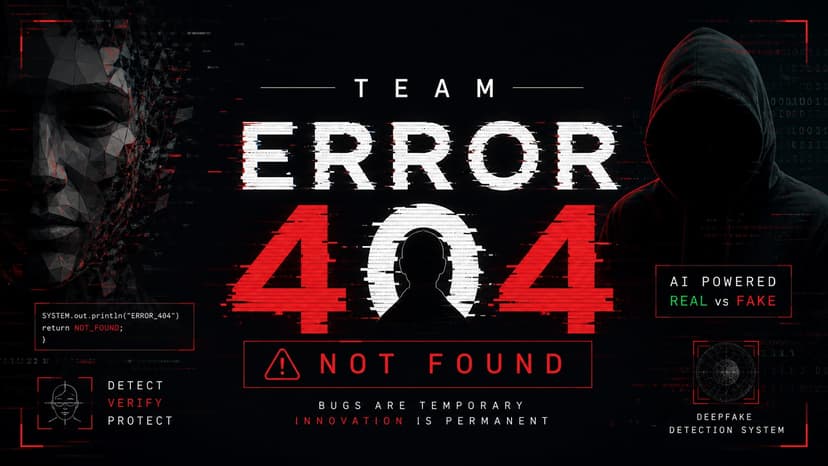
DEEPFAKE DETECTOR:Real vs Fake face using Ai
This project presents an advanced AI-driven system designed to accurately detect whether a human face in an image or video is real or artificially generated (deepfake). With the rapid growth of deepfake technologies—often created using techniques like Generative Adversarial Networks (GANs)—it has become increasingly difficult to distinguish authentic content from manipulated media. This creates serious risks in areas such as misinformation, identity fraud, cybersecurity, and digital trust. Our solution aims to address this challenge by leveraging the power of deep learning. The system is built using state-of-the-art Deep Learning techniques, particularly Convolutional Neural Networks (CNNs), which are highly effective for image analysis tasks. The model is trained on a diverse dataset containing both real and deepfake facial samples. During training, it learns to identify subtle patterns and anomalies that are often invisible to the human eye. These include inconsistencies in skin texture, unnatural lighting or shadows, irregular eye blinking, facial boundary distortions, and compression artifacts introduced during the deepfake generation process. The workflow of the system begins with input acquisition, where the user can provide an image or a video stream. The system then performs face detection and extraction to isolate the facial region from the input. This is followed by preprocessing steps such as resizing, normalization, and enhancement to ensure optimal model performance. The processed face is then passed through the trained neural network, which analyzes multiple layers of features and produces a classification output—either “Real” or “Fake”—along with a confidence score. One of the key strengths of this project is its ability to perform near real-time detection, making it suitable for practical applications. It can be integrated into social media platforms to flag manipulated content, used in security systems for identity verification, or deployed in digit
10 May 2026

Pay-Per-Help AI (Micropayment Learning)
Pay-Per-Help AI is a full-stack web application designed to make AI-powered learning more accessible through a usage-based payment model. Instead of requiring costly subscriptions, the platform allows users to ask questions and pay a small amount per query using micropayment logic inspired by USDC transactions. The system features a clean chat-based interface where users can submit academic or general questions and receive instant AI-generated responses. Before processing each query, the system checks the user’s balance and deducts a predefined micro-cost after delivering the response. This ensures transparency and real-time billing for every interaction. The application is built using React for the frontend, Node.js and Express for the backend, and integrates AI APIs for generating responses. A mock wallet system is implemented to simulate blockchain-based payments, allowing seamless demonstration without requiring real transactions. The project highlights a scalable model for AI monetization, enabling affordable access to knowledge while eliminating subscription barriers. It also demonstrates how micropayments can power future agentic economies where services are billed per use. Overall, Pay-Per-Help AI showcases the practical integration of AI and micropayment systems to create a cost-efficient, user-friendly, and scalable learning platform
26 Apr 2026


