

🤓 Latest Submissions
Remanon
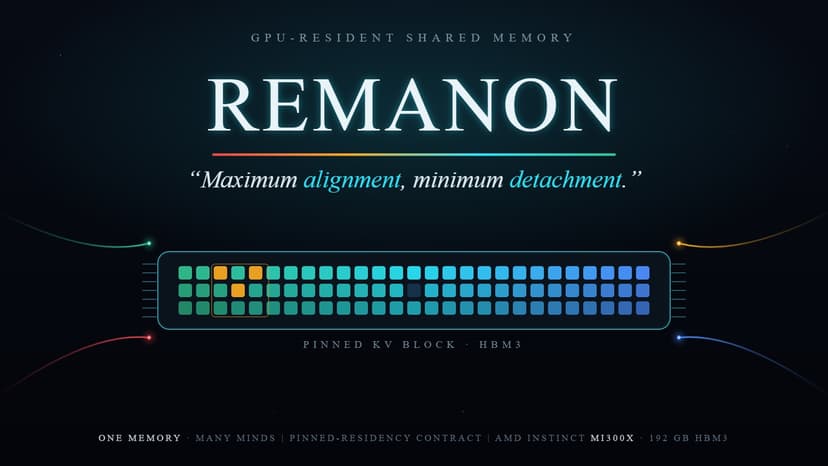
Every AI agent team pays the same tax: 62% of agent inference spend is re-reading context that was already processed (Stanford Digital Economy Lab, 2026). Ten agents on one incident means ten private copies of the same knowledge resident in GPU memory — memory and prefill paid ten times. Remanon is a GPU-resident shared-memory runtime that ends this. A cross-engine memory arbiter materializes the shared master context exactly once per distinct model, pins it, no code path can evict it, and lets every agent of that model read the same resident copy, each paying only a small private delta. Not vLLM's opportunistic prefix caching: a contract. Three guarantees, enforced by construction and verified at the HTTP transport layer by 173 automated tests. Proven on real AMD silicon: gpt-oss-20b served live under vLLM/ROCm on a 48 GB gfx1100 — 5.8x shared-context speedup (cold 10.635s → warm 1.839s), 66.3% engine hit rate, 110 prefills avoided, 0 evictions, 46.02 GB VRAM under load. Every number traces to a raw log in docs/evidence/, or is labeled COMPUTED with its derivation, an automated honesty-gate enforces this in CI. The demo: five role-differentiated agents (four distinct models) investigating real production failures from ~1M Loghub records — live storm, verdicts, exportable incident ledger, and a case where the contract rejected oversized model output twice and degraded gracefully instead of crashing. Why AMD: four models plus pinned masters need ~162 GB. On an 80 GB card the architecture cannot load. On one MI300X (192 GB HBM3) the team fits with headroom — capacity as an absolute advantage, not a percentage. The market just priced this problem: Engram raised $98M (training-time memory), Callosum $10M (scheduling). Remanon owns the GPU-runtime layer between them — per-GPU licensing, no retraining. One memory. Many minds. Zero evictions.
13 Jul 2026
Brightuity
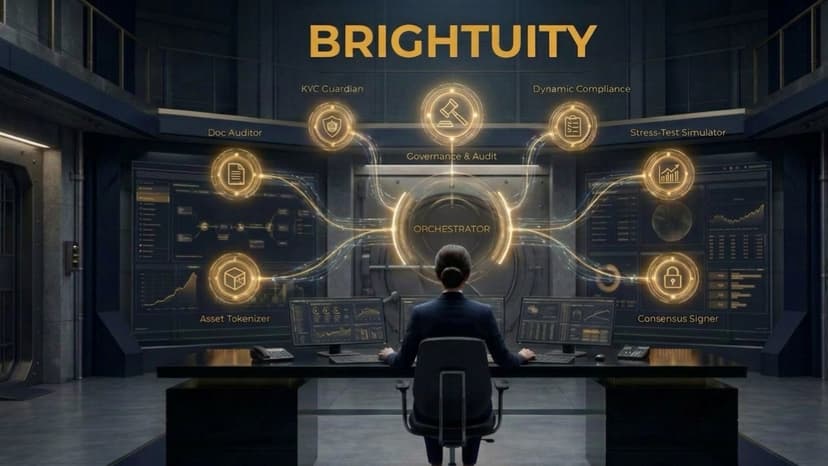
Banks are racing to tokenize real-world assets, but every tokenization decision carries regulatory, KYC, and risk exposure that no single model should make alone, and no auditor accepts an unexplained "the AI approved it." Brightuity is an enterprise B2B system for a bank's Digital Assets and Tokenization Division. It coordinates eight specialized AI agents (Orchestrator, Document Auditor, KYC Guardian, Dynamic Compliance, Stress-Test, Asset Tokenizer, Consensus Signer, and Governance and Audit) that work a single case together inside one Band chat room, where the room is both the case and the audit record. The Orchestrator @mentions each specialist, and each replies in the room with a verdict of PASS, FAIL, or HALT. The visible conversation IS the audit trail. Band is the spine, not a backdrop. The coordination becomes a timestamped, replayable compliance record, and the Orchestrator reads verdicts straight from the room messages, so the conversation a human watches is the exact record that gets sealed. Determinism lives where it matters. The Orchestrator enforces the governance gate in pure Python, so gate decisions are identical every run, and the Consensus Signer produces an ECDSA seal with no LLM involved. The five reasoning agents run on Claude, Gemini, and GPT through the AI/ML API, each with automatic primary to fallback failover. Dynamic Compliance grounds its opinion with RAG over real MiCA and AMLD text. Security is demonstrable. Customer PII sits in an air gapped Postgres zone with no internet route. Agents reach only allow listed endpoints through a Squid proxy, and Band traffic carries only a request ID and verdict text, never raw PII. The result is one signed, exportable Decision Evidence Package authorized by the Head of Digital Assets, proven on a clean approval and on a PEP match that forces a hard KYC halt with no seal.
19 Jun 2026
OlympusOS
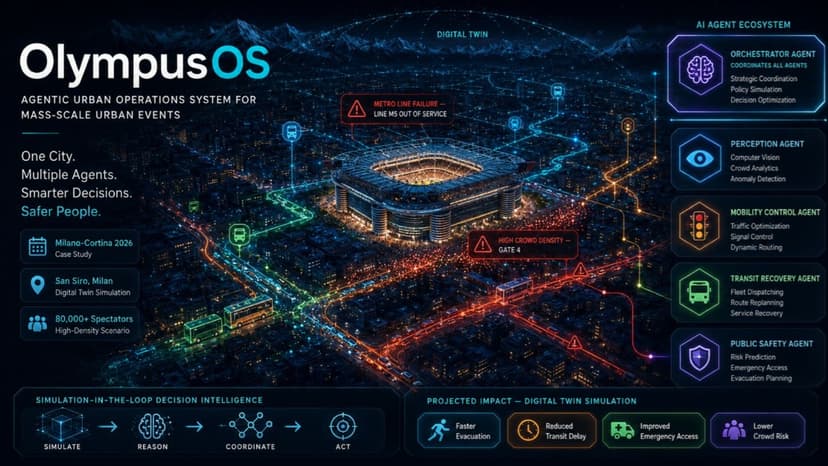
The Problem No Dashboard Can Solve Cities are the most complex systems humanity has ever built. Every day, millions of decisions about traffic, energy, safety, transport, infrastructure, and public services are made reactively, by humans, under pressure, with incomplete information. Traditional urban systems are passive. They display. They alert. They do not reason, predict, or act. The problem is not a lack of data, cities have more sensors and cameras than ever. The problem is the absence of urban cognition. The Innovation OlympusOS is not a dashboard. It is a Cognitive Urban Operating System, an autonomous AI coordination layer that sits above existing infrastructure and reasons across it in real time. A collaborative ecosystem of specialized AI agents including perception, forecasting, mobility, transit, safety, communications, and orchestration, operates simultaneously, sharing observations, proposing actions, and synthesizing decisions through a central Orchestrator with command authority. This architecture is domain-agnostic. The same cognitive layer that handles a stadium crowd crisis can manage energy distribution, coordinate disaster response, or orchestrate daily municipal operations. The Demonstration (Milano Cortina 2026) To prove the architecture, OlympusOS was applied to a Winter Olympics scenario: a metro failure during peak stadium outflow that would breach critical crowd density in under four minutes. The agents detect the anomaly, model the trajectory, coordinate buses, open evacuation corridors, and push public alerts, stabilizing the situation in under 60 seconds. The Olympics was the scenario. The problem is permanent. Why It Matters? Smart city platforms today aggregate data. None of them reason or act. OlympusOS is the first architecture designed to close that gap, a reusable cognitive layer any city can deploy. Cities are not static infrastructure. They are living systems. OlympusOS gives them the ability to think.
19 May 2026
AI Brand Guardian By Nevine Fakhreddin
Idea Overview: AI Brand Guardian is a specialized cognitive analysis system built for the trading industry (demonstrated on Deriv). Unlike generic sentiment tools, it reconstructs the "mental models" of traders by analyzing implicit beliefs behind their feedback. It utilizes a multi-agent architecture (CrewAI) powered by Claude 3.5 Sonnet for deep reasoning and Gemini 1.5 Flash for strategic action generation. Key Problems Solved: Early Churn Detection: Identifies switching signals (e.g., to eToro or Plus500) 30 days before they happen. Withdrawal Trust Monitoring: Detects erosion in "trust" regarding withdrawals before it leads to mass exodus. Regulatory Clarity: Monitors how traders perceive different licenses (VFSC vs. FCA). How it Works: The system orchestrates four specialized agents: Perception Agent: Scrapes trading-specific sources like ForexPeaceArmy and Reddit. Reasoning Agent: Extracts cognitive beliefs and emotional undertones (e.g., "betrayal" vs. "disappointment"). Planning Agent: Generates strategic roadmaps based on identified risks. Action Agent: Creates executable tasks for product and marketing teams. Business Impact: For platforms like Deriv, the system reduces analysis costs from weeks of manual work to just 3-4 minutes, costing approximately $0.15 per analysis while providing evidence-backed recommendations with real customer quotes.
7 Feb 2026


